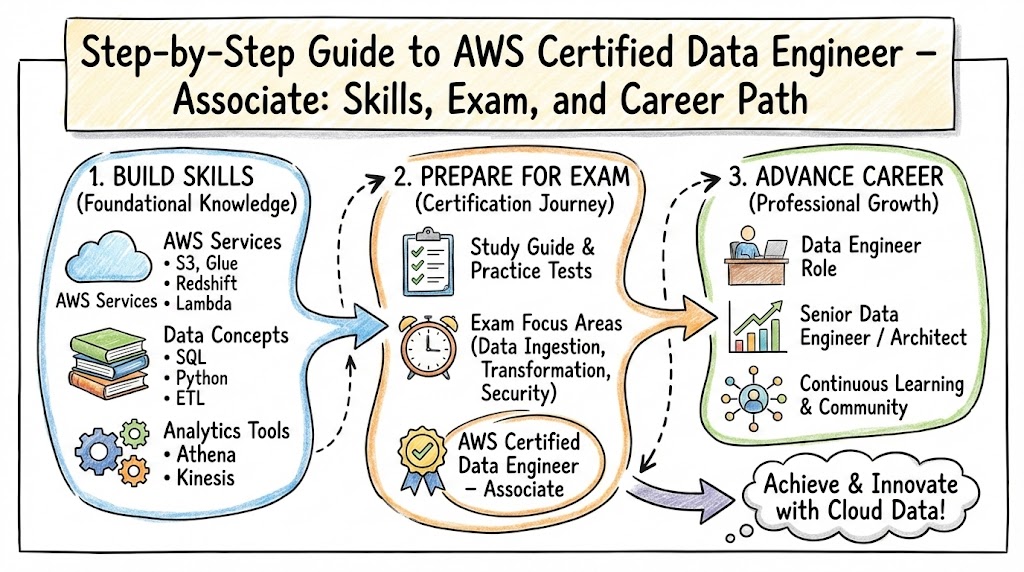
Introduction
In the digital age, data has become one of the most valuable assets for businesses. Companies are increasingly leveraging data to make informed decisions, streamline operations, and innovate. However, managing large-scale data systems and ensuring that data is accessible, secure, and processed efficiently requires specialized skills. The AWS Certified Data Engineer – Associate certification is one of the most respected credentials in the field of data engineering, particularly for those who work with AWS cloud technologies.
Whether you are an experienced data engineer or someone new to cloud data solutions, this certification validates your ability to design, build, and manage data systems using AWS. This guide will take you through everything you need to know about the certification: the skills it validates, the preparation process, and how it can enhance your career prospects.
What is the AWS Certified Data Engineer – Associate Certification?
The AWS Certified Data Engineer – Associate certification is designed to demonstrate your proficiency in designing, building, and managing data systems on AWS. This certification evaluates your ability to handle tasks such as data storage, data processing, and analytics on AWS. The certification exam tests knowledge of AWS data services, including Amazon S3, AWS Glue, Redshift, Kinesis, and Lambda, among others.
When you pass the certification exam, you are proving that you have the skills to work with cloud data platforms, manage large datasets, ensure security, and apply best practices for cloud data processing and storage. This certification is particularly relevant for professionals who want to work in data engineering roles in cloud environments, such as data architects, cloud engineers, and business intelligence developers.
Who Should Pursue This Certification?
The AWS Certified Data Engineer – Associate certification is ideal for anyone looking to build a career in cloud data management. If you belong to one of the following roles, this certification could be a perfect fit:
- Data Engineers: Those already working with data systems but looking to specialize in cloud technologies and AWS.
- Cloud Engineers: If you have experience managing cloud infrastructure and want to focus on data management within AWS, this certification is a natural progression.
- Software Engineers: Software developers who want to expand into the cloud data space and work with cloud-based data solutions.
- IT Professionals: Those working with infrastructure, databases, or storage solutions who wish to gain expertise in cloud data management.
- Business Intelligence Developers: Developers who work with data analytics and reporting and want to optimize their skills for cloud-based data solutions.
This certification will give you the necessary skills to build a data-driven cloud architecture and make you competitive in the growing field of cloud data engineering.
Skills You’ll Gain
Earning the AWS Certified Data Engineer – Associate certification will arm you with a wide range of critical skills, making you well-equipped to design, deploy, and manage cloud data solutions. Some of the key skills you will gain include:
- Data Storage and Management: You’ll learn to work with Amazon S3 for storing data and Redshift for building data warehouses. These tools are essential for managing large volumes of data in a scalable and cost-effective manner.
- Data Processing and Transformation: Master AWS Glue, a fully managed ETL (extract, transform, load) service that helps automate data preparation. You’ll also gain expertise in Lambda for serverless data processing.
- Real-Time Data Processing: With Kinesis, you will learn to build solutions for streaming data processing, allowing real-time analysis of data streams, which is essential for use cases like IoT and live data feeds.
- Data Security: Understand the importance of securing data in the cloud using services like IAM (Identity and Access Management), encryption, and access control policies to ensure compliance with security regulations.
- Data Analytics: Gain proficiency in querying large datasets using Amazon Athena and leveraging Redshift for running complex queries and producing actionable insights.
By mastering these services, you will be prepared to handle the most common tasks in cloud data engineering, ensuring that data is stored, processed, and analyzed efficiently and securely.
Real-World Applications After Certification
Upon obtaining the AWS Certified Data Engineer – Associate certification, you’ll be ready to take on a variety of data engineering tasks and projects that are commonly required in real-world environments:
- Designing and Building Data Pipelines: Using AWS services like Glue and Lambda, you’ll be able to create data pipelines that automate the movement and transformation of data from source to storage and analytics platforms.
- Creating and Managing Data Lakes: Using Amazon S3, you can build scalable and secure data lakes, allowing organizations to store vast amounts of raw data from various sources. This data can then be processed and analyzed using services like Redshift and Athena.
- Implementing Real-Time Data Solutions: With Kinesis, you can build solutions to handle real-time data streams, process data on the fly, and provide instant analytics.
- Ensuring Data Compliance and Security: Implement data encryption, access control policies, and security monitoring to ensure that your data solutions are secure and compliant with industry standards and regulations.
- Running Big Data Workloads: Utilize Redshift to run complex analytical queries on large datasets, providing valuable insights for business decision-making.
These practical applications will give you the confidence to tackle data engineering projects in various industries, from finance to healthcare to e-commerce.
How to Prepare for the AWS Certified Data Engineer – Associate Exam
Preparation for the AWS Certified Data Engineer – Associate exam can vary depending on your existing knowledge and experience with AWS. Here are some suggestions for different preparation timelines:
7–14 Days (Quick Review)
For individuals with some AWS experience:
- Focus on exam-specific AWS services like S3, Redshift, Glue, and Lambda.
- Review the AWS exam guide and take practice tests to familiarize yourself with the exam format.
- Spend time experimenting with key AWS services using the AWS Free Tier.
30 Days (Moderate Preparation)
For those with basic AWS experience:
- Dedicate 30 days to studying key services and understanding how they fit into the broader data engineering ecosystem.
- Complete hands-on labs and try building a simple data pipeline or data lake using AWS services.
- Focus on understanding data processing, analytics, and storage solutions, and take regular practice exams.
60 Days (Comprehensive Learning)
For beginners:
- Follow a structured online course that covers data engineering on AWS.
- Set up real-world projects on AWS Free Tier to gain hands-on experience.
- Review AWS documentation and focus on complex topics like data security and compliance.
- Take multiple practice exams to gauge your readiness.
Common Mistakes to Avoid
To help you pass the exam, be aware of these common mistakes:
- Skipping Hands-on Practice: AWS services are best learned through practical experience. Set up your own AWS environment using the free tier and work through practical projects.
- Not Reviewing AWS Whitepapers: AWS provides key resources, such as whitepapers and technical guides, which are critical for understanding best practices.
- Focusing Only on Theory: Don’t just memorize concepts—understand how AWS tools work together in real-world scenarios.
- Ignoring Security: Data security is a major part of the exam, so ensure you fully understand security practices on AWS, such as encryption and IAM.
- Not Using Practice Exams: Practice exams simulate the real test and help you identify weak areas before the actual exam.
Next Steps After Certification
Once you’ve passed the exam, you may want to continue advancing your career by pursuing one of these certifications:
- Same Track:
- AWS Certified Big Data – Specialty: This certification focuses on handling large-scale big data workloads on AWS, perfect for deepening your expertise in data engineering.
- Cross-Track:
- AWS Certified Solutions Architect – Associate: Ideal for those who want to expand into designing and architecting AWS systems.
- Leadership:
- AWS Certified Solutions Architect – Professional: A more advanced certification for those interested in leading cloud architecture projects.
Choose Your Path
After achieving the AWS Certified Data Engineer – Associate certification, you can choose from a variety of career paths that align with your interests and goals:
- DevOps: Focus on automating infrastructure and integrating data workflows with CI/CD processes.
- DevSecOps: Specialize in integrating security into cloud data solutions.
- SRE (Site Reliability Engineering): Ensure the reliability, scalability, and performance of cloud data systems.
- AIOps/MLOps: Work with machine learning and AI-driven data pipelines.
- DataOps: Combine data engineering with DevOps principles to streamline data management and processing.
- FinOps: Manage cloud costs effectively while maintaining high performance in data systems.
Role → Recommended Certifications
| Role | Recommended Certifications |
|---|---|
| DevOps Engineer | AWS Certified Solutions Architect – Associate, AWS Certified DevOps Engineer |
| SRE | AWS Certified Solutions Architect – Associate, AWS Certified DevOps Engineer |
| Cloud Engineer | AWS Certified Solutions Architect – Associate, AWS Certified Developer – Associate |
| Data Engineer | AWS Certified Data Engineer – Associate, AWS Certified Big Data – Specialty |
| Security Engineer | AWS Certified Security Specialty, AWS Certified Solutions Architect – Associate |
| Engineering Manager | AWS Certified Solutions Architect – Professional, AWS Certified DevOps Engineer |
Top Institutions Offering AWS Certified Data Engineer – ATop Institutions Offering AWS Certified Data Engineer – Associate Training
1. DevOpsSchool
DevOpsSchool offers structured courses focused on AWS data engineering roles. Learners benefit from live online sessions, guided labs, and real project examples that mirror industry requirements. Instructors use their cloud experience to explain not just “what” but “why” — helping you understand AWS data services in depth. They also include regular assessments, doubt‑clearing sessions, and exam strategy tips. This blend makes DevOpsSchool suitable for both beginners and professionals aiming to make a career shift to AWS data engineering.
2. Cotocus
Cotocus delivers AWS certification courses that emphasize practical application over theory. Their Data Engineer – Associate training breaks down complex topics such as data pipeline automation, serverless data processing, and analytics workflows into digestible sections. Case studies and hands‑on exercises are a key part of the curriculum, allowing you to reinforce concepts by doing real work rather than just reading. Personalized mentoring is offered, especially beneficial for learners who prefer one‑on‑one guidance.
3. ScmGalaxy
ScmGalaxy has earned strong reputation in the cloud training space for comprehensive AWS programs. Their AWS Data Engineer training is project‑centric, focusing on real operational scenarios like ETL orchestration, data warehousing with Redshift, and secure access management. ScmGalaxy emphasizes end‑to‑end learning, combining theoretical understanding with practice exercises and mock tests. This approach helps bridge the gap between certification preparation and job readiness.
4. BestDevOps
BestDevOps offers AWS certification courses tailored for working professionals. Their AWS Certified Data Engineer – Associate training covers major AWS data services while also emphasizing industry best practices such as scalability, fault tolerance, and operational monitoring. Learners get access to labs that mimic real enterprise use cases, ensuring they’re prepared for both the exam and real job challenges. BestDevOps also provides career guidance to help trainees transition more smoothly into data engineering roles.
5. DevSecOpsSchool
DevSecOpsSchool takes a slightly different angle by combining data engineering training with cloud security fundamentals. Their AWS curriculum includes secure design principles, data encryption strategies, IAM policies, and compliance requirements — all while covering core AWS data services. This institution is ideal if your future role involves working with sensitive data or building secure AWS pipelines. Their focus on security not only improves exam readiness but also strengthens practical cloud engineering skills.
6. SRESchool
SRESchool integrates AWS data engineering concepts with site reliability engineering principles. Training here focuses on building data systems that are reliable, scalable, observable, and maintainable — important traits in any real data ecosystem. Learners practice setting up monitoring, alerting, and performance diagnostics using AWS tools, which prepares them for operational challenges beyond certification. This makes SRESchool ideal for engineers who want both data engineering and reliability expertise.
7. AiOpsSchool
AiOpsSchool blends AWS data engineering training with AI and automation use cases. In addition to teaching core AWS services like Glue, Redshift, and Athena, learners explore how data workflows integrate with machine learning pipelines and automation tools. This training is useful if your work involves data preparation for AI/ML models, predictive analytics, or intelligent workflows. With a mix of data engineering and AI concepts, AiOpsSchool equips you for modern data roles where analytics and automation intersect.
8. DataOpsSchool
DataOpsSchool focuses on combining data engineering with DevOps principles — often referred to as DataOps. Their AWS training emphasizes the entire lifecycle of data workflows, including testing, automation, orchestration, and continuous improvement. Learners work on real pipeline deployment processes and use orchestration tools to automate continuous data flows. This mindset is valuable for teams that deploy production‑grade data systems in agile and automated environments.
9. FinOpsSchool
FinOpsSchool provides a unique training experience by integrating AWS data skills with cloud financial management (FinOps). In addition to core AWS Data Engineer topics, learners gain insights into cost optimization, budgeting, and spending governance on AWS. You’ll understand how to balance performance with cloud costs — a skill increasingly important for businesses running data systems at scale. This makes FinOpsSchool a great choice if you want to master both technical and financial aspects of AWS data solutions.
FAQs
1. How difficult is the AWS Certified Data Engineer – Associate exam?
The exam is of moderate difficulty. It requires both theoretical knowledge and hands-on practice with AWS services.
2. How long does it take to prepare for the exam?
Most candidates take between 30 and 60 days of focused study, depending on their prior experience.
3. Do I need prior experience in AWS to take the exam?
While not mandatory, having experience with AWS services and cloud data engineering concepts will make your preparation more efficient.
4. What AWS services should I focus on for the exam?
Focus on S3, Redshift, Glue, Athena, and Kinesis as these are heavily covered in the exam.
5. How can this certification help my career?
It will open doors to data engineering roles in cloud environments and demonstrate your expertise in managing and processing data on AWS.
6. What is the passing score for the exam?
The passing score is 720 out of 1000.
7. Can I retake the exam if I fail?
Yes, you can retake the exam after 14 days.
8. How long is the certification valid?
The certification is valid for three years, after which you will need to recertify.
FAQs
1. What is the difficulty level of the AWS Certified Data Engineer – Associate exam?
The exam is considered to be of moderate difficulty. It assesses both your theoretical understanding and practical application of AWS data services. Hands-on experience with key AWS services such as Redshift, Glue, and S3 is essential for passing the exam.
2. How much time should I spend preparing for the AWS Certified Data Engineer – Associate exam?
Preparation time varies depending on your current knowledge of AWS and data engineering concepts. On average, most candidates spend 30 to 60 days preparing, especially if they already have some experience with AWS or cloud technologies. However, beginners might require more time to familiarize themselves with core AWS concepts.
3. Do I need prior AWS experience to take the exam?
While no formal prerequisites exist for taking the exam, prior experience with AWS services and data engineering concepts will definitely help. Having basic knowledge of cloud computing and data management will make the preparation process smoother.
4. What AWS services should I focus on for the exam?
Key AWS services to focus on for this certification include S3, Redshift, Glue, Athena, Kinesis, Lambda, and IAM. Understanding how these services interact to store, process, and analyze data will be essential.
5. How many questions are there on the exam?
The exam consists of 65 multiple-choice and multiple-response questions, and you have 180 minutes to complete it. The questions test your practical knowledge and ability to apply AWS services in real-world scenarios.
6. What is the passing score for the exam?
The passing score for the AWS Certified Data Engineer – Associate exam is 720 out of 1000. This score reflects your overall performance across different sections of the exam, including data storage, processing, security, and analytics.
7. Can I retake the exam if I fail?
Yes, if you do not pass the exam, you can retake it after 14 days. AWS allows two retakes per year, so if you don’t pass initially, you can use the additional time to review your weak areas and improve your knowledge.
8. What are the best study resources for the AWS Certified Data Engineer – Associate exam?
The best resources include the official AWS exam guide, whitepapers, and documentation. Online courses from platforms like A Cloud Guru and Linux Academy also provide comprehensive learning paths. Practice exams are highly recommended to gauge your readiness and familiarize yourself with the exam format.
9. How does this certification benefit my career?
The certification proves your expertise in managing and processing data using AWS, making you a valuable asset to any organization leveraging cloud technologies. It can help you land roles such as Data Engineer, Cloud Data Architect, Business Intelligence Developer, or Cloud Solutions Architect.
10. How long is the AWS Certified Data Engineer – Associate certification valid?
The certification is valid for three years. After this period, you will need to recertify to ensure your knowledge is up-to-date with the latest AWS features and services.
11. What is the difference between AWS Certified Data Engineer – Associate and AWS Certified Big Data – Specialty?
The AWS Certified Data Engineer – Associate certification focuses on foundational data engineering concepts and AWS services for managing cloud data systems. The AWS Certified Big Data – Specialty is a more advanced certification that dives deeper into big data analytics and complex data processing techniques, making it suitable for those specializing in large-scale data solutions.
12. What resources are best for hands-on practice?
The AWS Free Tier is a fantastic resource for gaining hands-on experience with AWS services. Additionally, AWS labs, case studies, and tutorials are great ways to apply what you learn in real-world scenarios. Using these resources will help solidify your theoretical knowledge and make you more confident for the exam.
Conclusion
The AWS Certified Data Engineer – Associate certification is a powerful way to establish your expertise in cloud-based data engineering. As cloud technologies, particularly AWS, continue to dominate the tech landscape, this certification validates your ability to design, build, and manage scalable data solutions using AWS services.By following the preparation strategies outlined in this guide, gaining hands-on experience, and avoiding common mistakes, you can increase your chances of passing the exam and succeeding in the world of cloud data engineering.