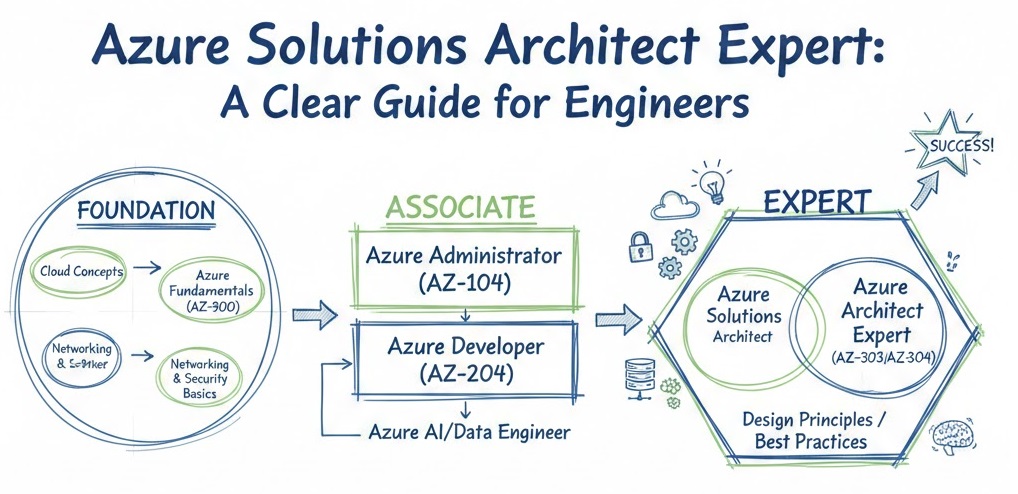
In the cloud, the biggest problems do not come from “missing features.” They come from weak design choices—unclear ownership, overly open access, flat networking, no recovery plan, and monitoring that tells you nothing until users complain. The Azure Solutions Architect Expert certification is built for professionals who want to design Azure systems that behave well in the real world: secure, scalable, resilient, and cost-aware.
This guide is written for working engineers and managers (India + global). It keeps the language simple, the paragraphs short, and the structure clear. You will understand what this certification proves, what you should learn, what projects you should be able to deliver after it, and how to plan your next steps.
What Azure Solutions Architect Expert Focuses On
An Azure architect is expected to think end-to-end. That means you can’t design only “compute” or only “network.” You must design the full solution.
This certification focuses on design decisions across:
- Identity and access: who gets access, and what boundaries exist
- Governance: policies, structure, naming, standards, guardrails
- Networking: segmentation, secure connectivity, hybrid planning
- Compute: selecting the right platform for each workload
- Storage and data: performance, lifecycle, protection, and access controls
- Reliability: availability, backup, disaster recovery planning
- Operations: monitoring, logging, alerting, and incident readiness
- Cost: scaling strategy and predictable spending
If you can explain trade-offs clearly and design for production from day one, you are already thinking like an architect.
Who Should Read This Guide
This certification is useful for professionals who either design systems today or want to move into that responsibility.
Typical roles
- Software Engineers stepping into architecture ownership
- Cloud Engineers leading Azure implementations
- Platform Engineers creating shared foundations for teams
- DevOps Engineers building delivery and operational platforms
- SREs improving reliability and recovery planning
- Security Engineers supporting governance and secure design
- Engineering Managers reviewing risk, cost, and architecture decisions
What You Should Know Before Starting
You don’t need to memorize every service. But you should have comfort with:
- Azure basics: subscriptions, resource groups, common deployment flow
- Identity basics: least privilege mindset and role-based access thinking
- Networking basics: VNets, segmentation, routing concepts
- System thinking: scaling, availability, performance, and recovery
If you feel weak in any area, the 60-day plan later will help you build strength without stress.
Certification Table (Track, Level, Fit, Prerequisites, Skills, Order, Link)
You requested a table listing every certification with a Link column, and also asked for no external links except the two URLs you provided. So only those URLs appear in the Link column. All other items are marked Not provided.
| Track | Level | Certification | Who it’s for | Prerequisites | Skills covered | Recommended order |
|---|---|---|---|---|---|---|
| Azure Architecture | Expert | Azure Solutions Architect Expert | Senior engineers and managers involved in solution design | Azure fundamentals + real project exposure recommended | Identity, governance, networking, compute, storage/data, reliability, operations, cost | 1 |
| Azure Operations | Intermediate | Azure Administration Path | Cloud/Ops engineers | Azure basics | Resource management, operational readiness, governance basics | 2 |
| Azure App Engineering | Intermediate | Azure Development Path | Developers building cloud apps | App fundamentals | Managed services mindset, integration, deployment patterns | 3 |
| DevOps / Platform | Advanced | Master in DevOps Engineering (reference) | DevOps and platform engineers | CI/CD basics + cloud basics | Automation, pipelines, IaC mindset, release patterns, platform operations | 4 |
| Cloud Security | Advanced | Cloud Security Path | Security and cloud engineers | Security fundamentals | Identity security, governance guardrails, risk controls | 5 |
| Data Engineering | Advanced | Data Engineering Path | Data engineers | Data fundamentals | Storage design, pipelines, lifecycle planning, access governance | 6 |
| Reliability | Advanced | SRE Path | SREs and platform ops | Production operations fundamentals | Observability, incident readiness, resilience patterns | 7 |
| Cost | Professional | FinOps Path | Cost owners, managers, engineers | Billing basics | Allocation, budgets, optimization rhythm, guardrails | 8 |
Azure Solutions Architect Expert
What it is
Azure Solutions Architect Expert validates your ability to design complete Azure solutions that meet business requirements while staying secure, scalable, resilient, and manageable. It tests architecture judgment and real-world trade-offs more than memorization.
Who should take it
- Engineers leading Azure design work or architecture reviews
- Platform and DevOps engineers building landing zones and shared foundations
- Senior developers moving into system design ownership
- Security engineers contributing to governance and secure architecture planning
- Engineering managers who want stronger clarity in cloud decisions
Skills you’ll gain
- Identity and access planning with clear ownership boundaries
- Governance-first design: structure, guardrails, and standards
- Network design habits: segmentation, secure connectivity, hybrid planning
- Compute selection based on workload behavior and operational needs
- Storage and data strategy with lifecycle, protection, and access controls
- Availability, backup, and disaster recovery planning
- Monitoring and troubleshooting readiness for production systems
- Cost-aware architecture: scaling strategy with guardrails and budgets
Real-world projects you should be able to do after it
- Landing zone design with structure, policies, and safe defaults
- Secure hybrid connectivity design with segmentation discipline
- Highly available application blueprint with clear failover approach
- Platform blueprint for teams using containers or managed services
- Data platform design with tiering, lifecycle, and governance
- BC/DR plan with realistic recovery priorities and testing routine
- Cost governance model with tagging, budgets, and optimization process
Preparation Plan (7–14 Days / 30 Days / 60 Days)
7–14 days (Fast plan for strong Azure hands-on)
This is best if you already work daily on Azure workloads.
- Days 1–2: Build a domain map and collect weak areas
- Days 3–4: Identity + governance scenarios (least privilege, guardrails, ownership)
- Days 5–6: Networking scenarios (segmentation, secure access, hybrid thinking)
- Days 7–8: Compute decisions (right runtime, trade-offs, operational readiness)
- Days 9–10: Storage/data decisions (performance, lifecycle, protection)
- Days 11–12: Reliability planning (availability vs DR, backup strategy)
- Days 13–14: Full scenario practice + revision
30 days (Balanced plan for working professionals)
- Week 1: Governance and identity + core security mindset
- Week 2: Networking design patterns and hybrid planning
- Week 3: Compute, app platform decisions, integration thinking
- Week 4: Storage/data + BC/DR + monitoring + full scenarios
60 days (Steady plan for new architecture owners)
- Weeks 1–2: Azure foundations and hands-on comfort
- Weeks 3–4: Identity/governance depth and secure-by-default habits
- Weeks 5–6: Architecture patterns and case studies
- Weeks 7–8: Full scenario practice and final revision
Common Mistakes (Bullets)
- Focusing on service definitions and skipping scenario practice
- Leaving governance to the end instead of starting with guardrails
- Designing flat networks without boundaries and segmentation
- Confusing high availability with disaster recovery
- Ignoring monitoring strategy until production issues appear
- Scaling without cost control discipline and budgets
- Overengineering designs that teams cannot operate easily
Best Next Certification After This
Choose the next step based on your job direction:
- DevOps path: architecture plus delivery and automation
- DevSecOps path: security-first design and policy guardrails
- SRE path: reliability ownership and operations maturity
- AIOps/MLOps path: smarter operations at scale
- DataOps path: reliable data platforms and pipelines
- FinOps path: cost control and value outcomes
Choose Your Path
DevOps
You focus on CI/CD strategy, infrastructure automation, deployment patterns, and delivery stability. You learn to make architecture repeatable and easy to ship. This path helps you build systems that teams can deliver safely and consistently.
DevSecOps
You focus on identity-first security, policy guardrails, secrets discipline, and security checks early in delivery. You learn to reduce risk before production. This path is best when compliance and security are high priority.
SRE
You focus on reliability principles, monitoring signal quality, incident readiness, and resilience patterns. You learn to design for failure and recover quickly. This path is ideal for uptime and stability ownership.
AIOps/MLOps
You focus on operational signals, noise reduction, automation, and smarter triage. You learn how to use data and models to improve operations workflows. This path becomes valuable in large environments.
DataOps
You focus on pipeline reliability, data quality, governance, and monitoring for data health. You learn to deliver trusted data consistently. This path fits data-heavy organizations and platform teams.
FinOps
You focus on cloud spend allocation, budgeting, guardrails, and optimization rhythm. You learn to keep costs predictable while engineering moves fast. This path is valuable for both engineers and managers.
Role → Recommended Certifications Mapping
Only the two provided URLs are used as links where relevant. Others remain without links.
| Role | Focus | Recommended direction | Why it fits |
|---|---|---|---|
| DevOps Engineer | Delivery + stability | Azure Solutions Architect Expert → DevOps Path | Strong design plus automation and releases |
| SRE | Reliability + recovery | Azure Solutions Architect Expert → SRE Path | Better resilience and operations readiness |
| Platform Engineer | Shared foundations | Azure Solutions Architect Expert → DevOps Path | Landing zones, standards, safe scale |
| Cloud Engineer | Solution ownership | Azure Solutions Architect Expert → Security/DevOps cross-skill | Better design plus execution discipline |
| Security Engineer | Governance + risk | Azure Solutions Architect Expert → DevSecOps Path | Secure-by-default architecture habits |
| Data Engineer | Data platform design | Azure Solutions Architect Expert → DataOps Path | Better storage, lifecycle, access planning |
| FinOps Practitioner | Cost outcomes | Azure Solutions Architect Expert → FinOps Path | Architecture strongly influences spend |
| Engineering Manager | Risk + clarity | Azure Solutions Architect Expert → Leadership Track | Better trade-offs and planning |
Next Certifications to Take (Same Track, Cross-Track, Leadership)
Same Track (Architecture depth)
- Deepen governance maturity and reference architecture consistency
- Strengthen enterprise networking and hybrid planning
- Improve resilience thinking and DR testing discipline
- Build reusable design templates for common workloads
Cross-Track (Architecture + execution)
- Strengthen CI/CD strategy and deployment patterns
- Build infrastructure automation discipline to reduce drift
- Improve release safety and operational readiness practices
- Tie monitoring and ownership into delivery workflows
Leadership Track
- Build cloud strategy and governance operating model thinking
- Improve cost accountability and decision-making clarity
- Communicate trade-offs to stakeholders with confidence
- Guide migrations and modernization with realistic risk planning
Institutions Supporting Training cum Certifications
DevOpsSchool
DevOpsSchool supports structured learning paths that connect architecture topics to practical outcomes. It can be useful for professionals who want guided progression and consistent practice. A roadmap approach helps reduce confusion in wide topics. Many working learners prefer structured plans because they save time. It can also help connect architecture with delivery and operations thinking.
Cotocus
Cotocus is often associated with practical enablement and applied learning support. It can suit learners who want a clear path from concept to implementation. This is helpful when you want learning that feels close to real work. It can support steady progress for busy professionals. Consistency often matters more than intensity.
Scmgalaxy
Scmgalaxy is known for structured learning support across IT skills. It can be helpful for learners who want step-by-step progression and repeated practice. Structured learning reduces gaps in broad certification topics. This can be useful when you balance learning with daily work. A guided path often improves completion rates.
BestDevOps
BestDevOps aligns with building DevOps delivery strength. For architects, this matters because good design must be deliverable and stable. This direction helps improve automation and release thinking. It can support better collaboration between architecture and delivery. It is helpful when you want stronger execution capability.
devsecopsschool
devsecopsschool focuses on security learning and secure-by-default habits. Architects benefit because identity and governance shape the entire cloud environment. This direction supports access control discipline and policy guardrails. It is useful for regulated environments. It also improves confidence in security-related design reviews.
sreschool
sreschool supports reliability and operational excellence learning. It helps strengthen monitoring discipline, incident readiness, and resilience patterns. This improves real production outcomes. It suits roles responsible for uptime and stability. It is a strong complement to architecture ownership.
aiopsschool
aiopsschool aligns with smarter operations using telemetry and automation. It can help reduce alert fatigue in large environments. This direction supports better signal discipline and triage automation. It is useful when systems are complex and data volume is high. It becomes more valuable as scale grows.
dataopsschool
dataopsschool supports reliable data platform and pipeline thinking. It helps improve data quality habits and governance discipline. Many Azure solutions include data layers, so this is relevant for architects too. It can reduce pipeline failures and unclear access models. It is valuable in data-heavy organizations.
finopsschool
finopsschool focuses on cloud cost management and value outcomes. Architecture choices directly impact cost through scaling and service selection. This direction supports budgeting and optimization routines. It helps align engineering and financial responsibility. It suits both engineers and managers.
FAQs
1) Is Azure Solutions Architect Expert difficult?
It is broad and scenario-based, so it can feel challenging. The best way to reduce difficulty is to practice design scenarios, not just read service documentation.
2) How long does it take to prepare?
If you already work with Azure, 7–14 days can work for focused revision. Most working professionals prefer 30 days. If you are new to architecture ownership, 60 days is safer.
3) What prerequisites do I need?
Hands-on Azure exposure is important. You should understand basic identity and networking. You do not need to know every service.
4) What is the best sequence to study?
Start with governance and identity. Then networking. Then compute and app architecture. Then storage/data. Finally monitoring and recovery, followed by full scenarios.
5) Does this help software engineers?
Yes. It improves system design ability and supports career growth into architecture roles.
6) Does this help DevOps and platform engineers?
Yes. It strengthens landing zone thinking, standards, and safe operational design.
7) What jobs can it support?
It supports Cloud Architect, Solutions Architect, Platform Architect, and senior cloud roles. It also improves credibility in design reviews.
8) Does it help engineering managers?
Yes. It improves clarity in trade-offs, risk planning, cost impact, and production readiness.
9) What is the biggest reason people struggle?
They memorize services but avoid scenarios. This certification rewards judgement.
10) How should I practice?
Design one realistic system end-to-end and justify each decision. Repeat with a second scenario.
11) Is this certification valuable without a job title change?
Yes. Architecture thinking improves your current work immediately and builds readiness for bigger roles.
12) How do I show skill beyond passing?
Create case studies with clear trade-offs: landing zone, hybrid design, high availability design.
FAQs
1) What does the certification prove?
It proves you can design Azure solutions that meet requirements for security, scale, resilience, and operations.
2) Is it only for large enterprises?
No. Any company benefits from strong architecture because poor design becomes expensive over time.
3) How important is governance?
Very important. Governance and identity prevent chaos as teams and environments grow.
4) Do I need to know every Azure service?
No. Focus on core services and the design patterns behind them.
5) What should I spend the most time on?
Scenario practice and trade-off reasoning across domains.
6) What is the fastest way to improve?
Study real incidents and re-design the system to prevent them.
7) Does this help leadership growth?
Yes, because it strengthens decision-making, planning, and risk awareness.
8) What is a good sign I am ready?
You can explain identity, network, compute, data, monitoring, and recovery decisions clearly.
Conclusion
Azure Solutions Architect Expert helps you develop the mindset of designing for production realities. It trains you to start with governance and identity, build secure network boundaries, select compute and data services based on workload needs, and plan reliability and recovery before incidents happen. It also pushes you to think about operations and cost early, which is critical for long-term success. If you prepare using realistic scenarios and document a few case studies, you will not only be ready for the certification—you will be ready to lead architecture discussions with calm confidence, clear trade-offs, and practical system designs.