Introduction
As more businesses adopt cloud computing, the role of DevOps Engineers has evolved into one of the most crucial positions in IT. Amazon Web Services (AWS), being the leading cloud service provider, offers a comprehensive suite of tools and services to automate infrastructure, deliver software efficiently, and monitor application health. For professionals aiming to prove their expertise in these areas, the AWS DevOps Engineer – Professional certification is a valuable credential that validates your skills in managing complex, automated cloud environments.
This certification focuses on the practical application of DevOps principles within the AWS ecosystem, covering everything from CI/CD pipelines to high availability and monitoring. Whether you’re looking to deepen your AWS expertise or pivot to DevOps, this guide will walk you through the certification’s key details, benefits, and how to effectively prepare for the exam.
What is AWS DevOps Engineer – Professional Certification?
The AWS Certified DevOps Engineer – Professional certification is an advanced-level credential designed for individuals who have significant hands-on experience with AWS. It validates your ability to provision, operate, and manage AWS environments with a strong focus on automation, monitoring, and optimizing the software development lifecycle.
Unlike beginner certifications, which focus more on the foundational aspects of cloud computing, this certification dives deeper into automation, continuous integration/continuous delivery (CI/CD), infrastructure management, and security — all essential skills for working in modern DevOps environments.
Core Focus Areas of the Exam:
- Automation of AWS Infrastructure: Utilizing services like AWS CloudFormation to automate the creation and management of cloud resources.
- CI/CD Pipelines: Designing and managing continuous integration and continuous delivery pipelines to streamline application development and deployment.
- Security: Implementing security best practices across the DevOps lifecycle, using tools like AWS IAM for identity management and KMS for encryption.
- Monitoring and Logging: Setting up and optimizing monitoring and logging solutions using AWS CloudWatch and CloudTrail to track system health, manage alerts, and monitor user activity.
- Scalability and High Availability: Designing cloud architectures that can scale automatically and remain resilient during peak loads, using services like Elastic Load Balancing, Auto Scaling, and Amazon RDS.
This certification tests both your knowledge of AWS services and your ability to apply them in real-world scenarios, ensuring that certified professionals can manage complex cloud environments effectively.
Who Should Pursue This Certification?
The AWS DevOps Engineer – Professional certification is ideal for professionals who already have experience working with AWS and DevOps principles and wish to formalize and validate their expertise. Here are the types of roles and professionals who would benefit from this certification:
Ideal Candidates:
- DevOps Engineers: If you’re already working as a DevOps Engineer and want to demonstrate your advanced skills in AWS cloud automation and DevOps practices.
- Cloud Engineers: Professionals who work with cloud infrastructure and want to focus on AWS-specific tools for automating operations and managing applications.
- System Administrators: Those who manage IT infrastructure and wish to adopt DevOps methodologies to improve automation, deployment, and monitoring.
- Software Developers: Developers who are responsible for deploying and maintaining applications and wish to integrate them seamlessly with cloud infrastructure and automation pipelines.
Prerequisites:
- AWS Experience: Prior hands-on experience with AWS services and DevOps practices is highly recommended.
- DevOps Knowledge: You should have a good understanding of core DevOps concepts such as CI/CD, automation, and cloud infrastructure management.
- Certifications: While there are no formal prerequisites, it is suggested that you hold certifications like AWS Certified Developer – Associate or AWS Certified SysOps Administrator – Associate before attempting this exam.
What Skills Will You Gain?
By earning the AWS DevOps Engineer – Professional certification, you will acquire a wide range of skills that are critical for managing complex, automated AWS environments. These include:
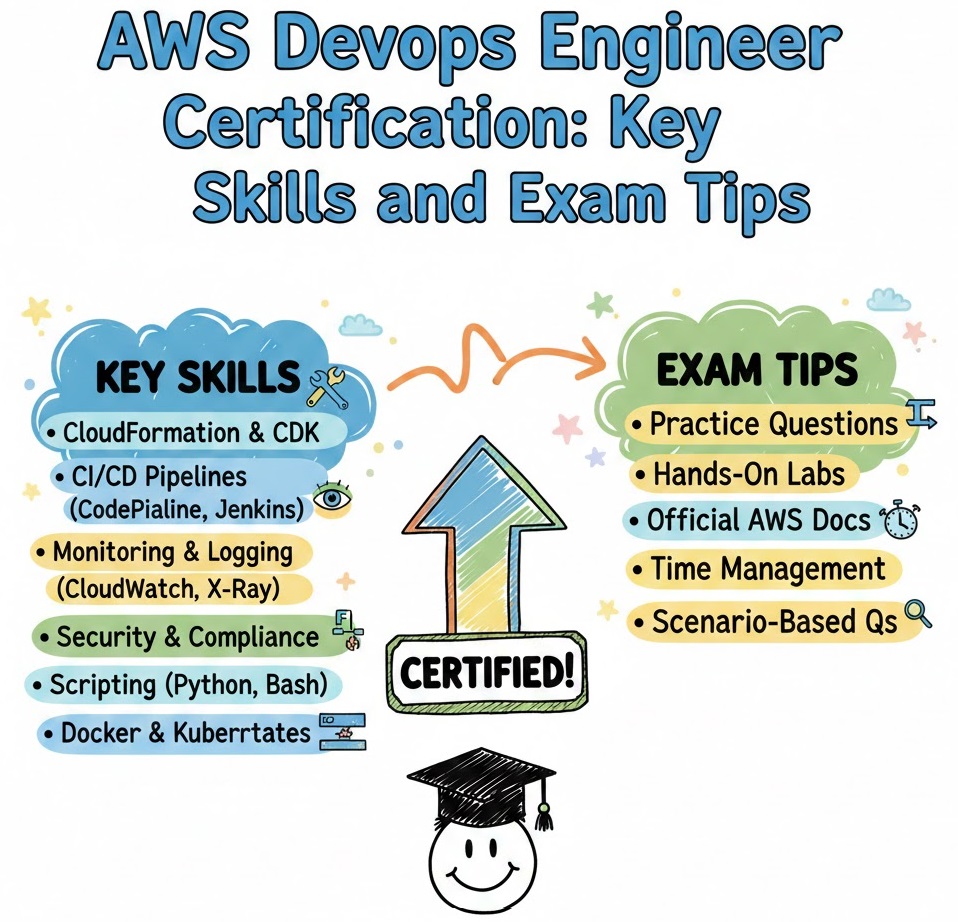
Key Skills You’ll Develop:
- Infrastructure as Code (IaC): Learn to use tools like AWS CloudFormation, Terraform, and AWS CLI to automate the setup and management of AWS resources. Automation helps eliminate human error and reduces the time it takes to provision new environments.
- CI/CD Pipeline Implementation: Gain the ability to design, implement, and manage CI/CD pipelines using AWS CodePipeline, Jenkins, GitLab, or other tools. This includes automating the entire software development lifecycle from code commit to deployment.
- Monitoring and Logging: Master AWS CloudWatch to monitor your cloud infrastructure’s performance and AWS CloudTrail for log management, helping you track and respond to anomalies and incidents quickly.
- Security Best Practices: Learn how to enforce security protocols across the DevOps pipeline using AWS IAM (Identity and Access Management) and AWS KMS (Key Management Service). You will ensure that your cloud infrastructure follows the latest security guidelines.
- Cost Management: Gain insights into how to optimize cloud resource usage and minimize unnecessary expenses with services like AWS Cost Explorer and AWS Budgets.
These skills ensure that you can manage complex DevOps workflows in AWS, implement continuous delivery practices, and ensure the security and cost-efficiency of your infrastructure.
Real-World Projects You Should Be Able to Tackle
Completing the AWS DevOps Engineer – Professional certification will equip you to handle a variety of real-world challenges in cloud infrastructure. Here are a few examples of the types of projects you will be ready to take on:
- Automating Infrastructure Management: Build and automate your entire cloud infrastructure using tools like AWS CloudFormation or Terraform. Automating this process ensures that you can scale environments consistently and quickly.
- Implementing CI/CD Pipelines: Design and build CI/CD pipelines that automate every step of the development process. This includes source code management, build automation, automated testing, and deployment.
- Integrating Security into DevOps: Set up automated security scans, compliance monitoring, and real-time threat detection using AWS IAM for access management, AWS GuardDuty for threat detection, and AWS Shield for DDoS protection.
- Performance Monitoring and Incident Management: Create and implement a monitoring system using CloudWatch to track application performance, set up custom alerts, and manage logs with CloudTrail for seamless incident management.
- Scaling AWS Environments: Configure Auto Scaling and Elastic Load Balancing to automatically adjust infrastructure resources according to traffic demands, ensuring high availability and cost efficiency.
How to Prepare for the Exam
Preparing for the AWS DevOps Engineer – Professional certification requires a mix of hands-on experience and study. Here’s a detailed preparation roadmap:
First 7-14 Days:
- Refresh AWS Basics: Ensure you understand the essential AWS services such as EC2, S3, VPC, Lambda, and RDS.
- Understand Core DevOps Practices: Get familiar with core DevOps concepts like CI/CD, IaC, and cloud monitoring.
15-30 Days:
- Deep Dive into AWS DevOps Tools: Spend focused time working with AWS services such as CodePipeline, CodeDeploy, Elastic Beanstalk, and CloudFormation. Create real projects and automate processes.
- Practice: Set up a basic CI/CD pipeline and automate infrastructure deployments on AWS.
30-60 Days:
- Master Advanced Topics: Focus on security, high availability, disaster recovery strategies, and complex monitoring solutions.
- Take Mock Exams: Practice with mock exams to familiarize yourself with the test format and question types. Evaluate your performance and focus on weak areas.
Common Mistakes to Avoid
To succeed in the AWS DevOps Engineer – Professional exam, avoid these common mistakes:
- Not Getting Enough Hands-on Practice: AWS is a practical platform. Make sure to apply the concepts you study through hands-on exercises and labs.
- Overlooking Security: Security is a crucial part of the DevOps workflow. Ensure you are well-versed in AWS security practices.
- Skipping the Exam Blueprint: Review the AWS exam blueprint carefully to understand the weightage of topics and to prioritize your study.
Best Next Certifications After This
After achieving the AWS DevOps Engineer – Professional certification, you can further specialize in AWS and cloud computing by considering the following certifications:
- Same Track: AWS Certified Solutions Architect – Professional: Deepen your knowledge of advanced cloud architectures and system designs.
- Cross-Track: AWS Certified Security – Specialty: Focus on security and learn how to implement best practices for securing AWS environments.
- Leadership: AWS Certified Cloud Practitioner: Gain a broader understanding of AWS management and leadership aspects.
Choose Your Career Path
Upon obtaining the AWS DevOps Engineer – Professional certification, you can pursue a variety of career paths based on your interests:
- DevOps: Automate software delivery and enhance deployment pipelines.
- DevSecOps: Integrate security practices within the DevOps pipeline.
- Site Reliability Engineering (SRE): Ensure system reliability and scalability.
- AIOps/MLOps: Use AI/ML technologies for operational efficiency.
- DataOps: Focus on managing data pipelines and automating workflows.
- FinOps: Manage and optimize cloud costs effectively.
Role → Recommended Certifications Mapping
Here’s a guide to help you determine the right certifications based on your career role after achieving the AWS DevOps Engineer – Professional certification:
| Role | Recommended Certifications |
|---|---|
| DevOps Engineer | AWS DevOps Engineer – Professional, Kubernetes Certified Engineer |
| SRE (Site Reliability Engineer) | AWS Certified Solutions Architect – Professional, Google Cloud DevOps Engineer |
| Platform Engineer | AWS DevOps Engineer – Professional, Kubernetes Certified Administrator |
| Cloud Engineer | AWS Certified Solutions Architect – Associate, AWS Certified SysOps Administrator |
| Security Engineer | AWS Certified Security – Specialty, AWS Certified Solutions Architect – Professional |
| Data Engineer | AWS Certified Data Analytics – Specialty, AWS Certified Solutions Architect |
| FinOps Practitioner | AWS Certified FinOps Practitioner, AWS Certified Solutions Architect |
| Engineering Manager | AWS Certified Cloud Practitioner, AWS Certified Solutions Architect – Professional |
Top Institutions Providing AWS DevOps Engineer – Professional Training & Certifications
Here are the top institutions offering AWS DevOps Engineer – Professional training to help you pass the certification exam:
- DevOpsSchool: Focused on hands-on training, DevOpsSchool offers expert-led courses covering key AWS DevOps practices, CI/CD pipeline implementation, and cloud automation.
- Cotocus: Known for comprehensive training in AWS DevOps, Cotocus offers deep dives into AWS services like CodePipeline and CloudFormation.
- ScmGalaxy: ScmGalaxy provides extensive training in AWS DevOps, focusing on automation, CI/CD, and cloud management.
- BestDevOps: Offers complete courses for AWS DevOps, with a focus on security integration and real-world scenarios.
- DevSecOpsSchool: Specializes in the integration of security within DevOps pipelines using AWS security tools and services.
- SRESchool: Offers training in Site Reliability Engineering and how to use AWS for ensuring system reliability and performance.
- AIOpsSchool: Focuses on combining AI with DevOps for smarter cloud management using AWS services.
- DataOpsSchool: Specializes in DataOps, teaching learners how to manage cloud data workflows using AWS.
- FinOpsSchool: Provides training in managing and optimizing cloud costs while working with AWS infrastructure.
FAQs – AWS DevOps Engineer – Professional
1. What is the difficulty level of the AWS DevOps Engineer – Professional exam?
The AWS DevOps Engineer – Professional exam is considered challenging and is designed for professionals with extensive hands-on experience in AWS and DevOps practices. It focuses on deep technical knowledge and the practical application of AWS services.
2. How much time do I need to prepare for the AWS DevOps Engineer exam?
Preparation time varies, but most candidates spend 2–3 months preparing for the exam. If you already have experience with AWS and DevOps practices, your preparation may be shorter.
3. What are the prerequisites for this certification?
Although there are no formal prerequisites, it’s highly recommended to have experience with AWS and a basic understanding of DevOps practices. It’s also beneficial to have AWS Certified Developer – Associate or AWS Certified SysOps Administrator – Associate certifications.
4. What services should I focus on for the exam?
Focus on core AWS services like EC2, Lambda, S3, CodePipeline, CodeDeploy, CloudFormation, CloudWatch, and IAM. Understanding how to use these services in DevOps workflows is crucial.
5. How is the AWS DevOps Engineer – Professional exam structured?
The exam consists of 75 multiple-choice and multiple-response questions, which you need to complete in 180 minutes (3 hours). The questions are scenario-based and test both theoretical knowledge and practical application.
6. What is the cost of the AWS DevOps Engineer certification exam?
The exam costs $300 USD, plus any applicable taxes. This fee covers one attempt at the exam.
7. How can I prepare for the AWS DevOps Engineer exam?
Preparation involves hands-on practice with AWS services, taking practice exams, studying AWS whitepapers, and reviewing the official exam guide. Participating in training programs and labs will also help solidify your understanding.
8. Do I need to take a formal training course to pass the exam?
No, formal training is not required. However, taking an AWS DevOps training course can provide structured guidance and hands-on experience, which can help improve your chances of passing the exam.
9. What are the common challenges faced during preparation?
Common challenges include managing time effectively, ensuring hands-on practice with AWS tools, and understanding the broad scope of services covered in the exam.
10. What are the passing requirements for the exam?
AWS does not disclose a specific passing score, but candidates typically need to score at least 70% to pass. The exam is designed to assess your practical understanding of AWS DevOps services.
11. How do I register for the AWS DevOps Engineer exam?
You can register for the exam through the AWS Certification Portal. After signing in, choose the exam, pay the fee, and select a testing center or opt for an online proctored exam.
12. Is the AWS DevOps Engineer certification valid for a lifetime?
No, the certification is valid for three years. After that, you will need to recertify by taking the latest exam or another relevant certification exam to maintain your credential.
FAQs
1. How long do I have to complete the exam?
You have 180 minutes (3 hours) to complete the exam, which consists of 75 questions.
2. What is the format of the AWS DevOps Engineer – Professional exam?
The exam consists of multiple-choice and multiple-response questions. It tests both conceptual knowledge and practical application of AWS services.
3. What’s the best way to gain hands-on experience for the exam?
You can use the AWS Free Tier to practice with various AWS services. Build CI/CD pipelines, automate infrastructure, and set up monitoring systems to simulate real-world environments.
4. How much does the AWS DevOps Engineer – Professional certification cost?
The certification exam costs $300 USD, with additional taxes if applicable in your region.
5. What happens if I fail the AWS DevOps Engineer exam?
If you don’t pass, you can retake the exam after a 14-day waiting period. You’ll need to pay the exam fee again for each attempt.
6. How long is the AWS DevOps Engineer – Professional certification valid?
The certification is valid for 3 years. After that, you must recertify by passing the latest version of the exam or another related certification exam.
7. What resources are available for exam preparation?
AWS provides official study materials, practice exams, whitepapers, and exam guides. Additionally, online courses and practice labs are widely available.
8. Can I take the AWS DevOps Engineer exam if I have no prior AWS certifications?
Yes, you can take the exam without prior AWS certifications, but having foundational knowledge through certifications like AWS Certified Developer – Associate or AWS Certified SysOps Administrator – Associate is beneficial.
Conclusion
The AWS DevOps Engineer – Professional certification is a valuable credential for anyone pursuing a career in cloud computing and DevOps. It showcases your ability to design, deploy, and manage scalable, reliable, and secure cloud infrastructures using AWS tools. With a deep understanding of continuous integration, delivery pipelines, security practices, and monitoring, you’ll be equipped to take on more advanced DevOps roles.This certification not only validates your technical skills but also demonstrates your commitment to professional development in the rapidly evolving cloud domain.