Introduction
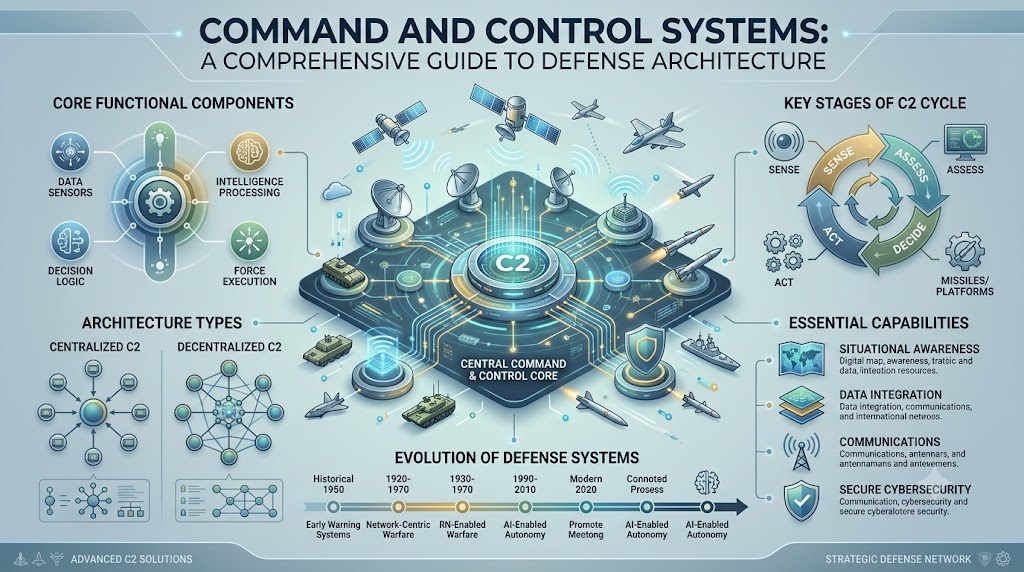
How do military organizations direct large-scale forces, maintain situational awareness, and align long-term strategy across land, sea, air, space, and cyber environments? The answer lies in Command and Control Systems, the structural, procedural, and technological networks that enable leadership to process information and execute decisions. At WarOpsX, providing educational clarity on defense infrastructure is central to understanding how modern security institutions operate. Command and control forms the structural nerve center of defense organizations, transforming raw data into coherent strategic understanding. From nineteenth-century telegraph lines to contemporary satellite-linked networks, the mechanism of command has adapted continuously to technological and organizational shifts. This article examines the core principles, historical evolution, technological frameworks, logistics dependencies, and systemic limitations of command and control architecture, giving students and researchers a foundational framework for defense studies.
Understanding the Core Concept
In defense studies, Command and Control Systems (frequently abbreviated as C2) refer to the exercise of authority and direction by a designated commander over assigned forces in the accomplishment of a mission. Rather than referring solely to computer hardware or radio gear, C2 encompasses the personnel, procedures, equipment, facilities, and communications necessary to plan, direct, coordinate, and control forces and operations.
When combined with related elements, the concept expands into technical designations:
- C3I: Command, Control, Communications, and Intelligence.
- C4ISR: Command, Control, Communications, Computers, Intelligence, Surveillance, and Reconnaissance.
Key Terminology
- Command: The legal and operational authority vested in an individual to direct forces.
- Control: The process of monitoring, verifying, and adjusting actions to align with the commander’s intent.
- Situational Awareness: The accurate perception of environmental elements, force disposition, and operational factors within a specific volume of time and space.
- Decision Cycle: The structural sequence through which information is gathered, evaluated, decided upon, and acted upon (often conceptualized as the Observe-Orient-Decide-Act or OODA loop).
Within defense studies, command and control provides the bridge between high-level policy objectives and practical execution. Without an effective C2 structure, strategic intent cannot be communicated reliably, nor can operational feedback reach decision-makers in time to adjust resource allocation.
Historical Evolution of Command and Control Systems
Command structures have evolved alongside advancements in communications, transportation, and industrial organization.
+-----------------------------------------------------------------------------------+
| 19th Century: Industrial Telegraph & Staff Systems (Prussian Staff Model)          |
+-----------------------------------------------------------------------------------+
                                         |
                                         v
+-----------------------------------------------------------------------------------+
| Mid-20th Century: Integrated Radar & Radio Networks (Dowding Air Defense System)  |
+-----------------------------------------------------------------------------------+
                                         |
                                         v
+-----------------------------------------------------------------------------------+
| Late 20th Century: Cold War C3I Satellite & Computer-Assisted Command Nodes       |
+-----------------------------------------------------------------------------------+
                                         |
                                         v
+-----------------------------------------------------------------------------------+
| Modern Era: Multidomain Integration (Cloud-Enabled JADC2 & Distributed Sensor Networks)|
+-----------------------------------------------------------------------------------+
The Industrial Era and Staff Systems
Before the nineteenth century, military command was largely limited by visual sightlines and physical couriers. The advent of the electric telegraph and rail networks dramatically expanded operational theaters. This change necessitated the general staff system—pioneered prominently by Prussia—which divided command responsibilities into specialized functional branches such as intelligence, operations, and logistics. Command shifted from immediate field presence to organized headquarters managing strategic transit and communications.
Mid-Twentieth Century Air Defense Networks
During World War II, the necessity of tracking fast-moving aerial formations led to the development of early integrated C2 networks. The Dowding System created by the Royal Air Force combined ground radar stations, visual observer posts, telephone links, and a centralized plotting room. This network consolidated disparate reports into a single operational display, allowing commanders to dispatch defense squadrons efficiently while preserving fuel and aircrew endurance.
The Late Twentieth Century and C3I
The Cold War introduced satellite communications, computerized air defense processing, and hardened underground command centers. The growth of nuclear and long-range ballistic capabilities compressed decision timelines from days to minutes. Defense organizations developed structured command protocols, early data networks, and standardized reporting procedures to maintain central authority under severe pressure.
The Modern Multidomain Era
Contemporary C2 frameworks address simultaneous interactions across five operational environments: land, maritime, air, space, and cyber. Contemporary defense initiatives focus on connecting sensors from any domain directly to decision-makers and units across functional branches.
Functional Components of Command and Control
Modern command and control relies on four interconnected pillars: human leadership, communication channels, data management, and strategic integration.
Leadership and Organizational Hierarchy
The foundation of any C2 system is the organizational structure. Defense organizations establish chains of command to define responsibilities and reporting lines clearly.
Defense studies identify two primary command philosophies:
- Centralized Control: Decision-making authority remains concentrated at high-level headquarters, prioritizing precise oversight and unified resource control.
- Decentralized Execution (Mission Command): Higher commanders communicate overall intent and objectives, empowering subordinate leaders to make tactical adaptations based on local conditions without waiting for explicit headquarters approval.
Communication Infrastructure
Communication systems serve as the physical and electronic pathways for information flow. This includes high-frequency radios, fiber-optic ground networks, encrypted satellite relays, and tactical data links. Modern infrastructure prioritizes redundancy—ensuring that if satellite communications are degraded, ground-based or aerial relay systems automatically maintain signal flow.
Information Management and Data Processing
Modern defense environments generate immense volumes of raw data from radar, video streams, satellite imagery, and ground sensors. Effective C2 systems prevent cognitive overload by processing, filtering, and organizing data into a Common Operational Picture (COP). A coherent COP ensures that leaders at different echelons share a consistent understanding of geographic coordinates, force dispositions, and operational status.
Decision-Support and Technological Integration
Modern command centers utilize software decision-support tools. These tools assist staff officers by automating routine data entry, running logistical algorithms, modeling weather impacts, and displaying real-time supply chain metrics.
The Role of Logistics in Command and Control
Command and Control Systems are intrinsically linked to military logistics. A command network cannot function without physical infrastructure, electrical power, hardware maintenance, and secure supply paths.
+------------------------------------------------------------------+
|                   LOGISTICS CONTROL ENTERPRISE                    |
+------------------------------------------------------------------+
        |                                          |
        v                                          v
+-------------------------------+      +-------------------------------+
|  SUSTAINMENT OF C2 NODES      |      |     LOGISTICAL C2 MANAGEMENT  |
|  - Continuous Power & Fuel    |      |  - Fleet Tracking & Transit   |
|  - Hardware Maintenance       |      |  - Depot Inventory Monitoring |
|  - Network Cable Protection   |      |  - Medical & Personnel Flow   |
+-------------------------------+      +-------------------------------+
Power and Infrastructure Sustainment
Fixed command headquarters and mobile signal nodes require significant electrical power to run computing stacks, cooling systems, and long-range transmitters. Supplying fuel for generators, maintaining batteries, and protecting relay towers are critical logistical tasks required to maintain communication uptime.
Logistical Information Tracking
Simultaneously, C2 systems manage logistics networks. Staff officers rely on specialized command software to track inventory levels, transit routes, equipment maintenance cycles, and casualty evacuations. Effective logistical C2 ensures that units receive ammunition, fuel, medical supplies, and spare parts before critical shortages occur.
Defense Technology and Multidomain Operations
The integration of advanced technology into command and control changes how information flows across organizations.
Space-Based Systems
Space infrastructure supports modern C2 by offering:
- Positioning, Navigation, and Timing (PNT): Satellite signals allow precise geographic tracking and microsecond synchronization of encrypted communications networks.
- Over-the-Horizon Communications: Satellite constellations connect headquarters with remote forces beyond line-of-sight limits.
- Early Warning and Reconnaissance: Space sensors provide early notification of missile launches and strategic force movements.
Cyber Domain Considerations
Command networks rely heavily on digital data links, making cybersecurity a foundational requirement of modern C2. Defensive cyber measures protect command servers from data manipulation, unauthorized access, and network disruption. Conversely, defense analysts study how network vulnerabilities can degrade an organization’s decision cycle.
Artificial Intelligence and Decision Support
Artificial intelligence applications within C2 research focus primarily on data classification and predictive analysis. AI algorithms process thousands of video feeds or radar tracks simultaneously, highlighting anomalies for human review. This speeds up data synthesis while leaving critical strategic decisions under human authority.
Comparison of Historical and Modern C2 Systems
| Epoch / Model | Primary Communication Medium | Decision-Making Speed | Centralization Level | Main System Limitations |
| 19th Century Staff Systems | Electric telegraph, written dispatches, couriers | Hours to days | Centralized at fixed headquarters | Vulnerable line infrastructure; rigid reporting structures |
| Mid-20th Century Air Defense | High-frequency radio, analog radar, telephone plot lines | Minutes to hours | Regional control sectors with central plot rooms | Frequency jamming susceptibility; manual plotting delays |
| Late 20th Century C3I Networks | Satellite relays, digital data links, early mainframe networks | Minutes | Tiered hierarchy with specialized command posts | High electrical power demands; bandwidth bottlenecks |
| Modern Multidomain Networks | Cloud architectures, space PNT, automated data links | Seconds to minutes | Distributed nodes with mission-tailored delegation | Vulnerability to cyber disruption; data overload |
Historical and Hypothetical Examples
Historical Example: The Dowding System (1940)
- Context: During the Battle of Britain, the Royal Air Force deployed an integrated defense network that combined Chain Home radar stations, visual observer posts, telegraph lines, and regional sector stations.
- Strategic Role: Disparate reports flowed into a central Filter Room at Bentley Priory, where staff verified track coordinates before sending updates to sector control rooms.
- Educational Insight: By consolidating information before directing aircraft, commanders avoided keeping fighter squadrons on continuous, exhausting air patrols. This system demonstrated that structured information management can multiply effective strength.
Historical Example: Union Military Telegraph Corps (1861–1865)
- Context: During the American Civil War, the U.S. War Department established a dedicated telegraph network parallel to industrial railway lines.
- Strategic Role: Military leaders in Washington communicated directly with field commanders across thousands of miles, coordinating troop movements across disparate regional theaters.
- Educational Insight: This marked an early integration of strategic telecommunications with logistical transportation systems, establishing the modern template for theater-level command headquarters.
Hypothetical Example: AI Implementation in Coastal Surveillance
- Scenario: A hypothetical defense organization installs an automated decision-support framework to monitor maritime traffic across an extended coastal boundary.
- System Analysis: Sensor platforms continuously send radar tracks and transponder signals to a central server. The algorithm flags unauthorized vessels or irregular navigation patterns, alerting human controllers.
- Implementation Challenges: While automated processing reduces routine monitoring time, staff officers must verify flagged anomalies to prevent false alarms caused by severe weather or faulty transponders. The system requires redundant power generators, fiber-optic backups, and continuous cyber auditing to remain operational.
Strategic Analysis Framework
Students and researchers can apply this step-by-step framework to evaluate any command and control network:
- Define Strategic Intent: Identify the policy goals and high-level objectives governing the military organization.
- Map Command Hierarchy: Outline the chain of authority, functional headquarters, and subordinate operational units.
- Audit Information Inputs: Catalog the sensor systems, surveillance assets, and reporting protocols feeding data to command centers.
- Evaluate the Decision Cycle: Analyze the speed, steps, and organizational layers required to move from data collection to decision and action.
- Assess Logistics and Sustainment: Review the power supply, physical infrastructure, maintenance requirements, and supply chains maintaining command nodes.
- Examine Cross-Domain Integration: Determine how effectively land, sea, air, space, and cyber data streams are consolidated into a unified picture.
- Identify System Vulnerabilities: Analyze potential failure points, including cyber vulnerabilities, electromagnetic jamming risks, and bandwidth constraints.
- Review Legal and Policy Boundaries: Verify compliance with legal frameworks, civilian oversight structures, and human supervision protocols.
Common Misconceptions
- Misconception 1: Command and Control consists only of software and radio hardware.
- Fact: Technology is merely an enabling mechanism. C2 is primarily an organizational, procedural, and human enterprise built around leadership, authority, training, and clear decision pipelines.
- Misconception 2: Generating more data automatically improves decision-making.
- Fact: Unfiltered data streams produce information overload, confusing decision-makers. Effective C2 systems prioritize relevant data, filtering out noise to maintain clarity.
- Misconception 3: Advanced C2 technology eliminates uncertainty and the “fog of war.”
- Fact: Equipment failures, delayed reports, adversary countermeasures, and human error persist regardless of technological complexity.
- Misconception 4: Command and Control functions independently of logistics.
- Fact: Command posts require continuous supply chains, secure power generation, hardware transport, and physical security to stay operational.
- Misconception 5: Multidomain operations simply require operating in multiple domains at once.
- Fact: Multidomain operations demand deep integration, shared data standards, and synchronized operational intent across all environments simultaneously.
Frequently Asked Questions
- What are Command and Control Systems in defense studies?
Command and Control Systems represent the structures, procedures, leadership hierarchies, communication tools, and software frameworks that enable organizations to plan, direct, and monitor military activities. - How do Command and Control Systems differ from tactical actions?
Command and Control Systems operate across strategic, operational, and tactical levels. While tactical actions focus on localized engagements, C2 frameworks organize force posture, resource allocation, and overall decision-making. - What does C4ISR stand for?C4ISR stands for Command, Control, Communications, Computers, Intelligence, Surveillance, and Reconnaissance. It describes the integrated enterprise that collects information and supports decision-making.
- Why is military history important when studying Command and Control Systems?
History illustrates how organizational structures adapt to new communication technologies—such as the telegraph, radio, and satellite relays—helping researchers identify persistent human and technical challenges. - How does military logistics support Command and Control Systems?
Logistics supplies fuel, electrical power generation, maintenance, and physical transportation to keep command nodes operational, while C2 software helps logisticians track supplies across transportation networks. - What role does space technology play in modern Command and Control Systems?
Space systems provide foundational support, including satellite communications, positioning, navigation, timing (PNT), and environmental monitoring across long distances. - How do Multidomain Operations affect command structures?
Multidomain Operations require command systems to integrate data from land, sea, air, space, and cyber environments simultaneously, demanding unified data standards and higher interoperability. - What is the difference between centralized control and mission command?
Centralized control retains decision authority at high-level headquarters, whereas mission command provides subordinates with strategic intent, empowering them to adapt execution based on local conditions. - What are the main vulnerabilities of modern Command and Control Systems?
Key vulnerabilities include cyber intrusions, electromagnetic jamming, satellite signal degradation, physical targeting of command centers, and cognitive data overload. - Where can students find introductory resources on Defense Studies?
Students can consult academic defense journals, historical case studies, official unclassified doctrine, and educational platforms like WarOpsX.com.
Conclusion
Understanding Command and Control Systems requires examining the balance between modern technology, organizational hierarchy, and human judgment. As defense environments incorporate artificial intelligence, cloud architecture, and space-based sensors, the fundamental objective remains unchanged: aligning organizational actions with strategic intent while managing risk and uncertainty.Studying these frameworks offers researchers, students, and policy analysts key insights into how complex security organizations maintain operational coherence across land, maritime, air, space, and cyber domains. Continued educational research into logistics resilience, technological integration, and ethical oversight ensures that command structures adapt responsibly to future security challenges. Educational platforms like WarOpsX.com provide structured analysis to support learners exploring military strategy, organizational systems, and defense studies.