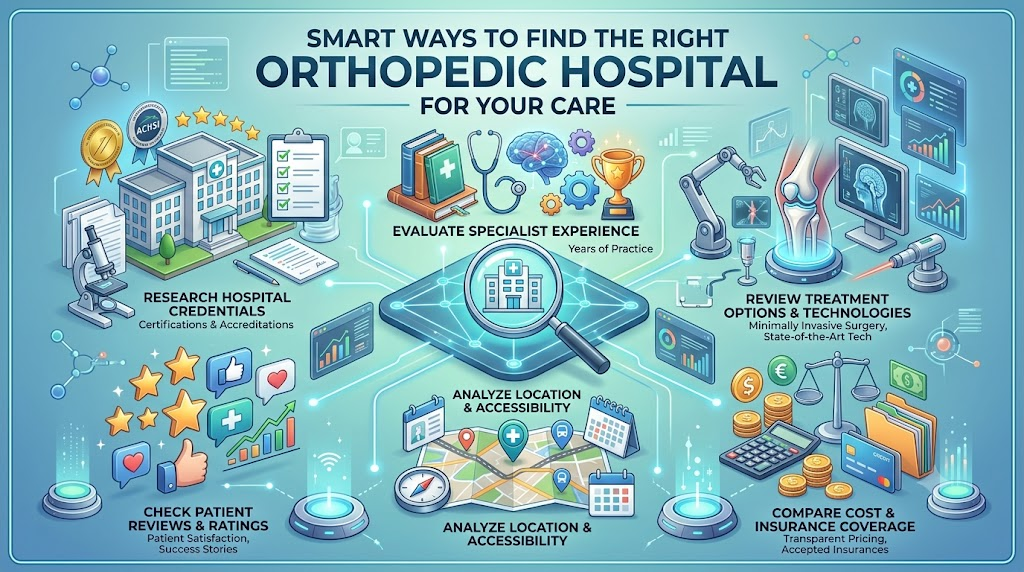
Introduction
Choosing an orthopedic hospital is an important health decision. Orthopedic care covers bones, joints, muscles, and ligaments. It also covers tendons, the spine, and sports injuries. Different hospitals may offer different services and specialists. Careful research can help you ask better questions. It can also help you understand your care options. BestOrthoHospitals.com can help with early hospital research. You can explore orthopedic care information at BestOrthoHospitals.
What Does an Orthopedic Hospital Do?
An orthopedic hospital treats problems linked to movement. It may provide bone and joint care. Some hospitals also offer spine and sports care. Others may focus on orthopedic trauma or joint replacement.
Orthopedic hospitals can have many specialists. They may also offer imaging and physical therapy. Rehabilitation helps patients work toward better movement. Follow-up care can support recovery after treatment.
Why Is Choosing the Right Hospital Important?
Hospital choice can affect access to care. Different hospitals have different teams and services. Some may have special orthopedic departments. Others may focus on certain orthopedic conditions.
Good research can help you find useful services. You can check doctors, tests, rehabilitation, and follow-up care. You can also ask about safety and communication. However, no hospital can promise one result for everyone.
Check the Hospital’s Orthopedic Specialties
Start by checking the hospital’s orthopedic specialties. Your care needs may require a specific service. One hospital may focus on joint care. Another may have more spine or sports services.
Common areas include joint replacement and spine care. Sports medicine can help with sports-related injuries. Orthopedic trauma can involve serious bone injuries. Pediatric orthopedics focuses on children. Hand, wrist, shoulder, and foot care are also common.
Look at Orthopedic Doctor Qualifications
Doctor qualifications are another key point. Check the doctor’s medical education and training. Look for relevant orthopedic training and sub-specialty work. Experience with similar cases can also matter.
Communication style is important too. A doctor should explain things in simple words. They should answer questions about care choices. Patients should feel comfortable asking about risks and follow-up needs.
Check Diagnostic and Imaging Services
Good orthopedic care often starts with proper assessment. Hospitals may offer different imaging services. These can include X-rays, MRI scans, and CT scans.
The right test depends on the patient’s situation. Not every patient needs the same test. Ask how tests are arranged and explained. Also ask how quickly results become available. Your healthcare team can explain which tests are suitable.
Look at Rehabilitation and Physical Therapy
Recovery may continue after hospital treatment. Rehabilitation can support movement and daily activities. Physical therapy is one common part of rehabilitation. It may also include mobility and recovery support.
Ask if the hospital offers follow-up rehabilitation. Also ask where therapy takes place. Some patients may need care after leaving hospital. Recovery needs can differ between patients. Do not rely on fixed recovery times.
Review Patient Safety Practices
Patient safety should always be part of your research. Ask how the hospital handles infection control. You can also ask about clean care areas. Safe surgery practices are another useful topic.
Ask about emergency support when needed. Check if qualified staff are available. Ask how follow-up care is planned. Avoid relying only on online safety claims. Verified hospital information is more useful than unsupported ratings.
Consider Communication and Patient Education
Clear communication can make healthcare easier to understand. Doctors should explain the condition clearly. They should discuss available care options. They should also explain possible risks.
Ask about expected follow-up needs. You can also ask about recovery planning. Cost questions should be clear before planned care. If something feels unclear, ask again. Good questions can help patients understand their choices.
Think About Location and Access
Location can matter for orthopedic care. Some patients need several follow-up visits. Physical therapy may also require regular travel. Emergency access can matter for some situations.
Think about travel time and family support. Also check parking and transport options. Appointment access can be important too. Still, the closest hospital may not meet every need. Personal care needs should guide the final comparison.
Check Appointment Availability
Appointment access can make care easier. Ask how consultations are scheduled. Check whether specialist appointments are available. Also ask about follow-up appointment options.
Hospital schedules can change over time. Do not assume that online information shows live availability. Confirm appointment details before making plans. Ask about urgent appointment processes when relevant.
Understand Costs and Insurance
Cost questions should be part of hospital research. Ask about consultation fees first. Diagnostic tests may have separate charges. Procedures can also include several hospital costs.
Ask about rehabilitation expenses too. Check whether your insurance covers planned care. Coverage can depend on your policy and medical needs. Do not assume every treatment has coverage. Confirm costs and insurance details directly with the hospital and insurer.
Read Hospital Reviews Carefully
Online reviews can help with basic research. They may show comments about communication and service. Reviews can also mention waiting times or general experiences.
However, reviews have clear limits. They do not prove medical quality. One person’s experience may not match another’s. Avoid choosing a hospital from ratings alone. Use reviews with other reliable hospital information.
Compare Hospitals Based on Your Needs
Start with your main orthopedic care needs. Then check the matching hospital specialty. Review doctor training and relevant experience. Check diagnostic and rehabilitation services too.
Next, consider safety and communication. Look at location and appointment access. Review costs and insurance information. Also consider follow-up care. This creates a simple orthopedic hospital comparison.
Common Mistakes to Avoid When Choosing an Orthopedic Hospital
Choosing only by online ranking can be misleading. A high rating does not fit every patient. Choosing only by price can also create problems. Lower cost does not always mean better personal fit.
Do not ignore specialist training. Do not trust every online review. Also check rehabilitation and follow-up services. Avoid hospitals that promise perfect results. Be careful with claims about guaranteed recovery.
What to Check vs Why It Matters
| What to Check | Why It Matters |
|---|---|
| Doctor expertise | Helps you understand relevant training |
| Orthopedic specialty | Helps match services to your needs |
| Diagnostic services | Supports proper medical assessment |
| Rehabilitation | Supports recovery and movement |
| Safety practices | Helps you ask about safe care |
| Location | Makes visits and follow-up easier |
| Cost and insurance | Helps avoid unexpected expenses |
Questions to Ask Before Choosing an Orthopedic Hospital
Ask about the doctor’s orthopedic training. Ask about experience with your type of problem. Ask which orthopedic specialty handles your concern. You can also ask about diagnostic services.
Ask how follow-up care works. Ask if rehabilitation is available. Discuss possible risks and care choices. Ask about emergency support when relevant.
Cost questions also matter. Ask about consultation and hospital charges. Ask what insurance may cover. Confirm these details before planned treatment.
How BestOrthoHospitals.com Can Help
BestOrthoHospitals.com can help users research orthopedic hospitals. The platform can support hospital and doctor discovery. Users can explore locations and orthopedic specialties. They can also research treatment and care information.
The platform can support early comparison and planning. It can help users learn what questions to ask. Still, it does not replace a medical consultation. Patients should confirm important details with hospitals and doctors.
Practical Example
General comparison example: A person needs care for a joint problem. They may compare two orthopedic hospitals. First, they can check joint care services.
Next, they can review doctor training and experience. They can check imaging and rehabilitation services. Location and appointment access may also matter. Finally, they can compare costs and insurance information.
This approach focuses on personal needs. It does not assume one hospital fits everyone. The same method can help with other orthopedic needs.
AEO, GEO, LLMO, AISEO, and E-E-A-T
Helpful health content should answer patient questions clearly. This supports AEO, or Answer Engine Optimization. GEO helps content work well in generative search. LLMO helps language models understand useful information. AISEO supports visibility in AI search.
E-E-A-T also matters for health content. It focuses on experience, expertise, authority, and trust. Clear facts can make health content easier to use. Simple language also helps readers understand important information.
Frequently Asked Questions About Choosing an Orthopedic Hospital
1. What should I look for in an orthopedic hospital?
Check the hospital’s specialties, doctors, tests, and rehabilitation. Also review safety, location, costs, and follow-up care. Your needs should guide the comparison.
2. How do I check an orthopedic doctor’s qualifications?
Review medical education and orthopedic training. Look for relevant sub-specialty training. You can also ask about experience with similar conditions.
3. Why does orthopedic specialization matter?
Orthopedic care covers many areas. These include joints, spine, sports injuries, and trauma. A matching specialty may provide more relevant care options.
4. Should an orthopedic hospital have diagnostic imaging services?
Imaging can support orthopedic assessment. Hospitals may offer X-rays, MRI scans, or CT scans. The suitable test depends on each patient’s situation.
5. Why is rehabilitation important after orthopedic treatment?
Rehabilitation can support movement and daily activities. It may include physical therapy and follow-up care. Recovery needs can differ between patients.
6. How should I compare two orthopedic hospitals?
Compare their specialties, doctors, diagnostics, rehabilitation, and safety practices. Also check location, costs, insurance, and follow-up care. Focus on your personal needs.
7. Does hospital location matter for orthopedic care?
Location can matter when follow-up visits are needed. Physical therapy may also require regular travel. Family support and emergency access may also matter.
8. What should I ask about orthopedic treatment costs?
Ask about consultation, tests, procedures, hospital charges, and rehabilitation. Also ask about insurance coverage. Confirm all details before planned care.
9. Can online reviews help when choosing an orthopedic hospital?
Reviews can provide basic information about patient experiences. They cannot prove medical quality. Use them along with other hospital information.
10. How can BestOrthoHospitals.com help me research orthopedic hospitals?
BestOrthoHospitals.com can help users explore orthopedic hospitals and doctors. It can support research by location and specialty. Patients should still confirm details with healthcare professionals.
Final Thoughts
Choosing an orthopedic hospital takes careful research. Start with the right orthopedic specialty. Then check doctor expertise and diagnostic services. Review rehabilitation, safety, communication, and follow-up care.
Location, appointment access, cost, and insurance also matter. The right choice depends on your healthcare needs. A careful comparison can help you ask better questions. BestOrthoHospitals.com can support your early orthopedic hospital research.