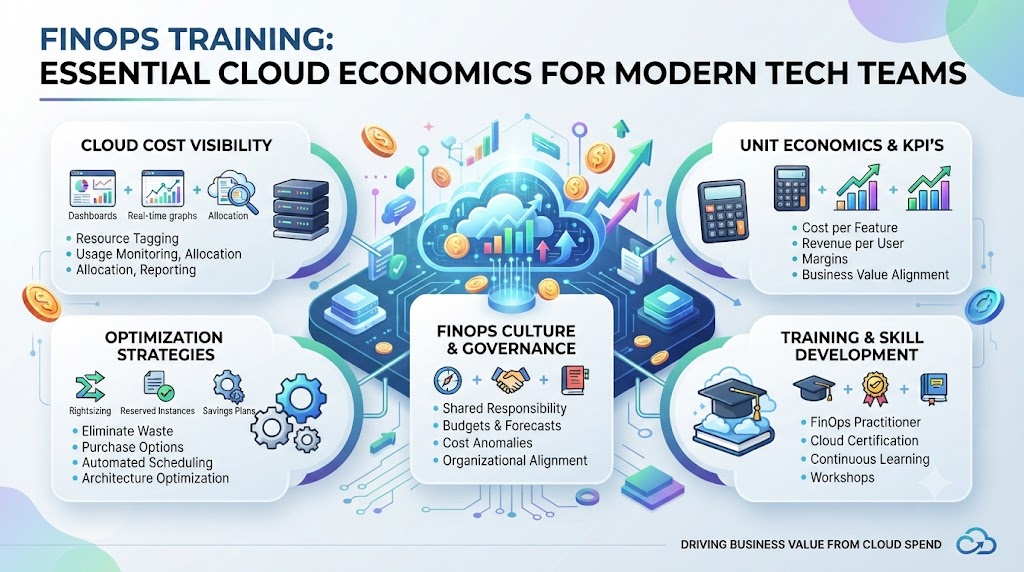
Public cloud infrastructure gives businesses remarkable speed, agility, and scale. However, as organizations expand their cloud footprint across platforms like AWS, Microsoft Azure, and Google Cloud, monthly infrastructure bills frequently outpace revenue growth. Unplanned cloud spending, unallocated resources, and unpredictable billing spikes make it difficult for leadership to maintain financial predictability. Without clear operational processes, engineering teams spin up resources without understanding the financial impact, while finance teams struggle to understand technical line items on monthly invoices.This disconnect creates friction between technical and business units. FinOps, or Cloud Financial Management, addresses this exact challenge by bringing financial accountability to the variable spend model of the cloud. Implementing effective cloud financial management requires practical expertise across culture, tooling, and architecture. Engaging in structured FinOps Training equips technology, operations, and finance teams with the exact skills needed to break down siloes, gain spend visibility, optimize workloads, and maximize the business value of every cloud dollar.
What Is FinOps?
Definition of FinOps
FinOps is an evolving cloud financial management discipline and cultural practice. It enables organizations to get maximum business value by helping engineering, finance, technology, and business teams to collaborate on data-driven spending decisions.
                  +-------------------+
                  |      INFORM       |
                  | (Visibility &     |
                  |   Allocation)     |
                  +---------+---------+
                            |
                            v
+-------------------+               +-------------------+
|      OPERATE      |<------------->|     OPTIMIZE      |
| (Governance &     |               | (Rates, Usage &   |
|   Automation)     |               |   Architectures)  |
+-------------------+               +-------------------+
Why FinOps Matters in Cloud Computing
Traditional IT procurement relied on fixed capital expenditure (CapEx) with strict approval flows. Cloud computing shifts infrastructure spend to an operational expenditure (OpEx) model, allowing engineers to deploy resources instantly. FinOps provides the framework needed to balance this speed with financial discipline.
FinOps and Cloud Financial Management
Cloud Financial Management goes beyond cost cutting. It treats cloud spend as a strategic driver for business growth, focusing on unit economics, velocity, and accountability.
Relationship Between Engineering, Finance, Procurement, and Business Teams
FinOps aligns diverse cross-functional teams:
- Engineering & DevOps: Build scalable systems while managing cost efficiency.
- Finance: Gains predictable forecasting and accurate budget tracking.
- Procurement: Negotiates vendor commitments and enterprise agreements.
- Business Leaders: Understand cloud cost relative to business value and margins.
FinOps Lifecycle
The FinOps process runs as a continuous cycle across three phases:
- Inform: Provide visibility into costs, allocate spend via tagging, and show real-time utilization.
- Optimize: Reduce waste, adjust resource sizes, and leverage commitment-based pricing discounts.
- Operate: Automate cost governance, track key metrics, and integrate cost awareness into daily engineering tasks.
What Is FinOps Training?
Purpose of FinOps Training
FinOps Training bridges the gap between technical operations and financial governance. It teaches professionals how to interpret cloud billing data, establish clear tagging rules, rightsize infrastructure, and build automated cost guardrails.
Skills Developed Through FinOps Training
Key skills acquired through structured learning include:
- Analyzing multi-cloud billing datasets.
- Designing cost allocation structures and showback/chargeback models.
- Managing pricing commitments like Reserved Instances and Savings Plans.
- Configuring cost anomaly alerts and budget limits.
- Collaborating across engineering and finance boundaries.
Who Should Learn FinOps?
FinOps education benefits professionals across several roles:
- Cloud & DevOps Engineers: To design cost-aware cloud architecture.
- Cloud Architects: To select cost-optimal infrastructure designs.
- Finance & Procurement Managers: To understand cloud usage metrics and manage commitment risk.
- Engineering Leaders: To balance delivery speed with budget guardrails.
FinOps Certification
Earning a recognised certification validates an individual’s understanding of cloud financial management principles, core terminology, and operational frameworks. Professionals seek credentials to demonstrate competency in cost visibility, cloud governance, and multi-cloud financial operations.
+-------------------------------------------------------------------+
|                  FINOPS CERTIFICATION PATHWAY                     |
+-------------------------------------------------------------------+
|  FOUNDATION LEVEL                                                 |
|  * FinOps Principles & Culture                                    |
|  * Terminology & Frameworks                                       |
|  * Basic Cost Allocation & Tagging                                |
+-------------------------------------------------------------------+
                                 |
                                 v
+-------------------------------------------------------------------+
|  PRACTITIONER LEVEL                                               |
|  * Advanced Allocation (Showback/Chargeback)                      |
|  * Commitment Management & Forecasting                            |
|  * Anomaly Detection & Policy Governance                          |
+-------------------------------------------------------------------+
                                 |
                                 v
+-------------------------------------------------------------------+
|  ENGINEERING / ARCHITECT LEVEL                                    |
|  * Automated Guardrails & IaC Integration                         |
|  * Container & Kubernetes Cost Allocation                         |
|  * Architectural Rightsizing & Waste Elimination                  |
+-------------------------------------------------------------------+
Preparing for a FinOps Certification helps candidates systematically review crucial topics like chargeback implementation, rate optimization strategies, and governance standards without relying solely on trial and error.
FinOps Course
A well-structured FinOps Course blends theoretical concepts with hands-on practice. Rather than simply reviewing cloud provider documentation, learners interact with simulated billing reports, mock cost allocation scenarios, and real-world optimization workflows.
Core components of a practical curriculum include:
- Cloud billing mechanics and cost drivers.
- Tagging strategies and hierarchy design.
- Building showback and chargeback systems.
- Managing cloud waste and resource rightsizing.
- Configuring automated budget alerts and monitoring anomalies.
FinOps Certification Training
Enrolling in comprehensive FinOps Certification Training gives learners a clear path from foundational concepts to practical application. This training equips candidates with both the conceptual knowledge needed for certification exams and the hands-on experience required in workplace environments.
Key focus areas include:
- Real-world scenario analyses of multi-cloud bill spikes.
- Discount structure evaluations across cloud providers.
- Cross-team governance frameworks that don’t reduce developer speed.
- Exam preparation modules and practice scenario walkthroughs.
Corporate FinOps Training
Enterprises deploying large-scale cloud infrastructure require cross-functional alignment. Corporate FinOps Training brings engineering, platform, finance, and procurement teams together under a unified operational methodology.
Corporate programs focus on enterprise-specific needs:
- Customized training based on an enterprise’s current cloud provider stack.
- Hands-on workshops focused on actual corporate billing structures.
- Establishing organizational tagging frameworks and governance policies.
- Streamlining cross-departmental communications and unit economics tracking.
FinOps Online Training
Flexible learning paths allow remote and distributed teams to build cloud cost management capabilities efficiently. Interactive online training programs provide access to practical materials, live instructor-led sessions, and hands-on exercises without geographic constraints.
Key aspects of effective online learning include:
- Structured online lectures led by industry experts.
- Hands-on exercises simulating cloud billing and optimization tasks.
- Self-paced learning options for working professionals.
- Interactive group discussions resolving practical implementation challenges.
FinOps Training in India
Cloud adoption across tech hubs in India—including Bengaluru, Hyderabad, Pune, and NCR—has surged. As organizations scale their usage of AWS, Azure, and Google Cloud, managing infrastructure costs efficiently has become a top operational priority.
Demand for local expertise in cloud cost visibility, resource allocation, and optimization continues to grow. IT services companies, product startups, and global capability centers (GCCs) in India actively seek professionals capable of managing cloud budgets while maintaining high performance standards.
FinOps Practitioner Training
Practitioner-focused education targets professionals managing cloud financial operations daily. A robust FinOps Practitioner Training program delivers deep instruction on building reports, tracking allocation metrics, and establishing governance controls.
Learners master:
- Designing precise allocation models for shared cloud services.
- Creating meaningful KPI metrics like cost per transaction or unit cost.
- Setting up budget tracking and variance alerts.
- Collaborating across technical and business divisions to maintain fiscal accountability.
FinOps Engineer Training
Engineering teams directly influence cloud expenditures through architectural and code-level decisions. FinOps Engineer Training focuses on technical strategies to embed cost management directly into modern delivery pipelines.
+-------------------------------------------------------------------+
|               TECHNICAL FINOPS PIPELINE INTEGRATION               |
+-------------------------------------------------------------------+
|  1. CODE & ARCHITECTURE                                           |
|     * Terraform / CloudFormation Cost Estimation                  |
|     * Cost-efficient architectural pattern selection              |
+-------------------------------------------------------------------+
                                 |
                                 v
+-------------------------------------------------------------------+
|  2. DEPLOYMENT & TAGGING                                          |
|     * Automated tagging enforcement via CI/CD policies            |
|     * Kubernetes pod-level resource limits & requests             |
+-------------------------------------------------------------------+
                                 |
                                 v
+-------------------------------------------------------------------+
|  3. RUNTIME OPTIMIZATION                                          |
|     * Auto-scaling & scheduled non-production shutdowns           |
|     * Anomaly alerts triggered to Slack / Teams / Jira             |
+-------------------------------------------------------------------+
Technical topics cover:
- Integrating cost estimation into Infrastructure as Code (IaC) workflows.
- Container and Kubernetes cost allocation using open-source tools.
- Enforcing tagging standards via automated CI/CD pipeline checks.
- Configuring automated resource shutdown schedules for dev and test environments.
Cloud Cost Optimization Training
Optimizing cloud infrastructure requires finding the right balance between cost efficiency and technical performance. Specialized Cloud Cost Optimization Training provides engineers with tactics to identify and eliminate waste without creating operational risks.
Core subjects include:
- Identifying idle, underutilized, and orphaned cloud resources.
- Rightsizing compute instances and database nodes based on metric trends.
- Evaluating Savings Plans, Reserved Instances, and Committed Use Discounts.
- Storage tiering, lifecycle policy management, and snapshot cleanup.
- Managing auto-scaling groups and spot instance strategies.
AWS, Azure, and Google Cloud FinOps
Each major cloud platform provides native tools, billing models, and discount mechanisms. Understanding these platform-specific variations is essential for effective multi-cloud financial management.
| Cloud Platform | Core Billing & Visibility Tools | Native Governance Capabilities | Discount & Commitment Models |
| AWS | AWS Cost Explorer, AWS Budgets, Cost & Usage Reports (CUR) | AWS Organizations, AWS Config, Tag Policies | Reserved Instances (RIs), Savings Plans, Spot Instances |
| Microsoft Azure | Azure Cost Management + Billing, Exports | Azure Policy, Management Groups, Resource Tags | Azure Reservations, Savings Plans for Compute |
| Google Cloud | Cloud Billing Reports, BigQuery Billing Export | Resource Hierarchy, Organization Policies, Labels | Committed Use Discounts (CUDs), Preemptible VMs / Spot |
Note: Cloud provider features, terminology, and discount structures change frequently; always consult official provider documentation for current specifications.
FinOps Core Practices
Implementing FinOps successfully relies on several interconnected practices across the cloud lifecycle.
Cost Visibility
Establishing transparent reporting dashboards so all stakeholders understand current spending trends across environments.
Cost Allocation
Assigning 100% of cloud costs to business units, product lines, or teams using structured tagging strategies.
Showback and Chargeback
Providing cost reports to technical teams (showback) or directly billing departments for their cloud usage (chargeback).
Budgeting
Setting clear, realistic budget caps for individual projects, applications, and engineering groups.
Forecasting
Predicting future infrastructure expenditure using historical utilization data and anticipated business growth.
Cost Optimization
Eliminating waste through rightsizing, storage optimization, and strategic discount commitments.
Anomaly Detection
Monitoring billing data continuously to detect and alert on unexpected spending spikes instantly.
Governance
Enforcing organizational guardrails, resource creation policies, and automated compliance checks.
Continuous Improvement
Regularly evaluating metrics, updating unit economics models, and refining cost practices as workloads evolve.
FinOps Tools and Technologies
Tools process cloud billing data and deliver actionable insights, but they work best when paired with solid operational processes.
+-------------------------------------------------------------------+
|                     FINOPS TOOLING ECOSYSTEM                      |
+-------------------------------------------------------------------+
|  NATIVE PROVIDER TOOLS                                            |
|  * AWS Cost Explorer  * Azure Cost Management  * GCP Billing      |
+-------------------------------------------------------------------+
                                 |
                                 v
+-------------------------------------------------------------------+
|  ENTERPRISE & THIRD-PARTY PLATFORMS                               |
|  * CloudHealth  * Apptio Cloudability  * Vantage  * Harness       |
+-------------------------------------------------------------------+
                                 |
                                 v
+-------------------------------------------------------------------+
|  KUBERNETES & AUTOMATION                                          |
|  * Kubecost  * OpenCost  * Infracost  * Cloud Custodian           |
+-------------------------------------------------------------------+
Categories of FinOps tooling include:
- Native Cloud Dashboards: AWS Cost Explorer, Azure Cost Management, GCP Billing.
- Multi-Cloud Enterprise Platforms: Specialized tools providing aggregated multi-cloud analysis.
- Kubernetes Cost Tools: Platforms like Kubecost and OpenCost that break down container costs to the pod and namespace level.
- IaC Cost Estimators: Tools like Infracost that preview infrastructure cost changes inside pull requests.
- Automation Engines: Frameworks like Cloud Custodian that enforce cost governance rules automatically.
FinOps Implementation Process
A structured deployment framework helps organizations establish cloud financial governance step-by-step.
+-------------------+      +-------------------+      +-------------------+
| Step 1: Establish | ---> | Step 2: Define    | ---> | Step 3: Set       |
| Cost Visibility   |      | Ownership & Alloc |      | Budgets & Forecast|
+-------------------+      +-------------------+      +-------------------+
                                                                |
                                                                v
+-------------------+      +-------------------+      +-------------------+
| Step 6: Automate  | <--- | Step 5: Implement | <--- | Step 4: Identify  |
| Cost Controls     |      | Optimization      |      | Cloud Waste       |
+-------------------+      +-------------------+      +-------------------+
          |
          v
+-------------------+
| Step 7: Continuous|
| Monitoring & Eval |
+-------------------+
- Establish Cloud Cost Visibility: Connect cloud provider billing accounts to centralized analytics tools.
- Define Ownership and Allocation: Develop an organizational tagging policy to attribute costs to teams.
- Set Budgets and Forecasts: Establish realistic spending baselines and alert thresholds for project teams.
- Identify Waste: Scan infrastructure for unattached storage disks, idle instances, and obsolete snapshots.
- Implement Optimization: Apply rightsizing recommendations and purchase appropriate commitment discounts.
- Automate Cost Controls: Configure auto-stopping schedules for non-production environments and enforce tagging at build time.
- Monitor and Improve Continuously: Review unit economics metrics regularly to refine processes over time.
Common FinOps Mistakes
Avoiding common implementation mistakes helps organizations establish effective cost control faster.
- Treating FinOps as purely a finance function: Engineering must own cost optimization decisions, as they build and manage the architecture.
- Focusing solely on cost cutting: Cutting costs indiscriminately can negatively impact application performance and user experience.
- Inconsistent tagging standards: Incomplete or unstandardized tagging leaves significant cloud spending unallocated.
- Ignoring anomaly monitoring: Relying on end-of-month invoice reviews allows small misconfigurations to run up large bills.
- Over-committing on savings options: Purchasing long-term discount plans without evaluating workload longevity can lock organizations into unnecessary spend.
- Relying entirely on tools over process: Software tools highlight spend data, but cross-team collaboration drives actual optimization actions.
Benefits of FinOps Training
Participating in professional FinOps education provides clear advantages for individuals and organizations alike:
- Improved Cost Visibility: Gain deep insights into multi-cloud expenditures and usage trends.
- Better Cross-Functional Alignment: Establish a shared language between technical, financial, and executive teams.
- Waste Reduction: Identify idle resources and optimize workloads systematically.
- Proactive Anomaly Prevention: Catch spending spikes early before monthly invoices arrive.
- Data-Driven Decision Making: Evaluate cloud investments based on unit metrics and business value.
- Skill Diversification: Build high-demand technical capabilities across cloud cost architecture and financial governance.
How to Choose FinOps Training
Selecting the right training program ensures you acquire practical, real-world capabilities. Evaluate prospective courses using the following criteria:
- Curriculum Depth: Look for courses covering allocation, commitment management, governance, and multi-cloud scenarios.
- Hands-On Learning: Ensure the program includes real billing analysis exercises and practical scenario walkthroughs.
- Role-Specific Focus: Select tracks tailored to your role, whether technical (engineering) or strategic (finance and leadership).
- Expert Instructors: Learn from experienced practitioners who have managed real-world cloud financial operations.
- Certification Alignment: Check if the curriculum aligns with recognised professional credentials.
FinOpsSchool.com Service Fit
FinOpsSchool offers focused educational resources tailored to diverse organizational roles and career goals:
- For Cloud & DevOps Engineers: Practical technical tracks such as FinOps Engineer Training focus on container cost allocation, IaC cost integration, and policy automation.
- For Finance & Procurement Teams: Structured modules cover cloud billing models, commitment management, and forecasting precision.
- For Enterprises & Teams: Tailored Corporate FinOps Training aligns engineering and financial units around shared operational goals and customized governance frameworks.
- For Career Advancement: Focused preparation programs help professionals earn recognised industry certifications.
Frequently Asked Questions (FAQs)
- What is FinOps Training?
FinOps Training is an educational program that teaches professionals how to manage cloud financial operations effectively. It covers cloud spend visibility, cost allocation, rightsizing infrastructure, managing commitment discounts, and establishing collaboration between engineering, finance, and operations teams. - Why is FinOps Certification valuable for IT professionals?
A FinOps Certification validates an individual’s understanding of cloud financial management principles, core terminology, and governance practices. It demonstrates competency in optimizing cloud spend, making certified professionals valuable assets to enterprise cloud teams. - What topics are covered in a comprehensive FinOps Course?
A thorough FinOps Course covers cloud billing structures, tagging strategies, showback and chargeback models, rightsizing techniques, commitment management, Kubernetes cost allocation, budget alerting, anomaly detection, and automated cost governance. - How does FinOps Certification Training help prepare for exams?
FinOps Certification Training combines theoretical principles with scenario-based practice questions, billing analysis walkthroughs, and real-world case studies to prepare candidates thoroughly for official certification exams. - What are the benefits of Corporate FinOps Training for enterprises?
Corporate FinOps Training brings engineering, finance, platform, and procurement teams together under a unified cost management model. It helps enterprises establish consistent tagging rules, custom governance policies, and cross-departmental accountability tailored to their cloud architecture. - Are FinOps Online Training courses interactive?
Yes, high-quality FinOps Online Training programs offer live instructor-led sessions, interactive billing walkthroughs, and practical exercises that let distributed teams learn cloud cost management concepts remotely. - Why is demand for FinOps Training in India growing?
As enterprise cloud adoption rapidly expands across tech hubs in India, organizations face rising infrastructure bills. Local demand is surging for professionals who can manage multi-cloud spending, optimize infrastructure, and enforce cloud cost governance. - Who should attend FinOps Practitioner Training?
FinOps Practitioner Training is designed for cloud managers, finance analysts, system administrators, and technology leads who oversee day-to-day cloud budgets, allocation reporting, and cost management workflows. - How does FinOps Engineer Training differ from general cloud training?
FinOps Engineer Training focuses specifically on the technical mechanics of cost optimization. It teaches engineers how to track container costs, automate guardrails, integrate cost estimation into IaC tools, and optimize infrastructure architectures. - What is covered in Cloud Cost Optimization Training?
Cloud Cost Optimization Training focuses on identifying and eliminating cloud waste. Topics include instance rightsizing, storage lifecycle rules, managing Reserved Instances and Savings Plans, auto-scaling configuration, and setting up automated anomaly detection. - What tools are typically used during FinOps implementation?
Organizations use native provider tools (AWS Cost Explorer, Azure Cost Management, GCP Billing), specialized multi-cloud platforms, container cost tracking tools (Kubecost, OpenCost), and automation frameworks (Cloud Custodian, Infracost) to manage spend. - How does FinOps improve collaboration between finance and engineering?
FinOps establishes a common language and shared metrics between teams. Finance gains predictable spend data and accurate unit costs, while engineering gets clear spend visibility and guidelines without losing operational speed.
Conclusion
Managing cloud infrastructure efficiently requires balancing rapid technical innovation with strict financial control. As multi-cloud deployments expand, relying on traditional procurement models or end-of-month invoice reviews leads to unexpected costs and organizational friction. FinOps establishes a modern operational model built on transparency, shared responsibility, and continuous improvement.Investing in structured Cloud Cost Optimization Training gives technical and business teams the expertise needed to implement robust tagging systems, eliminate infrastructure waste, and manage cloud commitments effectively. With clear visibility, proactive governance, and cross-functional alignment, organizations can control cloud spending while accelerating innovation.