Introduction
Navigating the legal landscape in India can feel overwhelming. Whether you are an individual dealing with a property dispute, an entrepreneur launching a startup, a victim of online financial fraud, or a family handling a delicate matrimonial matter, knowing where to turn is critical. The Indian legal system operates across multiple judicial levels—from District and Session Courts to High Courts and the Supreme Court of India—each governed by distinct procedural and substantive laws.This guide provides a comprehensive overview of how to understand your legal needs, identify specialized lawyers, avoid common pitfalls, and leverage digital tools like WakilSahab—a platform designed for legal discovery and verified legal information in India.
Understanding Legal Practice Areas in India
Legal matters in India are broadly classified under several legal domains. Choosing a practitioner who specializes in the specific area relevant to your situation ensures better strategy, procedural efficiency, and accurate guidance.
                    ┌────────────────────────────────────────┐
                    │    Main Categories of Indian Law       │
                    └───────────────────┬────────────────────┘
                                        │
     ┌──────────────────┬───────────────┼───────────────┬──────────────────┐
     ▼                  ▼               ▼               ▼                  ▼
┌──────────┐      ┌───────────┐   ┌───────────┐   ┌───────────┐     ┌─────────────┐
│ Criminal │      │ Civil &   │   │  Family   │   │ Corporate │     │ Cybercrime  │
│   Law    │      │ Property  │   │   Law     │   │   Law     │     │   & Tech    │
└──────────┘      └───────────┘   └───────────┘   └───────────┘     └─────────────┘
Criminal Law
Criminal law deals with offenses against the state or public order, governed primary by procedural codes and criminal statutes. Matters range from bailable and non-bailable offenses, filing of First Information Reports (FIR), anticipatory bail applications, police investigations, to criminal trial proceedings.
Civil and Property Law
Civil law addresses private disputes between individuals, organizations, or entities. Property law, a key branch of civil practice, handles title verification, land disputes, partition suits, boundary conflicts, tenant-landlord disagreements, and drafting agreements such as sale deeds and lease contracts.
Family and Matrimonial Law
Family law governs domestic relationships, including divorce proceedings (mutual consent or contested), child custody, alimony, maintenance applications under criminal and civil provisions, domestic violence matters, and estate inheritance.
Corporate and Commercial Law
Corporate law caters to businesses, startups, and commercial entities. Practice areas encompass company incorporation, statutory compliance under the Ministry of Corporate Affairs (MCA), contract drafting, non-disclosure agreements (NDAs), intellectual property registration, tax law, and labor compliance.
Cybercrime and Digital Law
With the rapid digitalization of finance and communication, cyber law covers online financial fraud, identity theft, unauthorized data access, cyber harassment, and breaches governed by the Information Technology Act.
Comparative Analysis of Legal Domains
To better understand which legal specialist aligns with your specific scenario, refer to the breakdown below:
Table 1: Legal Practice Areas and Suitability
| Legal Field | Primary Focus & Statutes | Common Legal Documents | Suitable For |
| Criminal Law | Offenses, Police Complaints, Bail, Trials | FIR, Bail Applications, Charge-sheets | Individuals facing criminal allegations, complainants |
| Civil & Property Law | Land Titles, Partition, Property Contracts | Sale Agreements, Property Deeds, Legal Notices | Property buyers, sellers, landlords, heirs, landowners |
| Family Law | Matrimonial Disputes, Custody, Maintenance | Divorce Petitions, Custody Applications | Spouses, parents, family members seeking legal resolution |
| Corporate Law | Business Contracts, Compliance, IP | Founders’ Agreements, Employment Contracts, NDAs | Startups, small businesses, corporate entities |
| Cyber Law | Cyber Fraud, Hacking, Data Breach | Cyber Cell Complaints, Information Reports | Victims of financial scams, identity theft, data leakage |
Why Professional Legal Guidance Matters
Attempting to resolve legal conflicts using informal internet searches or generic advice from acquaintances can lead to costly mistakes. The Indian legal framework relies heavily on procedural timelines, statutory deadlines, jurisdiction rules, and precise documentation.
Consulting a qualified advocate ensures:
- Procedural Accuracy: Submitting petitions, replies, or notices in the correct format and court jurisdiction.
- Risk Mitigation: Identifying hidden liabilities in commercial or property contracts before signing.
- Objective Assessment: Receiving an unbiased evaluation of the strengths and weaknesses of your legal position.
- Protection of Rights: Ensuring statutory remedies—such as filing an anticipatory bail or securing an interim injunction—are exercised in time.
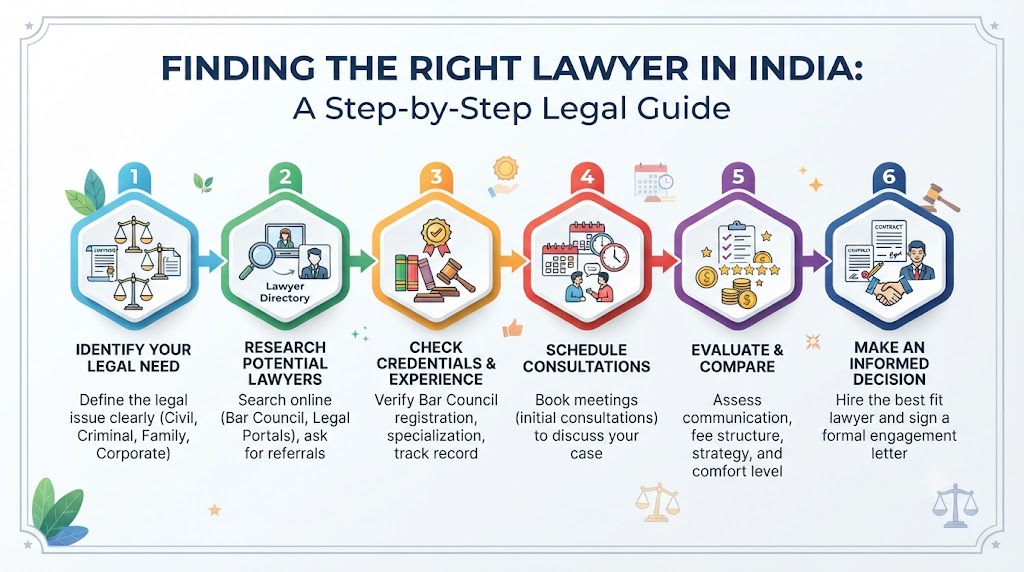
How to Choose the Right Lawyer in India
Selecting an advocate requires assessing more than just location. Consider these foundational criteria:
                  ┌──────────────────────────────────────────────┐
                  │   Key Factors When Selecting an Advocate     │
                  └──────────────────────┬───────────────────────┘
                                         │
    ┌─────────────────┬──────────────────┼──────────────────┬─────────────────┐
    ▼                 ▼                  ▼                  ▼                 ▼
┌───────┐     ┌───────────────┐  ┌───────────────┐  ┌───────────────┐  ┌──────────────┐
│ Domain│     │ Court & City  │  ┌ Communication │  │ Fee Structure │  │ Professional │
│ Focus │     │ Experience    │  │ & Transparency│  │ & Retainers   │  │ Standing     │
└───────┘     └───────────────┘  └───────────────┘  └───────────────┘  └──────────────┘
- Domain Specialization: Ensure the professional frequently handles matters matching your legal category.
- Court and Jurisdictional Experience: Practice in specific tribunals, District Courts, or High Courts provides valuable familiarity with local court administrative procedures.
- Communication and Accessibility: A good legal professional explains complex terms clearly and provides realistic timelines.
- Transparent Fee Structures: Clarify whether professional fees are charged per consultation, per hearing, or as a flat engagement fee.
- Bar Council Registration: Verify that the advocate is enrolled with a recognized State Bar Council.
Comparing Lawyer Consultation Methods
Modern legal discovery allows individuals to seek preliminary information online or meet advocates in person. Both avenues offer distinct operational advantages.
Table 2: Online Lawyer Consultation vs. In-Person Meetings
| Parameter | Online Lawyer Consultation | In-Person Lawyer Meeting |
| Best Used For | Initial advice, document review, preliminary legal strategy | Trial preparation, physical document signing, complex court filing |
| Convenience | High (accessible anywhere across India or for NRIs) | Requires travel to chambers or court premises |
| Preparation Needed | Digital scans of documents, typed summary timeline | Physical file folders, hard copies of evidence |
| Geographic Reach | Consult specialists outside your city or state | Restricted to local advocates near your court jurisdiction |
| Typical Cost | Often structured as flat-fee timed sessions | Varies; may include retainer or per-visit fee |
Steps in Common Legal Processes
Whether dealing with a civil dispute or criminal procedure, key stages exist across most legal matters in India.
Table 3: Common Legal Processes Comparison
| Legal Category | Initial Step | Intermediate Step | Final Objective |
| Criminal Matter | Filing an FIR / Complaint or seeking Bail | Police Investigation / Charge-sheet submission | Court Trial & Final Judgment |
| Civil/Property Dispute | Issuing a Formal Legal Notice | Filing a Plaint in Court & Written Statement | Decree or Injunction Order |
| Matrimonial Dispute | Counseling / Mediation / Petition Filing | Evidence Filing & Arguments | Decree of Divorce / Settlement Order |
| Business Contract | Term Sheet / Negotiation | Drafting & Reviewing Specific Clauses | Execution / Stamp Duty Signing |
Online Legal Consultation: What to Prepare
To make the most of an online lawyer consultation in India, adequate preparation is necessary. Legal professionals rely on factual records rather than emotional summaries.
                  ┌──────────────────────────────────────────────┐
                  │ Checklist: Preparing for Online Consultation  │
                  └──────────────────────┬───────────────────────┘
                                         │
    ┌─────────────────┬──────────────────┼──────────────────┬─────────────────┐
    ▼                 ▼                  ▼                  ▼                 ▼
┌─────────┐     ┌───────────┐      ┌───────────┐      ┌───────────┐     ┌───────────┐
│ Timeline│     │ Core File │      │ Written   │      │ Key       │     │ Clear     │
│  Draft  │     │ Documents │      │  Notices  │      │ Questions │     │ Objectives│
└─────────┘     └───────────┘      └───────────┘      └───────────┘     └───────────┘
- Chronological Timeline: Write a brief, factual event sequence with relevant dates.
- Primary Documents: Organize copies of contracts, deeds, notices, police complaints, or email threads.
- Specific Questions: List clear queries (e.g., “What is the statutory response period for this legal notice?” or “What are the valid grounds for bail in this matter?”).
- Clear Goals: Define what outcome you are seeking—such as an out-of-court settlement, drafting a reply, or filing a suit.
Understanding Legal Costs in India
Legal expenses in India vary based on several factors:
- Seniority and Reputation: Highly experienced practitioners or senior counsel typically charge higher consultation and appearance fees.
- Nature of Matter: Complex corporate litigation or disputed land titles involve higher workloads than simple contract drafting.
- Court Forum: Representation before High Courts or the Supreme Court incurs different cost structures compared to District or Magistrate Courts.
- Scope of Engagement: Services can be structured per-hearing, per-draft, or through ongoing monthly retainers for corporate clients.
10 Common Mistakes to Avoid
When handling legal matters, individuals often make predictable errors that complicate proceedings.
- Delaying Action: Waiting until statutory limitation periods expire or court deadlines pass.
- Hiding Relevant Facts: Failing to disclose key information or adverse documents to your advocate.
- Ignoring Written Notices: Suppressing or ignoring formal legal or police notices instead of issuing a timely reply.
- Selecting Solely Based on Lowest Cost: Choosing representation based on cheap fees rather than relevant practice expertise.
- Relying on Social Media Advice: Following generic legal opinions posted on discussion forums or social networks.
- Failing to Preserve Evidence: Deleting text messages, emails, financial receipts, or call logs pertinent to a dispute.
- Signing Unread Documents: Signing settlement agreements, deeds, or affidavits without thorough review.
- Bypassing Specialization: Engaging a corporate attorney for a complex criminal trial or vice versa.
- Neglecting Written Records: Agreeing to financial or property settlements verbally without formal written documentation.
- Confusing Legal Information with Legal Advice: Expecting general blog guides or articles to replace case-specific evaluation by an advocate.
Expert Tips for Working with Advocates
Establishing an effective working relationship with your legal counsel leads to better case management.
- Maintain a Case File: Keep digital and physical copies of all filed petitions, orders, and correspondence.
- Respect Timelines: Provide requested documents well in advance of court filing deadlines.
- Focus on Facts: Present clear, verified facts rather than assumptions or unverified hearsay.
- Clarify Professional Fees Early: Ensure clear agreement on consultation, drafting, and appearance fees.
- Ask for Written Drafts: Review affidavits and legal notices carefully before signing or authorizing their dispatch.
Best Practices for Legal Decision-Making
Following systematic best practices protects your rights and minimizes legal risks:
- Verify Enrolment: Confirm your advocate’s practice standing via local Bar Associations or directory resources.
- Prioritize Early Consultation: Seek legal guidance at the initial stage of a dispute rather than mid-litigation.
- Establish Secure Communications: Keep sensitive communications regarding disputes private and documented.
- Understand the Judicial Forum: Know which court, tribunal, or authority holds proper jurisdiction over your matter.
- Consider Mediation: Evaluate whether out-of-court settlement or alternative dispute resolution (ADR) is viable for civil or family matters.
The Future of Digital Legal Discovery in India
Digitalization is reshaping how individuals interact with the Indian legal ecosystem. Historically, finding an advocate relied on personal word-of-mouth recommendations, often limiting choices by geography and practice awareness.
Modern discovery platforms and legal tech initiatives are streamlining this access by providing:
- Structured Directory Listings: Categorizing advocates by practice area, location, court experience, and language.
- Virtual Consultations: Enabling initial opinions without requiring initial physical visits to legal chambers.
- Legal Information Portals: Educating citizens on fundamental legal rights, procedural basics, and regulatory compliance.
Platforms facilitating these services improve access while maintaining legal and ethical standards in professional discovery.
Why Explore WakilSahab for Legal Discovery
When facing a legal inquiry, accessing reliable, organized information is essential. WakilSahab functions as an online legal discovery and information platform in India, connecting users with resources and professional insights.
Through WakilSahab, users can:
- Browse Categorized Listings: Search for legal professionals across criminal, family, property, corporate, and cyber law.
- Filter by Location: Locate advocates experienced in specific district courts, cities, or states.
- Access Legal Educational Content: Read structured articles explaining legal concepts, notice procedures, and statutory compliance.
- Schedule Preliminary Consultations: Connect with qualified legal practitioners for online or in-person guidance.
By bridging information gaps, WakilSahab supports informed legal decision-making for individuals, families, and businesses across India.
Frequently Asked Questions (15 FAQs)
Q1: How can I find a verified lawyer near me in India?
You can find an advocate near you by utilizing structured legal discovery platforms like WakilSahab, consulting local Bar Association directories, or seeking professional recommendations based on the specific practice area required for your case.
Q2: How does an online lawyer consultation work in India?
An online lawyer consultation involves selecting an advocate specialized in your matter, uploading digital copies of relevant documents, and discussing your legal query via video or audio call to receive preliminary guidance and strategic direction.
Q3: What factors should I evaluate when choosing an advocate?
Key factors include the advocate’s specialization, years of practice, court experience, transparent fee structure, communication style, and familiarity with the specific legal issue you are facing.
Q4: When should I consult a criminal lawyer near me?
You should consult a criminal lawyer immediately if you receive a police summons, face criminal allegations, need to file a First Information Report (FIR), or require urgent relief such as anticipatory or regular bail.
Q5: When is the right time to contact a divorce lawyer?
It is advisable to consult a family law practitioner when experiencing irretrievable marital breakdown, considering mutual consent divorce, dealing with child custody disputes, or requiring formal guidance on maintenance rights.
Q6: Why is title verification important when consulting a property lawyer?
Title verification conducted by a property advocate ensures the real estate being purchased has a clear ownership record, is free from legal encumbrances, and is safe for financial transactions or execution of sale deeds.
Q7: What does a cyber crime lawyer do?
A cyber crime advocate assists victims of online financial scams, identity theft, data breaches, and cyber harassment by preparing complaints for the National Cyber Crime Reporting Portal and representing clients before law enforcement and courts.
Q8: How can a corporate lawyer assist my startup in India?
A corporate lawyer assists startups with business incorporation, drafting shareholder and employment contracts, ensuring regulatory compliance with the Ministry of Corporate Affairs, and safeguarding intellectual property rights.
Q9: Are online legal consultations as effective as in-person meetings?
Online consultations are highly effective for preliminary legal advice, document review, and understanding procedural options. Complex trial preparations or document executions may subsequently require in-person meetings.
Q10: What is the main benefit of using a legal directory in India?
A legal directory like WakilSahab allows users to search, filter, and compare legal professionals based on practice area, geographic location, court jurisdiction, and language, simplifying the discovery process.
Q11: What documents should I organize before meeting a lawyer?
Organize a chronological summary of events, legal notices received or sent, official identification, contracts, financial statements, emails, or police reports relevant to your legal matter.
Q12: How do advocates in India structure their consultation fees?
Advocates may charge fixed fees per consultation session, hourly rates, flat fees per court appearance, or ongoing monthly retainers depending on the nature and complexity of the legal work.
Q13: What is the difference between general legal information and personalized legal advice?
Legal information provides general educational explanations of laws and legal processes. Legal advice applies legal principles to an individual’s specific factual situation to recommend concrete legal courses of action.
Q14: Is it beneficial to seek a second legal opinion on a case?
Yes, seeking a second legal opinion can provide fresh perspective on complex litigation, evaluate existing legal strategies, and confirm the viability of proposed settlements or court appeals.
Q15: Can I get free legal advice online in India?
While general educational information and legal guides are available online for free on platforms like WakilSahab, case-specific advice generally requires a formal consultation with a licensed legal practitioner.
16. Conclusion
Understanding your legal rights and navigating court procedures in India does not have to be an intimidating journey. Whether dealing with personal family matters, property verification, business contracts, or urgent criminal proceedings, early awareness and timely professional counsel remain your strongest assets.By assessing your specific needs, evaluating advocates based on specialization and court experience, avoiding common procedural mistakes, and preparing thoroughly for consultations, you can make clear, confident decisions. Digital discovery resources play a pivotal role in democratizing access to verified legal knowledge across the country.