Meta Description: Master your ACL recovery with our comprehensive guide. Learn about rehabilitation phases, physical therapy milestones, and tips on how to recover from ACL surgery safely and effectively with BestOrthoHospitals.com.An Anterior Cruciate Ligament (ACL) injury is often a life-changing event, especially for active individuals and athletes. The road to recovery following ACL reconstruction surgery is a journey that requires significant dedication, patience, and professional guidance. While the surgery itself is the first step, the quality of your rehabilitation dictates your ultimate success and the long-term health of your knee.Understanding how to recover from ACL surgery is essential for managing expectations and staying motivated throughout the months of physical therapy. Whether you are aiming to return to high-impact sports or simply wish to regain full function in your daily life, a structured approach is your most reliable path to recovery.At BestOrthoHospitals, we help patients explore orthopedic hospitals, connect with leading sports injury specialists, compare rehabilitation services, and access the latest resources to make informed healthcare decisions. In this comprehensive guide, we will break down the recovery timeline, essential exercises, and the mindset required for a triumphant return to your active lifestyle.
Understanding ACL Injuries
The ACL is a vital ligament in the center of the knee that provides stability, especially during pivoting, cutting, or jumping movements. When this ligament is torn—often due to sudden changes in direction or direct impact—the knee becomes unstable. ACL reconstruction surgery replaces the torn ligament with a graft (taken from your own tissue or a donor) to restore the knee’s mechanical integrity.
Why Rehabilitation Is Critical After ACL Surgery
Surgery repairs the hardware, but rehabilitation restores the software. Without rigorous physical therapy, the knee muscles (quadriceps and hamstrings) can atrophy rapidly, leading to stiffness, instability, and a much higher risk of reinjury. A structured rehabilitation program ensures that you not only heal the surgical site but also re-learn how to move with proper biomechanics.
ACL Recovery Timeline
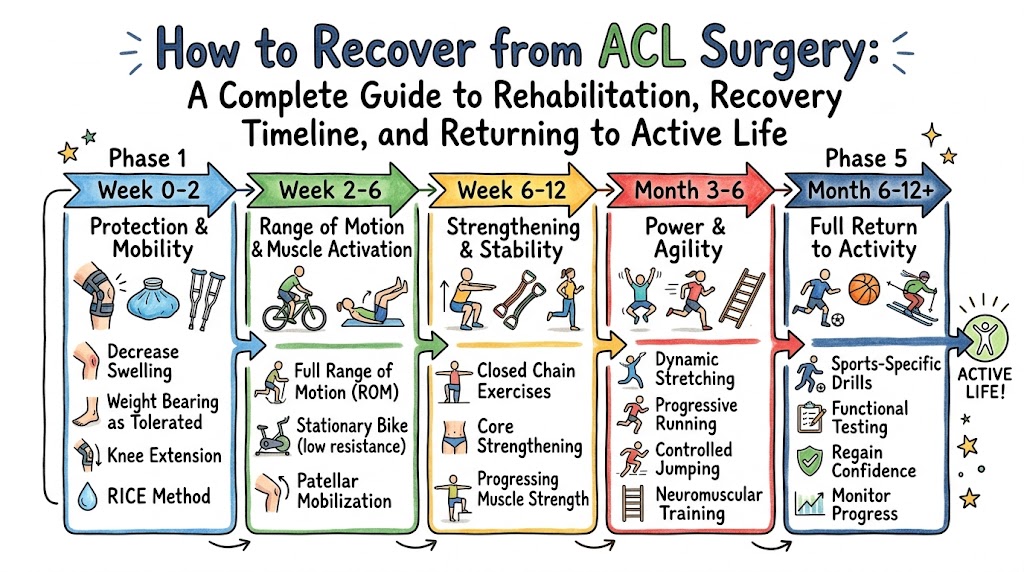
Recovery is divided into distinct phases, each with specific biological and functional goals.
Table 1: ACL Recovery Timeline
| Recovery Phase | Timeframe | Main Goals |
| Protection | Weeks 1–2 | Control swelling, regain full extension. |
| Early Rehab | Weeks 3–6 | Normalize gait, increase range of motion. |
| Strengthening | Months 2–3 | Rebuild quad and hamstring strength. |
| Agility | Months 3–6 | Begin impact training, improve balance. |
| Return to Sport | Months 6–9+ | Sports-specific drills, full confidence. |
Immediate Recovery After Surgery (First 2 Weeks)
The primary focus during the first 14 days is protecting the graft and reducing inflammation.
- Swelling Control: Use the R.I.C.E. method (Rest, Ice, Compression, Elevation).
- Full Extension: Achieving complete straightening of the knee is the most important milestone in early recovery.
- Muscle Activation: Gentle quadriceps contractions (quad sets) to prevent muscle “shutting down.”
Importance of Physical Therapy
Physical therapy (PT) is the engine of your recovery. A skilled therapist will tailor exercises to your specific progress, ensuring you don’t advance too quickly and compromise the graft, or too slowly, which can lead to stiffness.
Table 2: Physical Therapy Milestones
| Stage | Recommended Activities | Expected Outcomes |
| Phase 1 | Passive range of motion, isometric contractions. | 0° extension, minimal swelling. |
| Phase 2 | Stationary cycling, closed-chain exercises. | Normal walking gait, increased ROM. |
| Phase 3 | Lunges, squats, balance work. | Balanced strength in both legs. |
| Phase 4 | Plyometrics, jumping, agility drills. | Confidence in high-impact movements. |
Pain and Swelling Management
Pain is your body’s way of telling you that something is wrong. Manage it by:
- Adhering to Medication: Do not wait for pain to become severe before taking prescribed anti-inflammatories.
- Consistent Icing: Use an ice pack for 15–20 minutes every few hours.
- Elevation: Keep your knee above the level of your heart to drain excess fluid.
Nutritional Support for Faster Recovery
Your body needs high-quality fuel to rebuild tissue.
- Protein: Essential for muscle repair; prioritize lean meats, legumes, and Greek yogurt.
- Collagen & Vitamin C: Supports the structural integrity of the healing graft.
- Anti-Inflammatory Foods: Incorporate omega-3 fatty acids (fish oil, walnuts) to reduce systemic inflammation.
Warning Signs That Require Medical Attention
Table 3: Warning Signs During Recovery
| Symptom | Possible Concern | Action Required |
| Fever > 101°F | Infection at incision site. | Contact Surgeon immediately. |
| Calf Pain/Tenderness | Potential DVT (Blood Clot). | Emergency care required. |
| Increased Heat/Redness | Potential localized infection. | Contact Surgeon immediately. |
| Sudden Pop in Knee | Possible graft compromise. | Consult PT or Surgeon. |
Returning to Sports Safely
Returning to sports is not just about time; it is about objective physical readiness.
Table 4: Return-to-Sport Readiness Checklist
| Requirement | Importance | Assessment Method |
| Strength Symmetry | Prevents muscle imbalance. | Hop testing compared to healthy leg. |
| Dynamic Stability | Ensures knee doesn’t buckle. | Functional movement analysis. |
| Psychological Readiness | Prevents “fear of reinjury.” | Standardized readiness questionnaires. |
Common Mistakes Patients Should Avoid
- Skipping PT Sessions: Physical therapy is non-negotiable; missing sessions sets you back weeks.
- Rushing the Timeline: “Being a hero” and jumping back into sports too early is the leading cause of graft failure.
- Ignoring Pain: Pushing through sharp pain can lead to tendonitis or graft stress.
- Neglecting the “Good” Leg: You must maintain fitness in your uninjured limb to keep overall athletic performance high.
Psychological Recovery After ACL Surgery
The psychological toll of an ACL tear is often underestimated. Many athletes experience “kinesiophobia”—the fear of movement.
- Visualize Success: Mental imagery can help keep neural pathways for movement active.
- Set Micro-Goals: Focus on the next milestone (e.g., reaching 90 degrees of flexion) rather than the long road to return-to-sport.
- Stay Connected: Engage with your team or fitness community to prevent feelings of isolation.
Frequently Asked Questions
- How long until I can walk without crutches? Usually 2–4 weeks, depending on your surgeon’s protocol.
- Is surgery painful? The first few days are uncomfortable, but well-managed with medication.
- Can I drive after ACL surgery? Only when you are off pain meds and can safely operate pedals (usually 4–6 weeks for right knee).
- When will the swelling go down? Expect some swelling for 3–6 months.
- What is a graft? It’s the tissue used to replace your torn ACL.
- Does PT hurt? It should be challenging, but sharp, shooting pain should be reported.
- Can I return to soccer/basketball? Yes, typically after 9–12 months.
- Will I need a brace? Your surgeon may recommend a brace for high-impact sports initially.
- What if I miss a PT exercise? Don’t double up; just resume your routine the next day.
- How do I prevent muscle atrophy? Through consistent, early quad-activation exercises.
- Can I sleep in any position? Initially, keep the leg straight; pillows help.
- Is it normal to hear clicking in the knee? Minor clicking is normal; sharp pain or locking is not.
- Do I need special shoes? During rehab, wear supportive, stable sneakers.
- How do I manage stiffness? Consistent, gentle range-of-motion exercises.
- Will I have permanent arthritis? A rigorous rehab program reduces this risk.
- Is weight training safe? Yes, under the guidance of your therapist.
- Can I return to work? Sedentary jobs can often be resumed in 1–2 weeks.
- Why is extension so important? Lack of extension leads to a permanent limp.
- What if the graft fails? Revision surgery is an option, but success rates are lower than primary surgery.
- Where can I find top surgeons? Visit BestOrthoHospitals.com to find experts.
Conclusion
The path to overcoming an ACL injury is undeniably demanding. It requires a commitment to physical therapy that often lasts for months, combined with the patience to let your body heal at its biological pace. However, by understanding how to recover from ACL surgery through a structured, phase-based approach, you can transform this challenge into a triumph of resilience. Remember that the goal is not just to “get back” to where you were, but to build a knee that is stronger, more stable, and more resilient than it was before the injury.Success in recovery is built on the foundations of consistency and communication. Listen to the feedback from your physical therapist, monitor your swelling, and celebrate the small wins—whether it’s achieving an extra five degrees of knee flexion or hitting a new personal best on your leg press. These milestones are the building blocks of your return to full activity. It is equally important to address the psychological aspects of recovery; fear of reinjury is a real hurdle, but it is one you can overcome with gradual, confident progression and consistent exposure to controlled, sports-specific movements.