Introduction
Your spine is the structural foundation of your body, supporting your posture, protecting your spinal cord, and enabling your mobility. When spinal health is compromised due to injury, aging, or underlying conditions, it can lead to persistent pain and reduced functionality. Understanding the nature of spinal disorders—and the advancements in modern orthopedic care—is the first step toward regaining your comfort and quality of life.Early diagnosis and a comprehensive approach to treatment are essential for managing spinal health effectively. Whether you are dealing with chronic pain or a recent injury, partnering with an experienced orthopedic team can help you navigate your options, from conservative physical therapy to advanced surgical interventions. For those beginning their research, BestOrthoHospitals provides vital resources to help you understand orthopedic standards and compare leading institutions dedicated to specialized spine care.
Understanding the Spine
The human spine is a complex column of bones (vertebrae) separated by protective, shock-absorbing discs. It is divided into five regions, each supporting different levels of movement and weight.
SPINE OVERVIEW TABLE
| Aspect | Description |
| Body System | Musculoskeletal and Nervous system |
| Main Functions | Structural support, movement, nerve protection |
| Spine Regions | Cervical, Thoracic, Lumbar, Sacral, Coccygeal |
| Supporting Structures | Muscles, ligaments, tendons, discs, joints |
| Overall Goal | Maintaining alignment, flexibility, and nerve health |
Common Spinal Disorders
SPINAL DISORDERS TABLE
| Disorder | Description | Common Symptoms |
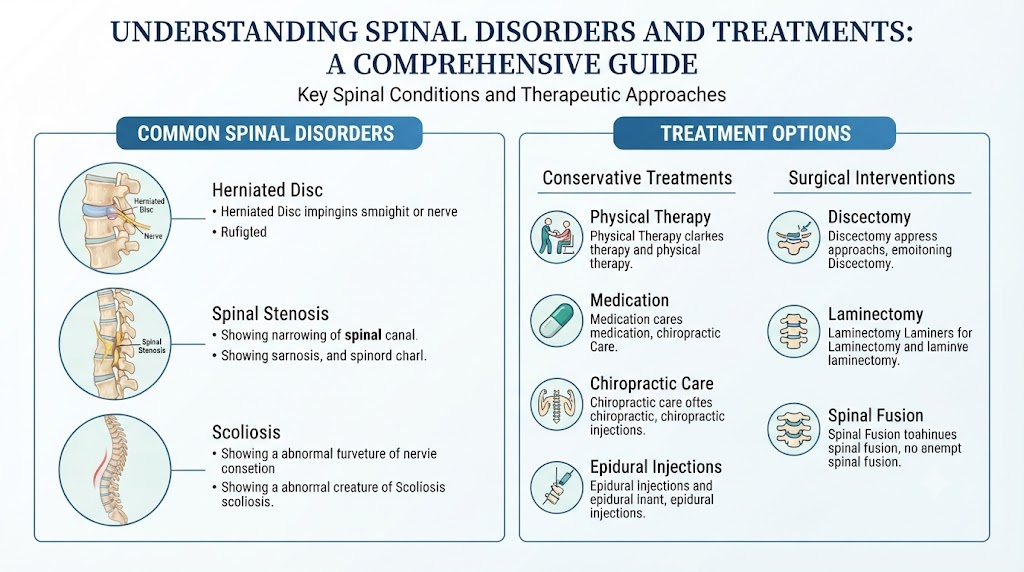
| Herniated Disc | Inner disc material presses on nerves | Radiating pain, numbness |
| Spinal Stenosis | Narrowing of the spinal canal | Leg pain, cramping when walking |
| Degenerative Disc | Natural wear and tear of discs | Chronic stiffness, mild pain |
| Scoliosis | Abnormal lateral curvature of the spine | Uneven posture, back pain |
| Sciatica | Irritation of the sciatic nerve | Sharp, shooting leg pain |
| Cervical Spondylosis | Age-related degeneration of neck discs | Neck pain, headaches, weakness |
Common Symptoms
SYMPTOMS TABLE
| Symptom | Possible Cause | Medical Evaluation? |
| Back Pain | Muscle strain or disc issues | Yes, if persistent |
| Neck Pain | Cervical strain or spondylosis | Yes, if persistent |
| Leg Pain | Nerve compression (Sciatica) | Yes |
| Numbness | Nerve irritation | YES |
| Tingling | Nerve compression | YES |
| Weakness | Significant nerve/muscle damage | YES |
Risk Factors
RISK FACTORS TABLE
| Risk Factor | Why It Increases Risk | Modifiable? |
| Aging | Natural tissue degradation | No |
| Obesity | Increased load on the spine | Yes |
| Poor Posture | Chronic stress on muscles/joints | Yes |
| Smoking | Impairs blood flow to spinal discs | Yes |
| Heavy Lifting | Acute strain and injury | Yes |
| Inactivity | Weak core support for the spine | Yes |
Diagnostic Tests
DIAGNOSTIC TESTS TABLE
| Test | Purpose | What It Helps Detect |
| X-ray | Bony anatomy imaging | Fractures, alignment, arthritis |
| MRI | Detailed soft tissue imaging | Disc herniations, nerve pressure |
| CT Scan | Advanced cross-sectional imaging | Complex bone structure details |
| Bone Density | Assessing bone strength | Osteoporosis risk |
| Nerve Study | Measuring electrical nerve activity | Nerve damage or neuropathy |
Treatment Options
TREATMENT OPTIONS TABLE
| Treatment | Best For | Main Benefit |
| Physical Therapy | Muscular imbalances/stiffness | Restores strength and mobility |
| Medication | Short-term pain/inflammation | Relief from acute symptoms |
| Epidural Injection | Targeted nerve inflammation | Reduces localized pain |
| Minimally Invasive | Specific disc or nerve issues | Faster recovery time |
| Spinal Fusion | Instability or severe deformity | Stabilizes spinal segments |
| Disc Replacement | Degenerative disc disease | Maintains range of motion |
Recovery and Rehabilitation
RECOVERY TIMELINE TABLE
| Recovery Stage | Focus | Expected Progress |
| First Week | Pain management, light movement | Controlled pain; initial mobility |
| First Month | Physical therapy initiation | Improved balance; gentle strength |
| 2–3 Months | Gradual return to activities | Increased endurance and function |
| Long-Term | Maintenance of strength/posture | Return to normal daily living |
Tips for Maintaining a Healthy Spine
SPINE HEALTH TABLE
| Healthy Habit | Benefit |
| Good Posture | Reduces uneven stress on vertebrae |
| Exercise | Strengthens muscles that support the spine |
| Stretching | Improves flexibility and joint health |
| Healthy Weight | Minimizes mechanical load on discs |
| Ergonomic Workspace | Prevents chronic neck and back strain |
| Safe Lifting | Protects discs from acute injury |
When to See a Spine Specialist
WARNING SIGNS TABLE
| Warning Sign | Why Immediate Evaluation is Important |
| Severe Pain | May indicate an acute fracture or infection |
| Loss of Bladder/Bowel | Possible Cauda Equina syndrome (Urgent) |
| Progressive Weakness | Suggests worsening nerve compression |
| Difficulty Walking | Indicates potential neurological deficit |
| Persistent Numbness | Signals long-term nerve irritation |
Future of Spine Care
FUTURE OF SPINE CARE TABLE
| Innovation | Potential Benefit |
| AI Diagnosis | More precise detection of spinal anomalies |
| Robotic Surgery | Higher surgical accuracy and safety |
| Navigation Systems | Enhanced visualization during procedures |
| Rehabilitation | Data-driven, personalized recovery plans |
| Regenerative Med | Potential to heal damaged discs/tissue |
Frequently Asked Questions (FAQs)
- What are spinal disorders? Conditions affecting the vertebrae, discs, or nerves.
- What causes back pain? Muscle strain, disc injury, or age-related degeneration.
- When should I see a specialist? If pain is persistent, severe, or causes neurological issues.
- What tests diagnose them? MRI, X-ray, and physical exams.
- Can they be treated without surgery? Most cases respond to physical therapy and lifestyle changes.
- What is minimally invasive surgery? Procedures using smaller incisions and specialized tools.
- How long is recovery? Depends on the procedure, ranging from weeks to months.
- Can exercise help? Yes, by supporting the spine with stronger muscles.
- How to prevent future problems? Focus on posture, core strength, and safe lifting.
- Which treatment is right? An orthopedic spine specialist will determine based on your diagnostics.
- Is spine surgery safe? Like all surgeries, it carries risks, but modern techniques have improved safety.
- Will I need physical therapy? It is a cornerstone of recovery for almost all spine issues.
- Is posture important? Extremely, to prevent long-term wear.
- What is a herniated disc? When the inner cushion of the disc leaks and touches a nerve.
- Does smoking affect my spine? Yes, it reduces the blood supply to discs.
Final Thoughts
Maintaining spinal health is an essential investment in your long-term mobility and quality of life. While spinal disorders can be challenging, early detection, patient education, and access to modern medical treatments make it possible to manage pain effectively and restore function. Remember that your journey to a healthy spine begins with professional evaluation and a commitment to healthy daily habits.For more trusted orthopedic education, spinal treatment guidance, and access to patient wellness resources, explore BestOrthoHospitals to find the support you need for your spine health.