Introduction
Joint surgery, whether it involves a total replacement or a repair procedure, marks the beginning of a journey toward restoring mobility and alleviating pain. While the surgical procedure itself is a critical step, the subsequent rehabilitation process is what truly determines your long-term success. Safe, consistent, and structured exercise is the cornerstone of orthopedic recovery, acting as the bridge between surgery and your return to daily activities.By following a guided rehabilitation plan, you can regain strength, improve flexibility, and build the confidence necessary to lead an active life again. To assist you in navigating your recovery path, BestOrthoHospitals offers reliable information and resources tailored to orthopedic health. In this guide, we will explore the stages of recovery, safe exercise progressions, and essential tips for maintaining joint health throughout your journey.
Understanding Joint Surgery Recovery
The healing process after joint surgery is a dynamic journey that requires patience and adherence to medical guidance. Your body needs time to integrate the new joint components or heal the repaired tissues, which is why movement must be managed carefully.Rehabilitation is distinctly different from generic exercise. It is a highly specialized program designed to address the specific needs of your joint, muscle groups, and surgical approach. An individualized recovery plan, created by your surgeon and physiotherapist, ensures that you progress at a pace that is safe for your body, rather than comparing your recovery to others.
JOINT RECOVERY OVERVIEW TABLE
| Recovery Stage | Typical Goal | Exercise Focus |
| Immediate Recovery | Minimize swelling and protect the joint | Gentle muscle activation and breathing |
| Early Rehabilitation | Restore range of motion | Passive and active-assisted movement |
| Strength Building | Restore muscle power around the joint | Progressive resistance and weight-bearing |
| Functional Recovery | Relearn daily movement patterns | Balance, gait training, and coordination |
| Long-Term Maintenance | Sustain mobility and prevent wear | Consistent low-impact activity |
Common Types of Joint Surgery
Knee Replacement Surgery
Focuses on resurfacing damaged cartilage in the knee joint to reduce pain and improve function. Recovery emphasizes quadriceps strengthening and knee flexion.
Hip Replacement Surgery
Replaces the hip joint with artificial components. The focus is on hip stability, gluteal strengthening, and safe walking mechanics.
Shoulder Replacement Surgery
Addresses degenerative or traumatic damage to the shoulder. Rehabilitation centers on rotator cuff stabilization and shoulder mobility.
Arthroscopic Joint Surgery
A minimally invasive procedure for repairing ligaments, cartilage, or bone. Recovery is often quicker, but still requires structured strengthening.
Ligament Reconstruction
Commonly performed on the knee (e.g., ACL). Recovery prioritizes joint stability and the safe restoration of agility.
COMMON JOINT SURGERIES TABLE
| Surgery Type | Common Reason | Typical Recovery Focus |
| Knee Replacement | Osteoarthritis | Knee bending and quad power |
| Hip Replacement | Joint wear or fracture | Hip stability and gait safety |
| Shoulder Surgery | Rotator cuff or arthritis | Range of motion and stability |
| Arthroscopy | Minor tear/damage | Early mobilization |
| Ligament Repair | Athletic injury | Stability and controlled loading |
Benefits of Safe Exercise After Joint Surgery
Safe exercise is not optional; it is a vital medical necessity that facilitates the body’s natural healing mechanisms.
- Improved Joint Mobility: Regular, controlled movement prevents scar tissue from stiffening the joint.
- Reduced Stiffness: Consistent activity keeps the surrounding tissues supple.
- Better Muscle Strength: Strengthening the muscles around the joint provides the necessary support to reduce stress on the joint itself.
- Improved Balance: Rehabilitation exercises train your body to coordinate movement, lowering the risk of falls.
- Faster Functional Recovery: Patients who engage in supervised exercises generally return to daily activities sooner.
- Better Blood Circulation: Movement aids circulation, which is critical for reducing swelling and preventing blood clots.
- Reduced Risk of Blood Clots: By activating muscles, you naturally encourage venous return.
BENEFITS TABLE
| Benefit | Why It Matters | Patient Outcome |
| Mobility | Prevents contractures | Easier daily movement |
| Strength | Offloads stress from the joint | Increased stamina |
| Flexibility | Keeps tissue supple | Reduced pain and cramping |
| Circulation | Promotes faster healing | Reduced swelling |
| Balance | Essential for safety | Fewer falls |
| Confidence | Builds trust in your joint | Better quality of life |
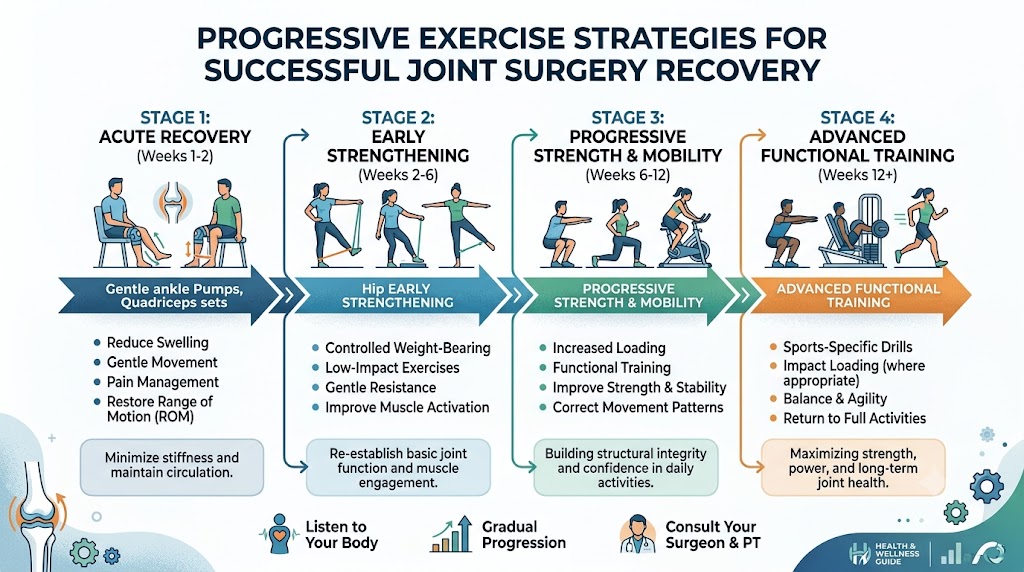
Safe Exercises During Early Recovery
Early exercises are gentle and focus on activating the muscles without putting excessive weight on the new or repaired joint. Always perform these under the guidance of a physiotherapist.
- Ankle Pumps: Move your foot up and down to encourage blood flow.
- Quadriceps Sets: Tighten the muscle on the top of your thigh by pressing the back of your knee down.
- Glute Squeezes: Contract your glute muscles while lying down to encourage hip stability.
- Heel Slides: Gently slide your heel toward your buttocks to improve knee range.
- Gentle Range of Motion: Moving the joint within the “pain-free zone” as permitted by your surgeon.
- Deep Breathing Exercises: Helps keep your lungs clear and supports overall recovery.
Exercises During Intermediate Recovery
As you progress, the intensity increases to begin building the foundation for functional movement.
- Straight Leg Raises: Keep your leg straight while lifting it to build hip and thigh strength.
- Stationary Cycling: Provides excellent, low-impact range-of-motion work for the knee.
- Seated Knee Extensions: Slowly straighten your leg from a seated position to target the quads.
- Standing Hip Exercises: Focus on abduction or extension to improve hip stability.
- Resistance Band Training: Use gentle tension to add resistance to your strengthening movements.
- Walking Programs: Gradual, measured walking increases your endurance and confidence.
Advanced Rehabilitation Exercises
These exercises prepare you for more strenuous daily activities and active hobbies.
- Stair Training: Learning to navigate stairs safely and with correct form.
- Balance Exercises: Single-leg standing (with support) to improve proprioception.
- Functional Strength Training: Squats (as advised), lunges, or step-ups once you have adequate strength.
- Low-Impact Cardio: Elliptical machines or seated rowers that keep the joint active without high impact.
- Swimming: Once the wound is fully healed and you are cleared, the water provides resistance and support.
- Elliptical Training: Smooth, gliding movement that avoids the pounding impact of running.
EXERCISE PROGRESSION TABLE
| Exercise | Recovery Stage | Primary Benefit |
| Ankle Pumps | Immediate | Blood clot prevention |
| Heel Slides | Early | Improved knee flexion |
| Walking | Early/Intermediate | Functional endurance |
| Cycling | Intermediate | Low-impact mobility |
| Resistance Bands | Intermediate | Muscle toning |
| Swimming | Advanced | Joint-supported strengthening |
Exercises to Avoid Initially
Pushing too hard can cause setbacks. Avoid these until explicitly approved:
- High-impact running or jogging.
- Jumping or explosive movements.
- Heavy weight lifting that creates axial load.
- Deep squats or lunges that stress the joint capsule.
- Twisting or pivoting activities (often discouraged in early hip/knee recovery).
- Contact sports.
EXERCISES TO AVOID TABLE
| Activity | Why It Should Be Avoided Initially |
| Running | High impact stresses the healing joint |
| Jumping | Sudden force can cause structural trauma |
| Heavy Weights | Excess load hinders tissue integration |
| Deep Squats | Stretches the surgical site too far |
| Contact Sports | High risk of unexpected trauma |
Tips for Exercising Safely
- Consultation is Key: Your physiotherapist and surgeon know your surgery type and health history better than anyone else.
- Warm-up: Use gentle motion to prepare the joint for strengthening.
- Progress Gradually: Do not try to rush your recovery by adding weight or repetitions too quickly.
- Stay Hydrated: Essential for tissue health and reducing post-exercise fatigue.
- Supportive Footwear: Wear shoes that provide stability and shock absorption.
- Listen to Your Body: Pain that lingers for more than an hour after exercise is a sign to scale back.
Warning Signs to Stop Exercising
If you notice any of the following, stop the activity and contact BestOrthoHospitals or your healthcare provider:
WARNING SIGNS TABLE
| Symptom | Recommended Action |
| Severe Pain | Stop and rest; contact your therapist |
| Excessive Swelling | Apply ice and elevate; reduce activity |
| Fever | Contact your surgeon immediately (risk of infection) |
| Redness | Observe for infection; report to your doctor |
| Joint Instability | Cease weight-bearing until evaluated |
Nutrition to Support Recovery
Your body needs high-quality fuel to rebuild muscle and repair bone tissue.
RECOVERY NUTRITION TABLE
| Nutrient | Food Sources | Recovery Benefit |
| Protein | Lean meats, legumes, tofu | Rebuilds muscle tissue |
| Calcium | Dairy, leafy greens, fortified foods | Essential for bone health |
| Vitamin D | Sunlight, fortified foods, fatty fish | Supports calcium absorption |
| Omega-3 | Salmon, chia seeds, walnuts | Reduces inflammation |
| Water | Plain water, herbal tea | Tissue repair and joint lubrication |
Common Recovery Mistakes
- Aggressive Exercise: Doing too much can increase inflammation and stall healing.
- Skipping Physiotherapy: PT is not optional; it is the core of your recovery.
- Inactivity: Remaining sedentary causes muscle atrophy and increased joint stiffness.
- Ignoring Pain: “No pain, no gain” does not apply to orthopedic rehabilitation.
- Poor Nutrition: Ignoring the body’s need for protein and micronutrients limits repair.
- Missing Follow-ups: Surgeon follow-ups ensure your joint is healing correctly and on schedule.
Real-Life Patient Scenarios
- Knee Replacement Success: A patient diligently performs quadriceps sets and heel slides for six weeks. By month three, they return to walking for 30 minutes daily with minimal discomfort.
- Hip Mobility Recovery: A patient focuses on stability exercises, using a stationary bike to gradually increase range, successfully returning to low-impact gardening by month four.
- Shoulder Strengthening: A patient follows a strict rotator cuff strengthening plan post-surgery, avoiding heavy lifting initially, and achieves full range of motion for daily reaching tasks within six months.
Future of Orthopedic Rehabilitation
Technology is making rehabilitation more efficient:
- AI Rehabilitation: Smart algorithms adapting your home workout based on your progress.
- Wearable Devices: Sensors that track your joint angle and movement quality in real-time.
- Virtual Physiotherapy: Tele-rehab allowing therapists to guide your exercises remotely.
- Robotic Therapy: Precision tools that assist in moving joints safely.
- Motion Tracking: Technology that provides instant feedback on your form to prevent injury.
FUTURE OF REHABILITATION TABLE
| Innovation | Potential Benefit |
| AI Rehabilitation | Personalized and adaptive exercise loads |
| Wearable Devices | Real-time form correction |
| Virtual Physiotherapy | Increased access to expert guidance |
| Robotic Therapy | Safe, controlled joint mobilization |
| Motion Tracking | Objective data on recovery progress |
FAQs
- When can I start exercising?
As soon as your surgeon gives the “go-ahead,” often within days for gentle movement. - Which exercises are safest?
Gentle range-of-motion and muscle-setting exercises initially. - Can walking improve recovery?
Yes, it’s one of the best functional movements for most joint surgeries. - How long does rehabilitation continue?
Typically 3 to 12 months, depending on the surgery. - Is physiotherapy necessary?
It is highly recommended to ensure you use correct form. - What exercises should I avoid?
High-impact running, jumping, and deep squats early on. - Can exercise reduce stiffness?
Yes, movement is the best cure for post-op stiffness. - How much pain is normal?
Mild discomfort is expected, but sharp or intense pain is a warning sign. - When can I return to sports?
Only after surgeon clearance, usually after 6+ months. - How can I prevent another injury?
Maintain a healthy weight and keep muscles around the joint strong. - Do I need a brace?
Your surgeon will decide based on your specific joint stability. - What if my joint clicks?
Some clicking is normal; sharp pain with clicking is not. - Is heat or ice better?
Ice is generally better for post-exercise swelling. - How do I measure progress?
Through improved range of motion and daily activity tolerance. - Can I exercise at home?
Yes, once you have mastered the techniques with a professional.
Final Thoughts
The path to recovery after joint surgery is a marathon, not a sprint. The discipline you invest in your rehabilitation today will define your quality of life for the years ahead. By prioritizing safety, listening to your healthcare team, and maintaining a consistent, gradual exercise routine, you can maximize your recovery and protect your joint’s longevity.Remember, your body communicates through signals; respecting those signals is the key to progress. Always stay in close contact with your surgical team at BestOrthoHospitals to ensure your recovery remains on the right track. Consistent, smart movement is the greatest tool you have to regain your independence and return to the activities you love.