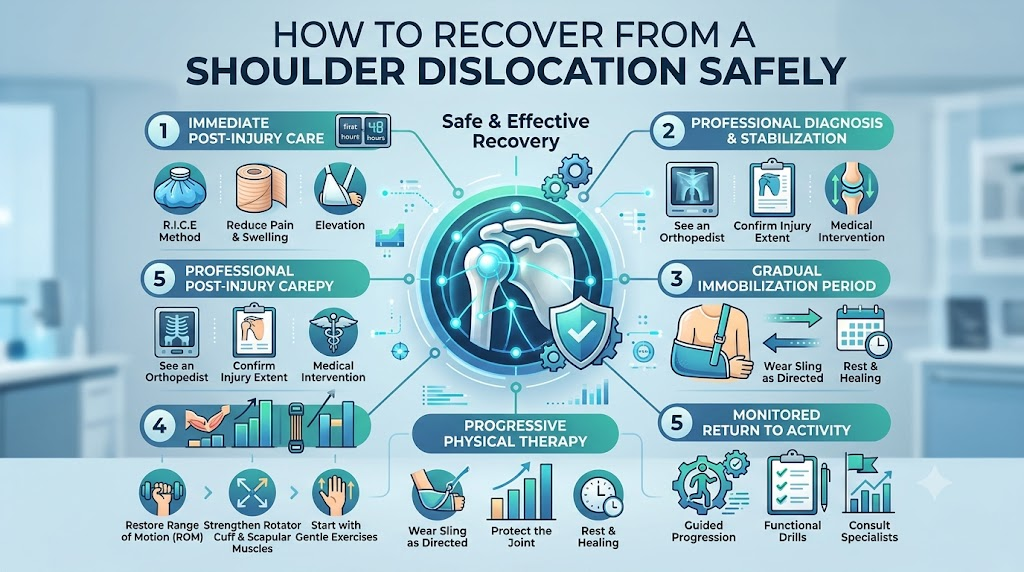
A shoulder dislocation happens when the upper arm bone moves out of its normal place in the shoulder socket. This joint allows the arm to move in many directions, but that wide range of movement can also make it less stable.
A dislocated shoulder can cause strong pain, swelling, weakness, and trouble moving the arm. Recovery often includes medical treatment, a sling for support, and physical therapy to help restore movement and strength.
If you think your shoulder is dislocated, seek urgent medical care. Bestorthohospitals. Moving it the wrong way can cause more damage to nearby bones, nerves, or blood vessels.
Learning how to recover from shoulder dislocation safely can help you protect the joint and return to daily life at the right pace. Your plan will depend on the injury, your health, and whether this is your first dislocation. Follow your healthcare professional’s advice throughout recovery.
Understand Your Shoulder Injury
The shoulder is a ball-and-socket joint. The rounded top of the upper arm bone fits into a shallow socket in the shoulder blade. Muscles, tendons, and ligaments help hold the joint in place while allowing the arm to move.
A dislocation occurs when the ball moves completely out of the socket. A subluxation, or partial dislocation, happens when the joint moves partly out of position and may return on its own.
A dislocation can stretch or damage the tissues that support the shoulder. It may also affect the tendons, cartilage, nerves, or blood vessels. In some cases, a bone may break during the injury.
The type and severity of the injury affect treatment and recovery. A first-time dislocation may need a different plan from repeated dislocations, which can point to ongoing shoulder instability.
Do not judge the injury only by how much pain you feel. A healthcare professional needs to assess the shoulder and check for other damage.
Get Medical Treatment Before Starting Recovery
A suspected shoulder dislocation needs prompt medical assessment. A doctor will check the shape of the shoulder, pain, movement, and the feeling and blood flow in your arm and hand.
An X-ray is often used to confirm the dislocation and check for a fracture. The doctor may also recommend other tests if there is concern about damage to the muscles, tendons, or other tissues.
The process of moving the shoulder back into its normal position is called reduction. A trained healthcare professional performs this procedure, sometimes using medicine to reduce pain and help the muscles relax. Afterward, the doctor may repeat checks of your nerves and blood flow and take another X-ray.
The shoulder is often placed in a sling after treatment. You may also need a follow-up visit with an orthopedic specialist, especially if there is a fracture, major tissue damage, or repeated instability.
Never try self-reduction or let an untrained person pull the shoulder into place. If your hand becomes cold, pale, or blue, or you develop new numbness or severe weakness, seek emergency care.
Use Your Sling as Directed
A sling supports the injured arm and may help reduce pain during early recovery. It also reminds you to protect the shoulder while it begins to heal.
Your clinician will tell you when to wear the sling and when it may be removed. The right length of use depends on the injury, pain, other damage, and whether surgery was performed.
Follow these tips:
- Keep your arm supported in the position recommended by your healthcare team.
- Check your skin for rubbing, pressure, or irritation.
- Ask how to remove the sling safely for washing and dressing.
- Move your fingers, wrist, and elbow only as instructed.
- Attend follow-up visits before changing your support plan.
Do not keep the shoulder still longer than advised. Too much time without suitable movement can cause stiffness. On the other hand, removing the sling too early or moving the shoulder in unsafe ways may increase the risk of another injury.
If the sling causes unusual pain, numbness, or changes in hand color, contact your healthcare team promptly.
Control Pain and Swelling at Home
Pain, bruising, and swelling may continue after the shoulder has been put back in place. These symptoms should gradually improve, although the pace differs between patients.
A cold pack may help ease discomfort. Wrap it in a thin towel and apply it for about 15–20 minutes at a time if your clinician says it is suitable. Never place ice directly on your skin.
You can also help protect the shoulder by resting the arm in the position recommended by your care team. Avoid lifting, pushing, pulling, or reaching overhead until you have been cleared to do so.
Use pain medicine only as directed by a doctor or pharmacist. Some medicines may not be suitable for people with kidney disease, stomach ulcers, certain allergies, or those taking blood thinners. Ask for advice before using a new medicine.
Do not ignore severe or increasing pain. New numbness, weakness, or a cold or discolored hand may point to a problem that needs urgent assessment.
Protect Your Shoulder During Daily Activities
Simple changes at home can make everyday tasks easier while your shoulder heals. The goal is to avoid sudden movements and keep the injured arm within the limits set by your clinician.
Getting dressed and washing
Choose loose clothing that is easy to put on and take off. Ask your healthcare professional how to dress without pulling or twisting the injured arm. If bathing is difficult, ask someone to help you stay safe.
Sleeping comfortably
Use pillows to support your arm in the position recommended by your healthcare team. Avoid sleeping in a position that puts pressure on the shoulder or causes pain. Ask your clinician if you are unsure which position is safe for your injury.
Working and doing chores
Keep frequently used items close to you so you do not have to reach high or lift heavy objects. Take breaks during desk work, and ask for help with shopping bags, cleaning, and other demanding tasks.
Do not force a movement just because it seems easy. Follow your specific movement restrictions, especially during the early stage of recovery.
Begin Physical Therapy at the Right Time
Physical therapy helps restore shoulder movement, strength, control, and stability. Starting at the right time matters because the shoulder needs protection at first, followed by safe and gradual movement.
The timing depends on whether the shoulder was treated without surgery or with an operation. Your orthopedic specialist or physiotherapist will choose exercises based on your injury and healing progress.
Early stage: Protect the shoulder
At first, you may be asked to use a sling and avoid certain shoulder movements. You may be allowed to move your fingers, wrist, and elbow to reduce stiffness, but only as instructed. Begin shoulder exercises when your clinician says they are safe.
Middle stage: Restore movement
As healing progresses, your plan may include gentle movements to help the shoulder become more flexible. Do not force the arm into a painful position or try to regain all movement at once.
Strengthening stage: Build control
Later exercises may focus on the muscles around the shoulder and shoulder blade. The goal is to improve strength and help the joint stay steady during everyday tasks.
Return-to-activity stage
Your physiotherapist may gradually add exercises that match your work, exercise, or sports needs. Progress depends on your movement, strength, stability, and clinical assessment.
Continue the prescribed plan even after pain improves. Feeling less pain does not always mean the shoulder has fully regained its strength and control.
Know Which Exercises May Be Part of Recovery
The exercises used after a shoulder dislocation depend on the type of injury and how well the joint is healing. A physiotherapist may choose from several exercise groups as your recovery progresses.
- Hand, wrist, and elbow movements: These may help reduce stiffness while the shoulder is supported.
- Gentle shoulder movements: These help restore movement when your clinician says it is safe.
- Range-of-motion exercises: These help the shoulder move more freely without forcing it.
- Rotator cuff exercises: The rotator cuff is a group of muscles and tendons that help move and support the shoulder.
- Shoulder-blade exercises: These help improve control of the muscles around the shoulder blade.
- Strength and balance exercises: These may be added later to help the shoulder stay stable during daily activities.
Follow the exercise plan provided by your treating clinician or physiotherapist. Do not copy advanced exercises from online videos without checking whether they are suitable for your injury.
Stop an exercise and seek advice if it causes sharp pain, new weakness, numbness, or a feeling that the shoulder is slipping out of place. Do not push through these symptoms.
No single exercise can guarantee that another dislocation will not happen. A planned rehabilitation program can help improve strength and control, but your risk also depends on the damage caused by the injury.
Understand Shoulder Dislocation Recovery Time
Recovery time varies from person to person. Your age, general health, injury severity, treatment, and daily activity needs can all affect how quickly you improve.
Pain and swelling may begin to ease over the first days and weeks. Everyday tasks may become easier as your movement improves, but strength and shoulder control often take longer to return.
Some people make good progress within four to six weeks, but this does not mean the shoulder is fully healed or ready for every activity. Recovery may take several weeks to months, especially after a serious injury or surgery.
A fracture, tendon injury, nerve problem, or repeated dislocation may slow progress. People who need to lift heavy objects, perform overhead work, or play contact sports may need a longer rehabilitation period.
Your progress matters more than a fixed date. Ask your healthcare team how they will assess your movement, strength, and stability before you return to demanding activities.
Reduce the Risk of Another Shoulder Dislocation
After a dislocation, the tissues that help hold the shoulder in place may be stretched or damaged. This can make the joint feel loose or increase the chance of another dislocation.
You can take steps to support shoulder stability:
- Complete your prescribed physical therapy program.
- Build strength and control gradually.
- Avoid returning to contact sports too early.
- Use suitable sports techniques and protective equipment.
- Follow advice about heavy lifting and overhead movements.
- Attend follow-up appointments.
- Tell your doctor if the shoulder slips, feels loose, or dislocates again.
Repeated dislocations may need further tests or an orthopedic specialist’s review. The specialist may discuss nonsurgical care or surgery, depending on the injury, tissue damage, activity needs, and history of instability.
Surgery is not needed for every dislocation. Likewise, exercise cannot remove every risk of another injury. Your treatment plan should reflect your needs and the findings of your medical assessment.
Return to Work, Driving, and Sports Safely
Returning to normal activities depends on pain, movement, strength, stability, and the type of task you want to do. Do not rely on pain relief alone to decide that your shoulder is ready.
Work
Desk work may be possible sooner than work that involves lifting, carrying, reaching, or physical labor. Ask your clinician whether you need temporary changes to your duties or working hours.
Driving
Do not drive while wearing a sling if it limits your ability to control the vehicle. Avoid driving if you are taking medicine that makes you sleepy or slows your reactions. Ask your clinician when you can safely return to driving.
Exercise and sports
Walking and other activities that do not strain the shoulder may be possible earlier, if approved by your care team. Throwing, swimming, contact sports, and overhead sports may need a longer recovery period.
Before returning to sport, your clinician may assess your shoulder movement, strength, stability, and ability to perform sport-specific tasks safely. Follow any limits set for your particular injury.
Heavy lifting
Wait for medical clearance before lifting heavy objects or returning to demanding physical work. Increasing activity too quickly can put extra stress on the healing shoulder.
Recognize Warning Signs During Recovery
Some discomfort may be part of recovery, but certain symptoms need urgent medical attention. Do not wait for severe symptoms to settle on their own.
Seek emergency care if:
- Your shoulder appears to dislocate again.
- You have severe or rapidly worsening pain.
- Your hand becomes cold, pale, or blue.
- You develop new numbness, tingling, or marked weakness.
- Your arm or hand suddenly changes in feeling or movement.
These symptoms may point to a new injury, nerve problem, or reduced blood flow. A healthcare professional needs to assess them promptly.
If you have had shoulder surgery, contact your surgical team promptly about wound redness, drainage, or other signs of infection. Fever or rapidly increasing swelling also needs medical advice.
If symptoms are severe or getting worse quickly, use the emergency care service available where you live. Do not try to correct the shoulder position yourself.
Table 1: Shoulder Dislocation Recovery Checklist
| Recovery step | What patients should do | Why it matters |
|---|---|---|
| Medical treatment | Get the shoulder assessed and repositioned by a trained professional | Helps restore joint alignment and check for other injuries |
| Sling use | Follow the prescribed support plan | Protects the shoulder during early recovery |
| Pain and swelling care | Use approved cold packs and follow medicine instructions | Helps manage discomfort safely |
| Daily activities | Avoid heavy lifting and painful movements | Reduces stress on the healing shoulder |
| Physical therapy | Follow the prescribed rehabilitation plan | Helps restore movement, strength, and stability |
| Follow-up visits | Attend recommended reviews | Helps identify ongoing problems |
| Return to sports | Wait for appropriate clinical clearance | Helps reduce the risk of reinjury |
When to See an Orthopedic Specialist
Follow-up visits help your healthcare team check that the shoulder is healing and that movement is returning as expected. They can also help identify problems that may need more care.
Arrange a review if:
- The shoulder repeatedly slips out of place or feels unstable.
- Pain or movement does not improve as expected.
- Weakness or numbness continues.
- Imaging shows a fracture or major tissue injury.
- You need to return to a physically demanding job or sport.
- Nonsurgical treatment has not restored safe function.
- You have had surgery and need guidance on rehabilitation.
A specialist may recommend more imaging or discuss different treatment options if the shoulder remains unstable. The right approach depends on your injury, health, activity goals, and recovery progress.
Do not compare your recovery too closely with another person’s. Two people can have similar-looking injuries but need different care plans.
Table 2: Shoulder Dislocation Symptoms and Recommended Actions
| Symptom or situation | What it may indicate | Recommended action |
|---|---|---|
| Mild pain that gradually improves | Expected recovery discomfort | Follow the care plan and monitor progress |
| Stiffness or limited movement | May occur during recovery | Ask the clinician when to begin or progress exercises |
| Shoulder slipping or dislocating again | Possible ongoing instability | Seek prompt orthopedic assessment |
| New numbness or weakness | Possible nerve involvement | Seek urgent medical assessment |
| Cold, pale, or blue hand | Possible blood flow problem | Seek emergency care |
| Severe or worsening pain | Possible complication or further injury | Seek urgent medical care |
| Redness or drainage after surgery | Possible wound problem | Contact the surgical team promptly |
Symptoms must be judged in context, including how severe they are and whether they are getting worse. Follow your clinician’s instructions, and seek urgent care for severe or rapidly worsening symptoms.
Frequently Asked Questions About Shoulder Dislocation Recovery
1. How long does it take to recover from a shoulder dislocation?
Recovery can take several weeks to months, depending on the injury and treatment. Pain may improve before strength and stability return. Some people make good progress within four to six weeks, but this is not a guarantee of full recovery. Follow your rehabilitation plan and ask your clinician when it is safe to increase activity.
2. How long should I wear a sling after a shoulder dislocation?
The time you need a sling depends on the injury, pain, tissue damage, and whether surgery was performed. Follow the instructions from your treating clinician rather than choosing a fixed number of days. Ask when you can remove it for washing and prescribed movements. Keeping the shoulder still for too long may cause stiffness.
3. Can I sleep on my side after a shoulder dislocation?
Sleeping on the injured side may cause pain or put pressure on the shoulder, so ask your healthcare professional which position is suitable. Some people find it more comfortable to rest on their back with pillows supporting the arm. Avoid any position that causes pain, pulling, or pressure on the injured joint.
4. When should physical therapy begin after a shoulder dislocation?
The right time depends on the severity of the injury, treatment, and whether surgery was needed. Some movements may begin early, while shoulder exercises may need to wait. Your doctor or physiotherapist will guide you through the stages of recovery. Do not start a shoulder exercise routine without knowing which movements are safe for your injury.
5. What exercises help with shoulder dislocation recovery?
A rehabilitation plan may include gentle movement, range-of-motion exercises, rotator cuff strengthening, and shoulder-blade control exercises. The choice and timing depend on how the joint is healing. Follow your physiotherapist’s plan and avoid forcing painful movements. Stop and seek advice if you notice new weakness, numbness, or a feeling that the shoulder is slipping.
6. When can I return to work after a shoulder dislocation?
The answer depends on your job and your recovery. Desk work may be possible earlier than work involving heavy lifting, reaching, or physical labor. Ask your clinician whether you need temporary work changes. Do not return to demanding tasks until your shoulder can handle them safely and your healthcare team has cleared you.
7. When can I drive after a shoulder dislocation?
You should be able to control the vehicle safely and react quickly before driving again. Do not drive if a sling limits your movement, if medicine makes you sleepy, or if pain prevents safe control. Ask your clinician for advice based on your injury and treatment. Follow local driving rules and any restrictions given to you.
8. Can a shoulder dislocate again after treatment?
Yes. Some people experience another dislocation, especially if the tissues that support the joint have been damaged. Completing rehabilitation and building strength may improve shoulder control, but cannot remove every risk. If your shoulder feels loose, slips, or dislocates again, arrange an orthopedic assessment to discuss the next steps.
9. Does every shoulder dislocation need surgery?
No. Many shoulder dislocations are treated by a trained professional moving the joint back into place, followed by support and rehabilitation. Surgery may be considered when the shoulder remains unstable, dislocations repeat, or certain injuries are present. Your specialist will consider your age, activity needs, tissue damage, and medical findings before discussing treatment options.
10. Which symptoms after a shoulder dislocation require urgent medical care?
Seek urgent or emergency care for severe or worsening pain, a suspected repeat dislocation, new numbness or weakness, or a hand that becomes cold, pale, or blue. These signs may indicate a problem with the joint, nerves, or blood flow. After surgery, contact your surgical team promptly about wound redness, drainage, or fever.