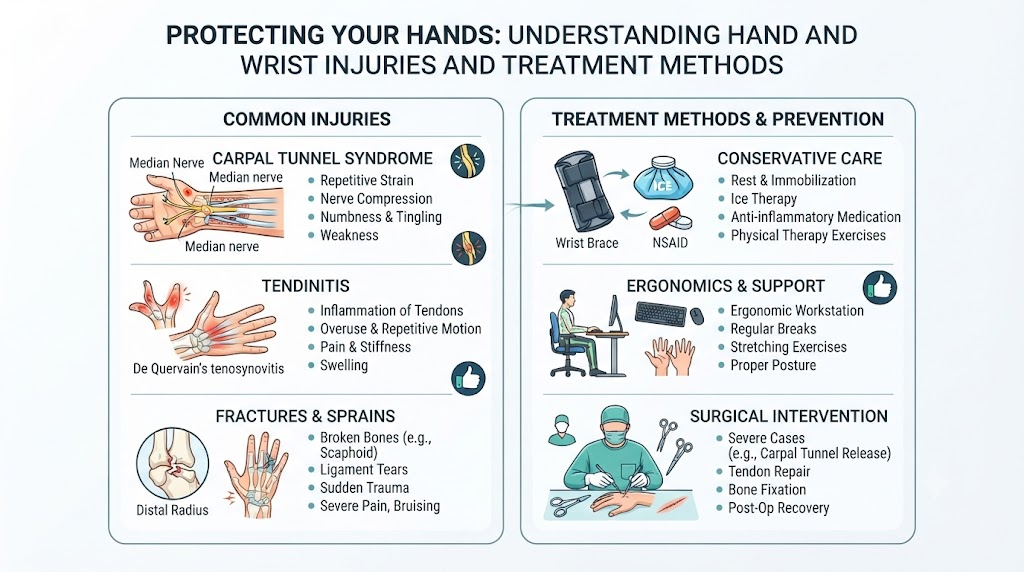
Introduction
The human hand and wrist form an incredibly sophisticated anatomical masterpiece. Together, they contain a complex network of delicate bones, articulating joints, coordinating ligaments, flexible tendons, responsive muscles, and highly sensitive nerves. This intricate design allows us to perform an extraordinary range of activities with both high-force power and micro-level precision. From the high-impact grip required to swing a hammer or tennis racket to the delicate coordination needed to play a piano, type on a keyboard, or perform microsurgery, our hands and wrists are fundamental to our independence, work, and personal passions.This detailed, patient-focused educational guide is designed to provide you with a comprehensive foundation in Understanding Hand and Wrist Injuries. We will explore the complex anatomy of the hand and wrist, discuss the most common injuries and their causes, outline the diagnostic process, and highlight evidence-based treatment and rehabilitation pathways.As you navigate this guide, online orthopedic health networks like BESTORTHOHOSPITALS serve as a vital resource, helping patients find accredited orthopedic centers, learn about specialized hand surgeons, and access reliable educational information to support their physical recovery.
What Are Hand and Wrist Injuries?
Hand and wrist injuries encompass any trauma, damage, or structural breakdown affecting the bones, ligaments, tendons, nerves, or soft tissues of the hand, wrist, and fingers. Because of the sheer complexity of these structures, even a seemingly minor injury can affect how the entire hand operates if not properly managed.
Basic Anatomy of the Hand and Wrist
To understand how these injuries occur, it is helpful to look at the remarkable anatomy that makes hand movement possible:
[ Forearm Radius/Ulna ] ──► [ 8 Carpal Bones (Wrist) ] ──► [ 5 Metacarpals (Palm) ] ──► [ 14 Phalanges (Fingers) ]
                                     ▲
                                     │
                 (Stabilizing & Functional Soft Tissues)
                  [ Ligaments, Tendons, Median/Ulnar Nerves ]
- Bones: The wrist alone is comprised of eight small, closely packed bones called carpal bones, which connect the two long bones of the forearm (the radius and ulna) to the hand. The palm contains five metacarpal bones, while the fingers and thumb are made up of fourteen smaller bones called phalanges.
- Joints: The hand and wrist contain dozens of small joints, each lined with protective cartilage to allow smooth, gliding movements.
- Ligaments: These tough bands of fibrous connective tissue connect bone to bone, providing vital structural stability to the numerous joints of the hand and wrist. A key example is the scapholunate ligament, which stabilizes the small bones of the wrist.
- Tendons: These strong, cord-like structures connect muscles to bones, acting like pulley strings. Flexor tendons on the palm side allow you to bend your fingers and make a fist, while extensor tendons on the back side allow you to straighten your fingers and lift your wrist.
- Nerves: Three major nerves—the median, ulnar, and radial nerves—run from the forearm down into the hand. They provide sensory feedback (allowing you to feel temperature, texture, and pain) and send motor signals to control muscle contractions.
- Muscles: Small, intricate intrinsic muscles located entirely within the hand control precise finger movements, while larger extrinsic muscles in the forearm provide the power for a strong grip.
Why Are These Structures Vulnerable to Injury?
The hand and wrist are highly vulnerable to injury primarily because of their anatomical exposure and active role in daily life. When we slip or trip, our natural protective reflex is to extend our arms and open our hands to break the fall. This action—known clinically as a FOOSH (Fall On Outstretched Hand) injury—forces the small bones and ligaments of the wrist to absorb the sudden, high-impact weight of the entire body. Additionally, the constant repetitive movements required by modern office work, manual labor, and sports can place repetitive strain on tendons and nerves, leading to overuse injuries over time.
Common Types of Hand and Wrist Injuries
Orthopedic specialists categorize hand and wrist injuries into acute trauma (such as fractures, sprains, and tears caused by sudden force) and chronic overuse conditions (resulting from repetitive strain and inflammation).
Wrist Sprains
A wrist sprain occurs when the ligaments that support the carpal bones are stretched or torn. Sprains are graded by severity: Grade 1 (mild stretching), Grade 2 (partial tearing), and Grade 3 (complete rupture of the ligament). A severe Grade 3 sprain can lead to chronic joint instability if the ligament does not heal in its correct position.
Hand Sprains
Similar to wrist sprains, hand sprains involve damage to the ligaments supporting the joints of the palm or fingers. These are particularly common in contact sports or activities where a finger is forced backward or twisted out of its normal range of motion.
Wrist Fractures
A wrist fracture is a break in one or more of the bones in the wrist area. The most common type is a Colles’ fracture, which is a break at the lower end of the radius bone close to where it connects to the wrist. Another common but easily overlooked injury is a scaphoid fracture—a break in one of the small carpal bones. Because the scaphoid has a unique and limited blood supply, proper diagnosis and treatment are critical to prevent complications like non-union (where the bone fails to heal) or avascular necrosis (bone cell death due to lack of blood).
Finger Fractures
Breaks in the small phalanges of the fingers can occur from direct trauma, such as getting a finger caught in a door, being struck by a ball, or experiencing a crush injury. Even minor, stable finger fractures must be properly aligned and stabilized to prevent permanent stiffness or deformity.
       [ Traumatic Force / Direct Impact ]
                       │
       ┌───────────────┴───────────────┐
       ▼                               ▼
 [ Wrist Fracture ]            [ Finger Fracture ]
 ├── Colles' (Distal Radius)   ├── Phalangeal alignment critical
 └── Scaphoid (Limited blood)  └── Risk of permanent stiffness
Thumb Injuries
The thumb is essential for overall hand function, providing up to 40% of our hand’s capability through its ability to pinch and grip. A common traumatic injury is Gamekeeper’s Thumb or Skier’s Thumb, which is a tear of the ulnar collateral ligament (UCL) at the base of the thumb. This injury often occurs when the thumb is forcibly bent outward away from the hand, such as during a ski fall or athletic contact.
Tendon Injuries
Because tendons run very close to the surface of the skin, they are highly vulnerable to cuts (lacerations) or sudden ruptures.
- Flexor Tendon Injuries: A cut on the palm side of the hand can slice the flexor tendons, making it impossible to bend the affected finger.
- Extensor Tendon Injuries: Damage to the back of the hand can prevent a patient from straightening their fingers. A common example is Mallet Finger, which occurs when an object (like a basketball) strikes the tip of an extended finger, tearing the extensor tendon and leaving the finger tip permanently drooped.
Ligament Tears
In addition to sprains, complete tears of critical stabilizing ligaments (such as the scapholunate ligament in the wrist) can occur. These tears disrupt the natural alignment of the carpal bones, causing pain, a clicking sensation, and a gradual decline in grip strength over time.
Dislocations
A dislocation occurs when a joint is subjected to a force that pulls the bones out of their normal alignment. Dislocations are common in the finger joints (especially the proximal interphalangeal, or PIP, joint) and require prompt medical alignment (reduction) to protect the surrounding nerves and blood vessels.
Carpal Tunnel Syndrome
Carpal Tunnel Syndrome is a highly common compression neuropathy. It occurs when the median nerve, which runs from the forearm into the hand through a narrow passageway in the wrist called the carpal tunnel, becomes squeezed or compressed. This compression is often caused by inflammation and swelling of the surrounding flexor tendons, leading to numbness, tingling, and weakness in the thumb, index, middle, and half of the ring finger.
 [ Swollen Flexor Tendons ] ──► [ Narrowed Carpal Tunnel Passage ]
                                          │
                                          ▼
  [ Weak Grip & Pinch ]    ◄── [ Compressed Median Nerve ] ──► [ Numbness & Tingling ]
Trigger Finger
Trigger finger (stenosing tenosynovitis) is a painful condition where a finger or thumb becomes stuck in a bent position. It occurs when the protective sheath surrounding the finger tendon becomes inflamed and swollen, making it difficult for the tendon to slide smoothly. As a result, the finger may suddenly pop or lock when you try to straighten it.
De Quervain’s Tenosynovitis
De Quervain’s tenosynovitis is an inflammatory condition affecting the tendons on the thumb side of the wrist. It causes localized pain, swelling, and tenderness near the base of the thumb, making it uncomfortable to turn your wrist, grasp objects, or make a fist.
Hand and Wrist Injuries Comparison Table
| Specific Injury | Common Symptoms | Primary Orthopedic Treatment | Potential Complication of Delayed Care |
| Wrist Sprain | Dull ache, local swelling, bruising, tenderness when rotating the wrist. | Rest, ice, compression, elevation (RICE), temporary splinting, targeted exercises. | Chronic joint laxity, persistent weakness, recurrent sprains. |
| Wrist Fracture (e.g., Colles’) | Sharp pain, immediate swelling, visible deformity or crookedness, inability to bear weight. | Manual bone alignment (reduction), casting, or surgical plate fixation (ORIF). | Malunion (healing in a crooked position), chronic stiffness, early osteoarthritis. |
| Finger Fracture | Swelling, focal bruising, localized tenderness, crooked finger alignment. | Buddy taping, custom protective splinting, or surgical pin placement. | Rotational deformity (fingers crossing when making a fist), permanent joint stiffness. |
| Tendon Injury (e.g., Mallet Finger) | Inability to straighten the fingertip, drooped finger tip, mild localized pain. | Continuous custom splinting for 6 to 8 weeks, or surgical tendon repair. | Permanent “droop” of the finger tip, chronic weakness in pinching or gripping. |
| Carpal Tunnel Syndrome | Numbness, tingling (pins and needles) in thumb/fingers, nighttime waking, dropping objects. | Nighttime wrist splinting, ergonomic adjustments, physical therapy, or surgical release. | Permanent loss of sensation, muscle wasting (atrophy) at the base of the thumb. |
| Trigger Finger | Finger clicking, popping, locking in a bent position, tender nodule in the palm. | Splinting, corticosteroid injections, physical therapy, or surgical pulley release. | Permanent joint contracture (finger permanently stuck in a bent position). |
Common Symptoms
Identifying the symptoms of hand and wrist injuries early is essential for preventing further damage. While symptoms can vary based on the specific type of injury, several common signs should prompt you to seek an orthopedic evaluation:
- Pain: Can range from a sharp, sudden pain following a fall to a dull, throbbing ache that worsens with activity or repetitive movements.
- Swelling: An inflammatory response that can cause the fingers to look puffy or make the wrist appear enlarged.
- Bruising: Discoloration of the skin caused by bleeding from damaged blood vessels beneath the surface.
- Stiffness and Restricted Range of Motion: Difficulty fully bending, straightening, or rotating your fingers or wrist.
- Weak Grip Strength: Finding it unexpectedly difficult to hold a glass, open a jar, turn a doorknob, or carry bags.
- Numbness and Tingling: A “pins and needles” sensation or loss of feeling in the hand or fingers, often indicating nerve compression or irritation.
- Visible Deformity: A finger or wrist that looks crooked, out of place, or asymmetrical compared to the uninjured side.
- Difficulty Performing Daily Tasks: Struggling with fine motor activities like buttoning a shirt, writing with a pen, or typing on a keyboard.
Common Causes and Risk Factors
Hand and wrist injuries can affect anyone, but certain daily activities, physical conditions, and lifestyle habits can significantly increase your risk.
                  [ Factors Influencing Hand & Wrist Risk ]
                                      │
         ┌────────────────────────────┼────────────────────────────┐
         ▼                            ▼                            ▼
[ Accidental Trauma ]        [ Occupational Strain ]       [ Biological Vulnerabilities ]
├── Sports impacts (Ski/Gym) ├── Ergonomically poor desks ├── Osteoporosis (Fragile bone)
├── Falls on hard surfaces   ├── Repetitive assembly work └── Pre-existing joint arthritis
└── Direct machinery crush   └── Heavy physical lifting   └── Age-related tissue wear
- Falls: Tripping on a slick surface, slipping on ice, or falling from a height and extending your arm to break the fall is the leading cause of acute wrist fractures and ligament tears.
- Sports Injuries: High-velocity sports (like snowboarding, skiing, skateboarding, and cycling) and contact sports (such as football, basketball, and rugby) carry a high risk of acute fractures, finger dislocations, and thumb ligament tears.
- Workplace Accidents: Operating heavy machinery, performing manual labor, or experiencing direct crush injuries can cause severe trauma to the hands and fingers.
- Repetitive Hand Movements: Spending long hours typing at an ergonomically poor workstation, performing assembly line work, playing musical instruments, or using vibrating power tools can place repetitive strain on tendons and nerves.
- Heavy Lifting: Lifting heavy objects without proper wrist support can strain the stabilizing ligaments of the wrist.
- Osteoporosis: A condition that weakens bone density, making older adults highly vulnerable to sustaining a wrist fracture from even a minor, low-impact fall at home.
- Pre-Existing Arthritis: Chronic joint wear and tear can weaken the cartilage and surrounding ligaments, making the joints of the hand more susceptible to acute injury.
- Aging: As we age, our tendons lose their natural elasticity, and bones become more fragile, increasing the risk of both chronic wear-and-tear conditions and acute fractures.
How Doctors Diagnose Hand and Wrist Injuries
An accurate diagnosis is essential to guide an effective recovery plan. Orthopedic hand and wrist specialists use a combination of detailed evaluations and advanced diagnostic imaging to identify the precise cause of your pain.
Comprehensive Medical History and Physical Exam
Your specialist will start by asking how the injury occurred, the location and type of pain you feel, and how the pain impacts your daily tasks. During the physical exam, the doctor will carefully evaluate your hand and wrist for swelling, bruising, tenderness, and visible deformities. They will also perform specialized clinical tests:
- Finkelstein’s Test: Used to diagnose De Quervain’s tenosynovitis by having you make a fist with your thumb inside your fingers and gently bending your wrist downward.
- Phalen’s Maneuver and Tinel’s Sign: Used to check for Carpal Tunnel Syndrome by compressing or gently tapping the median nerve at the wrist to see if it triggers tingling in your fingers.
- Stress Testing: Gently moving a joint to assess if a stabilizing ligament is partially or completely torn.
[ Physical Range of Motion Exam ] ──► [ Localized Palpation Tests ] ──► [ Diagnostic X-Ray Imaging ]
                                                                                  │
                                                                                  ▼
  [ Targeted Hand Therapy Plan ]  ◄── [ Advanced Soft Tissue MRI ]  ◄── [ Identify Bone Fracture ]
Advanced Diagnostic Imaging
- X-Rays: The standard first-line imaging test used to view the bones of the hand and wrist, allowing doctors to detect fractures, joint dislocations, and signs of arthritis.
- Magnetic Resonance Imaging (MRI): Uses magnetic fields and radio waves to create highly detailed images of soft tissues. This is the gold standard for identifying ligament tears, tendon ruptures, occult (hidden) fractures, and areas of nerve compression.
- CT Scan: Provides detailed, cross-sectional views of complex bone structures, often used to evaluate multi-fragment fractures or plan intricate surgical reconstructions.
- Ultrasound: A dynamic, non-invasive imaging tool that allows specialists to view tendons in motion, locate fluid-filled cysts, or check for tendon inflammation in real time.
- Nerve Conduction Studies (NCS) and Electromyography (EMG): Diagnostic tests that measure the speed and strength of electrical signals passing through your nerves, helping to confirm the severity and location of nerve compression (such as in Carpal Tunnel Syndrome).
Treatment Options
Orthopedic specialists focus on restoring full function and stability while minimizing pain and stiffness. Treatment pathways are highly personalized, taking into account the type and severity of your injury, as well as your age and daily activity needs.
Conservative and Non-Surgical Treatments
Many common hand and wrist injuries can be managed successfully without surgery using conservative therapies:
- The R.I.C.E. Protocol:
- Rest: Limiting activities that cause pain or strain to allow the injured tissues to heal.
- Ice: Applying cold packs for 15 to 20 minutes at a time to reduce acute swelling and numb localized pain.
- Compression: Using a supportive elastic bandage to help manage swelling.
- Elevation: Keeping your hand elevated above the level of your heart to prevent fluid buildup and reduce throbbing.
- Splints, Braces, and Casts: Custom-fitted splints or fiberglass casts are used to hold fractured bones or torn ligaments in precise alignment, allowing them to heal securely.
- Targeted Pain Management: Over-the-counter anti-inflammatory medications (NSAIDs) or localized corticosteroid injections can help reduce severe inflammation and relieve pain in conditions like trigger finger or De Quervain’s tenosynovitis.
Physical and Occupational Therapy
Working with a certified hand therapist (CHT) is a cornerstone of recovery for both non-surgical and post-surgical patients. Therapy focuses on:
- Range-of-Motion Exercises: Gentle, structured movements to prevent joints from becoming stiff and frozen during recovery.
- Strengthening Exercises: Gradual progressive exercises to rebuild grip and pinch strength.
- Sensory Re-education: Specialized techniques to help restore normal feeling in the hand following nerve injuries or compression.
 [ Cast Removal / Early Healing ] ──► [ Gentle Range of Motion (Therapy) ]
                                                   │
                                                   ▼
 [ Restored Grip & Normal Work ] ◄── [ Progressive Hand Strengthening ]
Orthopedic and Hand Surgery
Surgery is typically reserved for complex fractures, completely ruptured tendons or ligaments, and severe nerve compression that does not respond to conservative care:
- Fracture Fixation (ORIF): Open Reduction and Internal Fixation involves placing tiny plates, screws, or pins to secure fractured bones in their proper alignment.
- Tendon and Ligament Repair: Surgically suturing torn tendons or stabilizing ruptured ligaments to restore joint function.
- Carpal Tunnel Release: A quick, minimally invasive procedure to cut the transverse carpal ligament, relieving pressure on the median nerve.
Recovery and Rehabilitation
The recovery journey following a hand or wrist injury requires time, patience, and active participation in your rehabilitation program.
Realistic Healing Timelines
Soft tissues like ligaments and tendons typically require a minimum of 6 to 8 weeks of protected healing, while fractured bones often require 6 to 12 weeks to regain solid structural strength. It is important to understand that complete recovery—including regaining your pre-injury grip strength and fine motor skills—can sometimes take several months of dedicated therapy.
The Role of Custom Hand Therapy
A certified hand therapist is essential for helping you navigate this process safely. They design a customized exercise program to help you rebuild flexibility, coordination, and strength without overloading the healing tissues. Skipping therapy or removing a splint too early can lead to permanent stiffness, joint weakness, and a higher risk of re-injury.
Tips to Prevent Hand and Wrist Injuries
While accidents can happen, incorporating a few simple habits into your daily routine can significantly reduce your risk of sustaining hand and wrist injuries.
- Set Up an Ergonomic Workstation: Arrange your desk, keyboard, and mouse so your wrists remain in a relaxed, neutral position, rather than bent sharply upward or downward.
- Take Regular Rest Breaks: If your daily work or hobbies involve repetitive hand movements, take a 5-minute break every hour to stretch your fingers, hands, and wrists.
- Perform Daily Hand Stretches: Gentle wrist extension and flexion stretches help maintain tissue flexibility and reduce tension in your forearm muscles.
- Wear Protective Sports Gear: Always wear appropriate wrist guards when snowboarding, inline skating, or skateboarding, and use padded gloves during cycling or weightlifting.
- Practice Safe Lifting Techniques: Keep your wrists straight and aligned with your forearms when lifting heavy objects, using your legs and core to bear the weight.
- Focus on Fall Prevention at Home: Keep walkways clear of clutter, secure loose rugs, and ensure stairways are well-lit to reduce the risk of slips and falls, especially for older adults.
Daily Habits That Support Hand and Wrist Health
| Healthy Habit | Core Benefit for Hand & Wrist Health | Simple Ways to Practice |
| Regular Stretching | Improves flexibility and relieves muscle tension in the forearms and wrists. | Gently pull your fingers back toward your forearm for 15 seconds, twice a day. |
| Ergonomic Workstation | Minimizes repetitive strain on the carpal tunnel and surrounding tendons. | Adjust your chair height so your forearms are parallel to the floor while typing. |
| Protective Sports Gear | Helps absorb sudden impacts and prevents severe fractures during falls. | Wear custom wrist guards every time you go snowboarding, skating, or skateboarding. |
| Grip Strengthening | Supports joint stability and improves overall hand and finger control. | Squeeze a soft therapy ball or stress ball for 5 minutes during breaks. |
| Taking Regular Breaks | Gives repetitive-use tendons a chance to rest, reducing the risk of inflammation. | Set a gentle timer to remind you to rest and stretch your hands every 60 minutes. |
| Balanced Nutrition | Supports strong bones and healthy cartilage to protect against fractures. | Ensure your diet includes adequate calcium, vitamin D, and anti-inflammatory foods. |
Warning Signs That Need Immediate Medical Attention
Certain acute symptoms indicate a severe injury or compromised blood flow/nerve function, requiring immediate emergency medical evaluation to prevent permanent damage.
- Severe, Uncontrolled Pain After Trauma: Intense pain that does not improve with rest, ice, or over-the-counter pain relievers.
- Visible Deformity or Crookedness: A joint or bone that looks clearly out of place, bent, or deformed.
- Open Fractures: Any bone break where the bone has pierced through the skin, or where there is a deep cut over the injury site.
- Inability to Move Your Fingers: Being completely unable to bend, straighten, or wiggle your fingers or thumb.
- Loss of Sensation or Numbness: Sudden or progressive numbness, coldness, or loss of feeling in your hand or fingers.
- Pale, Cold, or Blue Fingers: Signs of compromised blood circulation, which require urgent medical intervention.
- Severe, Rapid Swelling: Extreme swelling that develops quickly, especially if you are wearing a ring or tight watch that could restrict blood flow.
How BESTORTHOHOSPITALS Supports Orthopedic Health Awareness
Navigating a sudden orthopedic injury or finding the right specialist can feel overwhelming. The educational resources at BESTORTHOHOSPITALS are designed to simplify this journey, connecting patients and families with expert guidance.
- Accredited Orthopedic Center Directory: Easily search for and locate highly rated, accredited orthopedic hospitals and specialized hand surgery centers in your region.
- Specialist Profiles and Credentials: Access detailed information about the training, surgical expertise, and clinical focus of board-certified hand and upper extremity surgeons.
- Patient-Focused Educational Resources: Read clear, easy-to-understand articles on a wide variety of orthopedic injuries, non-surgical therapies, and recovery steps.
- Comprehensive Rehabilitation Guides: Access practical information on hand therapy, post-surgical care, and stretching exercises to support your recovery journey.
- Empowering Informed Decisions: By providing transparent, reliable medical information, the platform helps you collaborate closely with your healthcare providers to make confident choices for your recovery.
Common Mistakes People Make
Avoiding these common pitfalls can help ensure a safer, smoother, and more complete recovery from hand and wrist injuries.
- Ignoring Chronic or Lingering Pain: Assuming that a persistent ache or stiffness is just a minor strain that will resolve on its own, which can lead to chronic joint instability or early arthritis.
- Delaying Professional Diagnostic Care: Putting off an evaluation by an orthopedic specialist, which can cause fractures to heal in a crooked position (malunion) or allow nerve compression to worsen.
- Continuing to Play or Work Through Pain: Pushing through a hand or wrist injury during sports or physical work, which can turn a minor sprain into a complete ligament or tendon rupture.
- Removing Splints or Braces Too Early: Taking off a custom splint or cast before your bone or ligament has fully healed, which can disrupt the healing process and lead to re-injury.
- Skipping Post-Injury Rehabilitation Exercises: Neglecting to perform your recommended range-of-motion and strengthening exercises, which can lead to permanent joint stiffness and weakness.
- Attempting to Self-Diagnose Complex Injuries: Relying on online search results to diagnose an injury, rather than obtaining professional diagnostic imaging like X-rays or MRIs.
Practical Solutions
To protect your recovery, always have any significant hand or wrist trauma evaluated by an orthopedic specialist. If you are prescribed a splint, cast, or hand therapy program, follow your team’s instructions closely. Keep a calendar of your therapy sessions and exercises, and discuss any changes in your pain or mobility with your specialist immediately.
Common Myths vs Facts
| Myth | Fact |
| A wrist sprain is always a minor injury that will heal quickly on its own. | A severe Grade 3 ligament tear can be just as serious as a bone fracture, requiring professional care and sometimes surgery to prevent chronic joint instability. |
| Only competitive athletes develop hand and wrist injuries. | Anyone can sustain a hand or wrist injury from everyday accidents, repetitive office work, slips at home, or age-related bone thinning. |
| Every bone fracture in the hand or wrist requires surgical repair. | Many stable hand and wrist fractures heal beautifully with custom casting, splinting, and structured physical therapy, without the need for surgery. |
| Rehabilitation and hand therapy are optional parts of recovery. | Proper hand therapy is essential for restoring joint flexibility, grip strength, and fine motor skills after any significant injury or surgery. |
Real-Life Educational Scenarios
Scenario 1: Recovering from a Colles’ Fracture After a Slip and Fall
An active grandmother slipped on a wet sidewalk and extended her hand to break her fall. She experienced immediate, severe pain, swelling, and noticed her wrist looked crooked. At the hospital, X-rays confirmed a Colles’ fracture of her distal radius. An orthopedic surgeon performed a manual reduction to realign the bone, followed by six weeks in a cast. Once the cast was removed, she worked closely with a certified hand therapist to rebuild her flexibility and strength, eventually returning to her daily gardening with ease.
Scenario 2: Managing Repetitive Strain Injury in an Office Environment
A software developer began experiencing a persistent dull ache in his wrist, along with a clicking sensation when typing. Realizing he was dealing with a repetitive strain injury, he consulted an orthopedic specialist. The doctor recommended ergonomic changes, including adjusting his keyboard height, using a supportive wrist rest, and taking regular stretching breaks. By making these changes early and performing daily stretching exercises, he managed his discomfort successfully and avoided more invasive treatments.
 [ Non-Ergonomic Typing & Long Hours ] ──► [ Persistent Wrist Ache & Tendon Clicking ]
                                                     │
                                                     ▼
   [ Pain-Free, Safe Typing ]     ◄── [ Ergonomic Workstation & Regular Stretches ]
Scenario 3: Athlete Rehabilitates a Thumb Ligament Injury (Skier’s Thumb)
During a ski trip, a young man fell with his ski pole still in hand, forcing his thumb back and tearing his ulnar collateral ligament (UCL). Recognizing the severe swelling and weakness when pinching, he sought an orthopedic evaluation. An MRI confirmed a complete tear of the UCL (Skier’s Thumb). He underwent a minimally invasive surgical repair, followed by structured physical therapy. Thanks to his commitment to hand therapy, he fully restored his grip strength and returned safely to his favorite sports.
Scenario 4: Timely Intervention for Carpal Tunnel Syndrome
A professional chef noticed progressive numbness and tingling in her thumb, index, and middle fingers, which grew so severe it woke her up at night. Fearing she might drop her kitchen tools, she sought help through BESTORTHOHOSPITALS. A nerve conduction study confirmed moderate Carpal Tunnel Syndrome. She began wearing a supportive wrist splint at night and made simple ergonomic changes in the kitchen. This timely, conservative care relieved her symptoms completely, allowing her to continue her passion for cooking comfortably.
FAQs
What are the most common hand and wrist injuries?
The most common injuries include wrist sprains, hand sprains, distal radius fractures (wrist fractures), finger fractures, ligament tears (such as Skier’s Thumb), tendon injuries (like Mallet Finger), carpal tunnel syndrome, and trigger finger.
What causes sudden wrist pain?
Sudden wrist pain is most commonly caused by acute trauma, such as falling on an outstretched hand (FOOSH), direct sports impacts, sudden twisting injuries, or unexpected structural breaks (fractures) in the carpal bones.
How do I know if my wrist is fractured or sprained?
A fracture typically causes severe pain, rapid swelling, bruising, immediate loss of function, and a visible deformity. A sprain may share similar symptoms but is generally less likely to cause a visible bone deformity. An X-ray is the only way to confirm a fracture.
When should I see an orthopedic specialist for hand or wrist pain?
You should see a specialist if your pain is severe, if you notice a visible deformity, if you cannot move your fingers, or if you experience persistent swelling, numbness, or a gradual decline in your grip strength.
What are the classic symptoms of Carpal Tunnel Syndrome?
The most common symptoms are progressive numbness, tingling (a “pins and needles” feeling), and weakness in the thumb, index, middle, and half of the ring finger, which often worsens at night.
Can hand injuries heal completely without surgery?
Yes, many hand and wrist injuries—including mild sprains, stable fractures, and repetitive strain conditions—can heal successfully with conservative treatments like splinting, casting, physical therapy, and lifestyle changes.
How long does recovery from a hand or wrist injury usually take?
The healing timeline depends on the specific injury. Soft tissues like ligaments and tendons generally require 6 to 8 weeks to heal, while fractured bones typically take 6 to 12 weeks. Complete functional recovery can take several months of dedicated therapy.
What simple exercises can improve hand and wrist strength?
Gentle exercises like squeezing a soft stress ball or therapy putty, performing finger extensions against a rubber band, and practicing wrist flexion and extension stretches can help rebuild hand strength safely.
Can repetitive computer work cause wrist injuries?
Yes. Repetitive typing or using a mouse with poor hand alignment can place constant strain on the tendons and nerves in your wrist, increasing your risk of developing repetitive strain injuries or carpal tunnel syndrome.
How are hand fractures treated?
Treatment depends on the fracture’s severity. Stable, aligned fractures are treated with custom splinting or casting. Displaced or unstable fractures may require a quick surgical procedure to secure the bones in place with tiny plates, screws, or pins.
What imaging tests are used to evaluate hand and wrist injuries?
X-rays are the standard first step to view bone structures and check for fractures. MRIs are used to evaluate soft tissues like ligaments, tendons, and nerves, while CT scans provide detailed, cross-sectional views of complex bone breaks.
How can sports-related hand and wrist injuries be prevented?
You can reduce your risk by wearing appropriate protective equipment like wrist guards, using proper form and techniques, keeping your hands and wrists strong, and not playing through persistent pain.
What are the main warning signs of nerve damage in the hand?
Warning signs include sudden or progressive numbness, a constant tingling or burning sensation, muscle weakness (such as dropping objects unexpectedly), or visible muscle wasting at the base of your thumb.
When is surgery recommended for a hand or wrist injury?
Surgery is typically recommended for unstable or displaced fractures, completely ruptured tendons or ligaments, severe joint dislocations, or when conservative treatments fail to relieve severe nerve compression.
How does BESTORTHOHOSPITALS help patients find orthopedic care?
The platform provides a comprehensive directory of accredited orthopedic hospitals, detailed profiles of hand and wrist specialists, and a variety of patient-friendly educational resources to help you make informed decisions about your care.
Final Thoughts
Our hands and wrists are essential tools that connect us to the world around us, enabling us to work, create, play, and live independently. Understanding the various types of hand and wrist injuries—whether caused by a sudden fall or chronic repetitive strain—is a crucial first step in protecting your physical health and mobility. While minor aches can occasionally occur, persistent pain, swelling, or numbness should always be evaluated by a medical professional.By practicing safe lifting techniques, taking regular breaks during repetitive tasks, setting up an ergonomic workspace, and wearing protective gear during sports, you can significantly reduce your risk of sustaining these injuries. If an injury does occur, obtaining a prompt, accurate diagnosis from an orthopedic specialist and committing to your rehabilitation program are the best ways to ensure a safe, successful, and complete recovery.