Introduction
The human spine is a masterpiece of biological engineering, acting as the structural pillar for the entire body. It provides the core strength that keeps us upright, protects the central nervous system, and gives us the flexibility needed to twist, bend, and move through daily life. Every day, this delicate chain of bones, discs, and muscles handles immense mechanical stress as we walk, lift, and sit. To distribute these physical loads safely without causing injury, the spine relies on its natural, shock-absorbing curves. However, if these natural curves are continuously forced out of alignment by poor daily habits, weak muscles, or poor workspace setups, the surrounding tissues must work twice as hard, paving the way for chronic stiffness, joint strain, and persistent discomfort.We will look at the primary triggers for modern postural strain, examine the differences between static and dynamic balance, map out clear workstation setups, and outline safe, low-impact exercises that build natural internal support. To discover trusted musculoskeletal education tools, explore comprehensive orthopedic insights, and access a wealth of diagnostic resources, you can visit BESTORTHOHOSPITALS, a dedicated educational orthopedic and spine health guide engineered to support your personal healthcare research journey.
Why Spine Health and Posture Matter
Geriatric and orthopedic medicine emphasize that healthy posture is not about holding your body in a rigid, uncomfortable position. Instead, proper alignment means keeping your bones and joints positioned so that your muscles can work efficiently, minimizing the mechanical wear and tear on your spinal structures. Because the ideal posture varies slightly between individuals, the primary goal should always be to maintain the spine’s natural alignment rather than forcing a stiff, artificial position.
[Proper Biomechanical Alignment] ➔ [Balanced Load Distribution] ➔ [Reduced Muscular Strain] ➔ [Long-Term Spinal Wellness]
The Structure and Complex Functions of the Spine
The spinal column is built from 33 individual bones called vertebrae, stacked neatly on top of one another and cushioned by flexible, fluid-filled intervertebral discs. When viewed from the side, a healthy spine displays three natural, gentle curves that create an “S” shape: the inward curve of the neck (cervical lordosis), the outward curve of the upper back (thoracic kyphosis), and the inward curve of the lower back (lumbar lordosis). These natural curves act like a highly efficient spring system, spreading out the physical impact of walking, running, and lifting so that no single section of the back bears too much weight.
Static vs. Dynamic Alignment and Everyday Comfort
Musculoskeletal health requires paying attention to both types of posture:
- Static Posture: How you hold your body when you are not moving, such as when you are sitting at a desk, standing in a line, or resting in bed.
- Dynamic Posture: How you align your framework during active movement, including walking, running, bending down to pick up an object, or reaching up to a high shelf.
Maintaining proper structural balance has a profound impact on your overall physical function that goes far beyond avoiding standard muscle fatigue. When your shoulders are relaxed and your spine rests in its natural alignment, your ribcage can expand fully, allowing your lungs to take in deep, oxygen-rich breaths. Proper alignment also ensures that your digestive organs are not compressed, supporting smooth internal function. By keeping your joints positioned correctly, you allow your body to distribute mechanical loads evenly, preventing the uneven friction that can wear down cartilage over time.
Common Causes of Poor Posture
Modern clinical research highlights that chronic spinal discomfort rarely stems from a single, sudden injury. Instead, it is typically the cumulative result of minor, repetitive physical stresses that slowly exhaust the body’s supporting muscles. Understanding these everyday triggers allows individuals to catch poor habits early and adjust their routines safely.
The Realities of Prolonged Sitting and Weak Muscles
Spending hours sitting without moving is a leading trigger for back strain in our modern lifestyle. When you sit for long periods, especially on a chair that lacks proper lower back support, your pelvic bowl naturally tilts backward, flattening the vital curve of your lower spine. This poor positioning forces the deep muscles in your abdomen and lower back to work continuously to keep you upright. Over time, if a sedentary routine is not balanced with targeted movement, these core muscles become weak and fatigued, leaving your spine without its natural structural stability.
The Impact of Modern Tech and Incorrect Lifting
- Excessive and Monotonous Screen Time: Spending hours looking down at smartphones, tablets, or poorly positioned laptop screens creates a habit known as forward head posture or “text neck.” For every inch your head tilts forward out of its natural alignment, you add significant extra weight for your neck muscles to support, leading to chronic upper back tension.
- Poor Workplace Setups: Working at a desk where your chair height is wrong, your keyboard is too far away, or your monitor sits at an awkward angle forces your body into a constant slouch, straining the delicate tissues of your neck and shoulders.
- Incorrect Lifting Habits: Bending forward from the waist with straight legs to lift heavy objects places immense mechanical pressure directly on the discs of your lower back, rather than using the natural strength of your legs and hips.
- Unbalanced Everyday Loads: Regularly carrying heavy, single-strap bags or overloaded backpacks over just one shoulder creates an uneven weight distribution, forcing your spine to tilt sideways to compensate.
Healthy Spine Habits Comparison Table
| Healthy Habit | Core Biomechanical Benefit | Target Musculoskeletal Area | Practical Daily Strategy |
| Maintain Good Posture | Reduces structural stress and limits wear on discs | Entire spinal column and deep neck muscles | Keep your ears aligned directly above your shoulders while standing |
| Strengthen Core Muscles | Builds a natural internal corset for optimal spinal support | Deep abdominal layers and lower back stabilizers | Dedicate 10 minutes to gentle planks or bird-dog exercises daily |
| Take Regular Movement Breaks | Flushes away localized stiffness and boosts circulation | Intervertebral discs and large muscle groups | Set a simple timer to stand up and move around every 30 minutes |
| Setup an Ergonomic Workspace | Supports natural spinal curves during long working hours | Lumbar curve, wrists, and upper shoulders | Position your computer screen directly at your natural eye level |
| Stretch Daily | Improves joint flexibility and relaxes tight muscle fibers | Hamstrings, hip flexors, and chest muscles | Enjoy a gentle, full-body reaching stretch every morning |
| Maintain a Healthy Weight | Lowers the physical load and pressure on your lower back | Lumbar discs and major weight-bearing joints | Focus on eating balanced, nutrient-dense whole foods daily |
Tips for Maintaining a Healthy Spine and Good Posture
Building smart, simple adjustments into your everyday activities is the most reliable way to protect your back, strengthen your supporting muscles, and lower the risk of chronic joint strain.
Sit with Proper Back Support and Align Your Screen
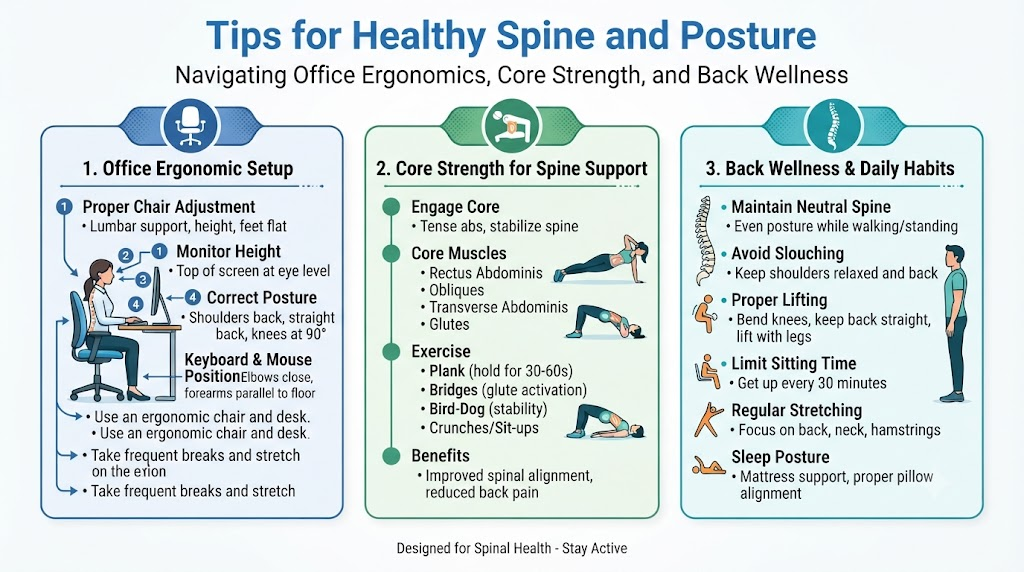
When sitting at your desk, choose a supportive chair that matches the natural curve of your lower back, or add a small lumbar roll to keep your spine aligned. Keep your feet resting flat on the floor with your knees at a comfortable 90-degree angle, and position your computer monitor directly at eye level. This simple change keeps you from tilting your chin down or slouching forward, protecting your neck and shoulders from unnecessary tension during long working hours.
Stand Tall with Relaxed Shoulders and Lift Safely
When standing, imagine a straight line running down from your earlobe, through your shoulder and hip, directly to the center of your ankle. Distribute your weight evenly across both feet, keep your knees slightly soft rather than locked tight, and let your shoulders drop back and down naturally. When you need to pick up an object from the floor, always stand close to the item, bend deeply at your knees and hips, and use the natural power of your legs to stand back up, keeping the object close to your chest to protect your lower back.
Stay Active, Stretch, and Adjust Your Sleep Setup
Engage in regular, low-impact movements—like walking or swimming—to keep your joints well-lubricated, and pair this activity with daily stretches for your hips and chest to relieve built-up tension. Choose a comfortable, supportive mattress that keeps your spine aligned, and sleep in a back-friendly position, such as on your side with a small pillow between your knees. Finally, choose supportive footwear with good arch support to provide a solid base for your body, helping to keep your spine balanced naturally with every step you take.
Common Spine Problems Linked to Poor Posture
Allowing poor postural habits to go uncorrected over time can gradually exhaust your supporting muscles and place uneven pressure on your joints, leading to common areas of discomfort.
Localized Muscle Strains and Tension
- Neck and Shoulder Pain: Continuously tilting your head forward to read screens forces the muscles at the back of your neck to stay tightly contracted. This constant strain limits local circulation, leading to dull aches, muscle knots, and tension headaches.
- Upper and Mid-Back Discomfort: Slouching forward over a desk stretches the muscles of your upper back out of their natural shape while tightening your chest muscles, resulting in a persistent, burning ache between your shoulder blades.
- Lower Back Aches: Sitting without adequate support flattens the natural curve of your lower spine, transferring the weight of your torso directly onto the delicate ligaments and muscles of the lumbar region.
Structural Adjustments and Reduced Flexibility
- Rounded Shoulders and Forward Head Posture: Over time, the body can adapt to poor sitting habits by shortening the muscles in the front of your chest and weakening the muscles in your upper back, making it harder to stand up straight comfortably.
- Sciatica and Nerve Irritation: In some cases, slouched sitting combined with a weak core can place uneven pressure on the flexible discs of your lower back, which can irritate nearby nerves and send a sharp, radiating discomfort down the back of your leg.
- Reduced Range of Motion: When joints are rarely moved through their full, natural range, the surrounding tissues can become stiff and less flexible, making simple movements like turning around to look behind you feel restricted.
Workplace Ergonomics for Better Posture
Since many adults spend a significant portion of their day at a desk, structuring your workspace according to clear ergonomic principles is a primary factor in preventing long-term back strain.
[Screen at Eye Level] ➔ [Elbows at 90 Degrees] ➔ [Lumbar Support in Place] ➔ [Feet Flat on Floor]
Optimize Your Seating and Keyboard Setups
Adjust your office chair height so that your feet rest completely flat on the floor, ensuring your thighs stay parallel to the ground and your knees align comfortably with your hips. Pull your keyboard and mouse close enough that your upper arms can hang relaxed near your torso, allowing your elbows to bend at a comfortable 90-degree angle. This setup keeps you from reaching forward unnecessarily, protecting your wrists, forearms, and shoulders from constant micro-strain.
Perfect Your Monitor Placement and Take Movement Breaks
Position your computer screen directly in front of you, about an arm’s length away, with the top of the monitor sitting right at your natural eye level. If you work on a laptop, consider using an external keyboard and placing the laptop on a stand to avoid looking down continuously. Most importantly, remember that no matter how perfect your desk setup is, your body is built to move; make it a rule to stand up, stretch your arms, and walk around for a few minutes every 30 minutes to keep your circulation moving freely.
Exercises That Support Spine Health
Building simple, targeted exercises into your weekly routine is an excellent way to strengthen the supporting muscles around your spine, improve your balance, and keep your body moving smoothly.
- Brisk Daily Walking: A simple 30-minute walk at a comfortable pace is an outstanding, low-impact exercise that stimulates healthy circulation, strengthens your leg and hip muscles, and gently moves your spinal joints without placing harsh impact on your back.
- Deep Core Strengthening: Practicing exercises like the bird-dog or dead-bug builds internal strength in your deep abdominal layers and lower back stabilizers, creating a steady foundation that supports your spine during everyday movements.
- Stabilizing Forearm Planks: Holding a clean, well-aligned forearm plank activates your core, shoulders, and glutes together, helping to build the muscular endurance needed to maintain a healthy posture throughout the day.
- Gentle Back Extensions: Lying prone on a comfortable mat and gently lifting your chest a few inches off the floor strengthens the muscles of your upper back, directly countering the slouched positioning caused by sitting at a desk.
- Mindful Yoga or Pilates Practices: Participating in structured yoga or Pilates sessions focuses on careful body alignment, lengthening tight muscle groups, and building structural stability under controlled, gentle conditions.
- Simple Balance Training: Standing on one foot or practicing slow heel-to-toe walking sharpens your coordination and trains your stabilizer muscles, helping to prevent accidental slips and falls.
Warning Signs That Need Medical Evaluation
While minor muscle stiffness from an unusually busy day often clears up with gentle movement and rest, certain symptoms point to deeper structural changes that require professional attention. Consult a qualified orthopedic specialist or physiotherapist if you experience any of the following warning signs:
Persistent and Spreading Symptoms
If you experience back or neck pain that lasts for several weeks without improvement, or if the discomfort wakes you from a sound sleep, it is important to seek a comprehensive medical assessment. Pay close attention if the pain begins to radiate away from your spine, traveling down into your shoulders, arms, or down past your hips into your legs, as this can point to localized nerve compression.
Neurological Warning Signs and Physical Weakness
- Persistent Numbness or Tingling: Experiencing a constant “pins and needles” sensation or a loss of normal feeling in your hands, fingers, legs, or feet requires a professional neurological check.
- Noticeable Muscle Weakness: If you suddenly find it difficult to lift the front of your foot when walking, frequently trip over minor bumps, or struggle to grip everyday objects securely, schedule an orthopedic checkup promptly.
- Discomfort Following an Injury: Any significant back or neck pain that develops immediately after a car accident, a hard fall, or a sports injury should be evaluated by a medical team to check for structural changes.
- Critical Emergency Warning: If you experience a sudden loss of bowel or bladder control, or notice severe numbness spreading around your groin area, seek emergency medical care immediately, as these symptoms require urgent intervention to protect your nerves.
How BESTORTHOHOSPITALS Helps Patients
Navigating persistent back pain and evaluating different orthopedic options can sometimes feel confusing for patients and families. BESTORTHOHOSPITALS serves as an objective, educational platform engineered to simplify your search for high-quality musculoskeletal care.
Verified Orthopedic Center Discovery
The platform provides a comprehensive directory of accredited orthopedic centers, specialized spine clinics, and dedicated physical rehabilitation departments. Users can explore facility locations, review the professional credentials of practicing spine specialists, and find highly rated care close to home without needing to sort through unverified online sources.
Transparent Center Comparison and Educational Libraries
Through easy-to-read guides and comprehensive facility overviews, the platform allows you to evaluate medical centers based on objective quality markers, such as advanced minimally invasive surgical suites, board-certified physical therapists, and comprehensive patient recovery rates. This helps clarify complex medical terms, ensuring you know exactly what options to discuss with your specialist.
Direct Access to Practical Resources
Beyond serving as a trusted educational library, the platform allows users to easily request treatment overviews and facility profiles. By helping families connect smoothly with accredited orthopedic care systems, the platform empowers you to manage the planning and scheduling aspects of your care journey with complete confidence from home.
Common Mistakes People Make
Avoiding common behavioral errors during your everyday routine can protect your back from unnecessary stress and help you avoid long-term joint strain.
Sitting for Long Stretches Without Moving
Believing that a single workout in the morning makes it safe to sit completely still at a desk for the next eight hours allows localized stiffness to build up in your joints and discs.
Looking Down at Handheld Screens Continuously
Holding your smartphone down at chest level and tilting your chin down toward your collarbone places a continuous, heavy physical load on the delicate muscles of your neck.
Relying Entirely on Posture Braces
Using tight, elastic posture braces all day long to force your shoulders back actually allows your natural supporting muscles to become lazy and weak, rather than building real internal strength.
Lifting Heavy Objects with a Slouched Back
Bending forward from your lower back with straight legs to lift heavy grocery bags or boxes transfers the entire mechanical load directly onto your discs instead of using your powerful leg muscles.
Ignoring Recurring Sub-Acute Back Pain
Covering up constant, low-grade back stiffness with heat patches or over-the-counter painkillers instead of identifying the underlying lifestyle triggers allows poor habits to continue causing strain.
Common Myths vs. Facts
Myth: Holding your body completely straight and rigid like a board all day long is the absolute gold standard for perfect posture.
Fact: Healthy, natural posture means keeping your muscles relaxed and maintaining the natural, gentle curves of your spine. Forcing an artificial, rigid position actually creates extra muscular tension and fatigue.
Myth: Bothersome back discomfort and spinal changes are structural issues that only affect older adults later in life.
Fact: Postural strain can develop at any stage of life. Children, teenagers, and young adults frequently experience neck and back tension due to long hours of schoolwork, heavy backpacks, and excessive screen time.
Myth: If you are currently dealing with standard lower back pain, the most effective treatment is to stay in bed and avoid all physical movement.
Fact: Prolonged bed rest can cause your muscles to become stiff and weak, which can delay your recovery. Gentle, low-impact movements like short walks are usually far more effective for supporting your recovery.
Myth: Adjusting your everyday posture and desk ergonomics will immediately prevent every type of spinal condition from developing.
Fact: Good postural habits significantly lower your risk of muscle strain and joint wear, but they cannot completely prevent every condition. Genetic factors, natural aging, and unpredictable injuries also play a role in your spinal health.
Real-Life Educational Scenarios
Scenario A: Rebuilding Desk Ergonomics for Shoulder Comfort
An office worker suffered from persistent, burning discomfort between their shoulder blades and frequent tension headaches by the end of every afternoon. After evaluating their workstation, they realized they were sloucing forward to read a low laptop screen and reaching too far for their mouse. By raising their screen to eye level on a sturdy stand, pulling their keyboard close, and taking a quick movement break every 30 minutes, they successfully relieved the daily strain on their upper back.
Scenario B: Reducing Neck Strain Through Smarter Device Habits
A college student began experiencing sharp neck stiffness after spending long hours studying and reading textbooks on their smartphone. Their physical therapist pointed out the heavy physical strain caused by tilting their chin down toward their chest for hours at a time. The student adjusted their habits by holding their device up at eye level, using a supportive book wedge for studying, and practicing simple neck stretches, which quickly restored their comfort.
Scenario C: Supporting Stability Through Guided Core Exercises
A senior citizen wanted to maintain their independent lifestyle but noticed they felt increasingly stiff when standing up from a low chair. They began a gentle, structured routine focused on low-impact walking combined with simple, doctor-approved core stability movements like the bird-dog. Within a few months, this consistent, gentle physical training significantly strengthened their abdominal and back muscles, giving them better balance and greater physical ease.
Scenario D: Seeking Expert Orthopedic Evaluation for Radiant Pain
A forklift driver developed a dull lower back ache that gradually turned into a sharp discomfort radiating down past their right knee, accompanied by intermittent tingling in their toes. Recognizing that radiating symptoms require professional attention, they scheduled an assessment at an accredited spine clinic. The orthopedic specialist accurately diagnosed an irritated nerve root and designed a personalized recovery plan, helping the patient return to work safely.
FAQs (Frequently Asked Questions)
1.Why is keeping a healthy posture so important for long-term health?
Proper alignment keeps your bones and joints positioned correctly so your muscles can work efficiently, lowering mechanical stress on your ligaments, preserving joint cartilage, and supporting comfortable breathing.
2.What are the primary warning signs that point to poor posture?
Common early signs include chronically rounded shoulders, a forward head position, constant muscle knots in your upper back, a flattened lower spine when sitting, and recurrent tension headaches.
3.Can a slouched sitting habit really trigger persistent neck pain?
Yes. Tilting your head forward out of its natural alignment forces your neck muscles to contract continuously to support the weight of your head, leading to localized fatigue, inflammation, and stiffness.
4.How frequently should I take movement breaks if I work at a desk?
Leading orthopedic guidelines generally recommend standing up, stretching your arms, and moving around for two to three minutes every 30 minutes to refresh your circulation and prevent joint stiffness.
5.Which specific exercises are most effective for supporting my spine?
Your back benefits most from low-impact cardiovascular movements like brisk walking, combined with targeted core stabilization exercises such as planks, bird-dogs, back extensions, and gentle bridge movements.
6.Does sitting all day at work affect my spine even if I exercise later?
Yes. Spending consecutive hours sitting still places a continuous, heavy physical load on your lumbar discs, making regular movement breaks throughout the day just as important as your dedicated workout sessions.
7.What key features define a properly arranged ergonomic workstation?
An ergonomic setup includes a computer monitor positioned right at eye level, a supportive chair that matches the curve of your lower back, elbows resting at a 90-degree angle, and feet flat on the floor.
8.Can making adjustments to my posture help relieve existing back pain?
Yes. Correcting your alignment and modifying your workspace helps remove uneven physical pressure from strained muscles and joints, which can significantly lower your discomfort and support healing.
9.What is the most supportive sleeping position for long-term back health?
Sleeping on your side with your knees slightly bent and a small pillow tucked between them is highly recommended, as this setup keeps your pelvis balanced and maintains your spine’s natural alignment.
10.When should I schedule a visit with an orthopedic spine specialist?
You should seek a professional assessment if your back pain lasts for more than a few weeks, wakes you up at night, or is accompanied by radiating pain, muscle weakness, numbness, or tingling in your limbs.
11.Does my overall body weight have a direct impact on my spine?
Yes. Carrying excess weight, particularly around your abdomen, pulls your pelvis forward and increases the arch in your lower back, placing extra mechanical strain on your lumbar discs and joints.
12.Is it possible for young children to develop posture-related concerns?
Yes. Children can develop postural strain due to long hours sitting at unadjusted desks, spending excessive time hunched over screens, and regularly carrying heavy, improperly balanced school backpacks.
13.How can I practice better alignment while using my mobile phone?
You can protect your neck by raising your smartphone up closer to eye level rather than tilting your head down, and taking regular breaks to gently roll your shoulders back.
14.What simple daily habits support optimal spine health over the years?
Long-term spinal wellness is built on staying hydrated to keep discs cushioned, maintaining core strength, using safe lifting techniques, taking frequent movement breaks, and choosing supportive footwear.
15.How does BESTORTHOHOSPITALS support patients searching for back care?
The platform serves as a trusted educational guide, providing verified directories of accredited orthopedic hospitals, listing specialist profiles, and sharing easy-to-read guides on spine care from home.
Final Thoughts
Prioritizing smart postural habits, building regular physical movement into your day, and maintaining an ergonomically supportive environment are among the most valuable choices you can make to protect your spine and support your long-term orthopedic wellness. Advanced medical care and surgical interventions provide outstanding solutions for complex structural issues, but the daily comfort and long-term strength of your back rely heavily on the simple choices you make every day. By adjusting your desk setup, strengthening your core muscles, using safe lifting habits, and staying active, you create a solid, stable foundation for your entire body.