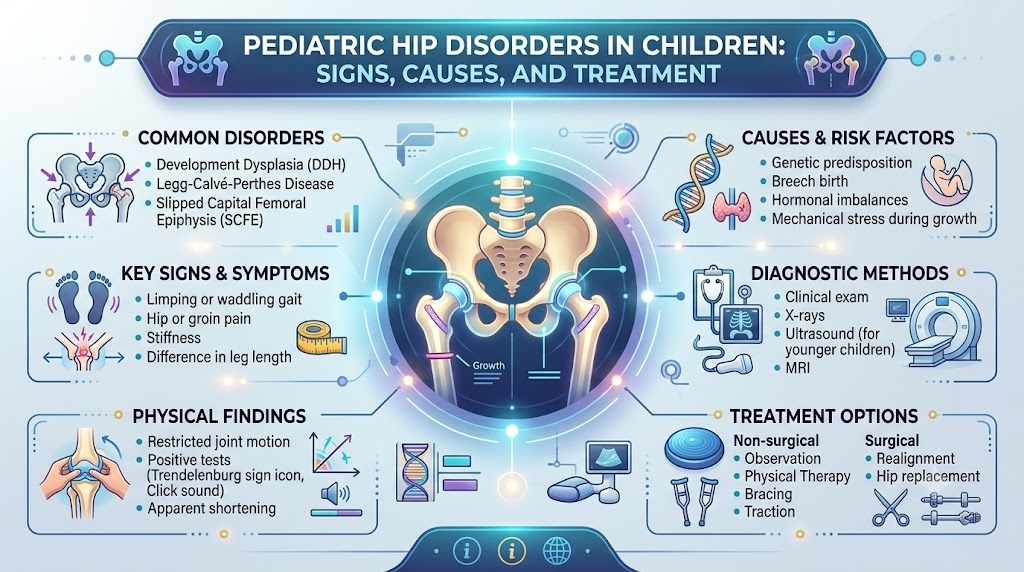
Children use their hips every day to walk, run, play, and move comfortably. Some hip problems begin before birth, while others develop as children grow. These conditions can affect the hip joint, nearby bones, or surrounding tissues.
A child with a hip problem may limp, feel pain, or move one leg less freely. Some babies show few clear signs. Early medical assessment can help identify the cause and guide care.
Understanding pediatric hip disorders helps parents know what to watch for and when to seek help. Bestorthohospitals can be a starting point for exploring orthopedic health information. A qualified healthcare professional can assess your child’s symptoms and explain suitable treatment options.
What Are Pediatric Hip Disorders?
Pediatric hip disorders are conditions that affect the hip joint or the bones and tissues around it. They can occur in babies, young children, and teenagers.
The hip is a ball-and-socket joint. The rounded top of the thigh bone fits into a cup-shaped part of the pelvis. This design allows the leg to move in several directions.
Healthy hip development supports walking, balance, and everyday movement. Some problems begin before birth or during infancy. Others appear during periods of rapid growth or after an injury.
Symptoms vary by condition and age. A baby may have limited hip movement, while a teenager may develop pain and a limp. Some conditions need only careful monitoring, while others require specialist treatment or surgery.
Common Types of Pediatric Hip Disorders
Several conditions can affect children’s hips. Their symptoms may overlap, so a medical examination is important.
Developmental Dysplasia of the Hip (DDH)
Developmental dysplasia of the hip, or DDH, occurs when the hip joint does not form or fit together properly. The ball at the top of the thigh bone may not sit securely in its socket.
DDH may be present at birth or become clearer as a baby grows. Some babies have no obvious signs. This is why routine infant hip checks and recommended screening matter.
Possible signs include:
- Limited movement when opening the hips.
- One leg appearing different from the other.
- Uneven skin folds around the thighs.
- A difference in leg length in some children.
- A limp or unusual walking pattern in older children.
These signs do not confirm DDH. A doctor must examine the baby or child to assess the hip joint.
Ultrasound may help examine the hips of young babies. X-rays may be more useful as children get older. The choice depends on age and clinical findings.
Treatment depends on the child’s age and the degree of hip instability. A special harness may help guide hip development in some babies. Braces or surgery may be needed in selected cases. Early assessment helps the care team choose the right approach.
Legg-Calvé-Perthes Disease
Legg-Calvé-Perthes disease, often called Perthes disease, affects the blood supply to the top of the thigh bone. The bone may weaken and change shape before it heals.
It most often affects children between about four and eight years old, though other ages are possible. The condition usually develops gradually.
Parents may notice:
- A limp that comes and goes.
- Pain in the hip, thigh, or knee.
- Stiffness or reduced hip movement.
- More discomfort after physical activity.
Some children have little pain at first. A doctor may examine the child’s walking and hip movement, then order X-rays. Other imaging may be needed in certain cases.
Treatment depends on the child’s age, the stage of the disease, and how much the hip is affected. Care may include monitoring, changes to physical activity, physical therapy, or surgery. Regular follow-up helps doctors track healing and hip shape.
Slipped Capital Femoral Epiphysis (SCFE)
Slipped capital femoral epiphysis, or SCFE, happens when the upper part of the thigh bone slips at its growth plate. It often occurs during the teenage years.
A child may report pain in the hip, groin, thigh, or knee. Limping and difficulty moving the leg can also occur. Because the pain may be felt in the knee, the actual hip problem can be missed.
Doctors usually use an examination and X-rays to assess suspected SCFE. Prompt treatment is important because the slip can worsen and damage the hip.
Important safety message: Suspected SCFE requires urgent medical assessment. The child or teenager should not put weight on the affected leg while waiting for medical care. Arrange emergency assessment rather than asking the child to walk or exercise.
Transient Synovitis of the Hip
Transient synovitis is temporary inflammation around the hip joint. It can cause hip discomfort or a limp, sometimes after a recent viral illness. It is more common in young children.
Symptoms may begin suddenly. A child may limp or complain of pain in the hip, thigh, or knee. Some children may have mild symptoms, but a doctor should assess them.
This condition can resemble a serious joint infection. Parents should not assume that hip pain after a cold is harmless. Fever, severe pain, difficulty bearing weight, or a child who appears very unwell needs urgent medical care.
When a clinician confirms transient synovitis, treatment may include rest and suitable pain relief. Follow the clinician’s advice and arrange follow-up if recommended. Seek another assessment if symptoms worsen, return, or fail to improve as expected.
Pediatric Hip Injuries and Fractures
Falls, sports injuries, and road accidents can damage the hip or nearby bones. The severity can range from a mild injury to a fracture.
Possible signs include pain after an accident, swelling, reduced movement, or difficulty standing. Some fractures may not be obvious from the outside.
A healthcare professional may examine the child and order X-rays or other imaging. Treatment depends on the type of injury, the child’s age, and whether the bones remain aligned.
A suspected fracture or inability to bear weight after an injury needs prompt medical assessment. Do not force the child to stand or walk while waiting for help.
Other Hip Problems in Children
Other conditions can also affect hip movement. Juvenile idiopathic arthritis is a long-term condition that can cause joint inflammation, stiffness, and pain. Symptoms may be worse after rest or in the morning.
Some children have structural differences in the hip or nearby bones. These may affect movement as the child grows.
A limp, stiffness, or pain can have many causes. Arrange a medical assessment for persistent or unexplained symptoms rather than trying to identify the condition at home.
Signs and Symptoms Parents Should Watch For
Hip disorder symptoms in children vary. Parents may notice changes during walking, play, dressing, or routine care.
Watch for signs such as:
- A new limp or change in walking.
- Pain in the hip, groin, thigh, or knee.
- Stiffness or reduced hip movement.
- Difficulty standing or walking.
- One leg appearing shorter or moving differently.
- Less interest in playing or taking part in usual activities.
- Unusual hip movement noticed during an infant check.
Babies may not be able to show or explain pain. Some hip conditions have few visible signs early on. Routine infant examinations and recommended screening can help identify certain problems.
A single limp does not always mean a serious disorder. However, ongoing pain, repeated limping, or reduced movement deserves medical attention.
When Should Parents Seek Medical Care?
Arrange a medical appointment if your child has ongoing hip pain, a continuing limp, or reduced hip movement. A noticeable change in walking also deserves assessment, even if the child does not complain of pain.
Seek urgent medical care if your child:
- Cannot walk or put weight on a leg.
- Has sudden or severe hip pain.
- Has hip pain with fever.
- Appears very unwell or unusually sleepy.
- Develops severe pain after an injury.
- Has symptoms that suggest a slipped capital femoral epiphysis.
A painful hip with fever can signal a joint infection. This may need urgent treatment to protect the joint and the child’s health. Do not wait for these warning signs to improve on their own.
If you are unsure how serious the symptoms are, contact a healthcare professional for advice. When symptoms are severe or the child cannot bear weight, seek emergency assessment.
How Are Pediatric Hip Disorders Diagnosed?
Doctors use the child’s symptoms, medical history, physical examination, and sometimes imaging tests. The goal is to find the cause of the problem and choose the right care.
The doctor may ask:
- When did the pain or limp begin?
- Did it start after an injury or illness?
- Does movement make the pain worse?
- Has the child had similar symptoms before?
- Were any hip concerns found during infant checks?
- Is there a family history of hip problems?
The doctor may watch the child walk, if it is safe to do so. They may check leg position, hip movement, and differences between the two sides. A child with suspected SCFE or a possible fracture should not be asked to walk unnecessarily.
Imaging tests depend on the child’s age and suspected condition. These may include:
- Ultrasound: Often used to assess the hip joint in young babies.
- X-rays: Help show bones and joint alignment.
- MRI or other tests: May be needed when initial findings do not answer the clinical question.
- Blood tests: May help investigate infection or inflammation in selected cases.
Not every child needs every test. The doctor will explain which tests are appropriate and what the results may mean.
Treatment Options for Pediatric Hip Disorders
Pediatric hip treatment options depend on the diagnosis, the child’s age, symptom severity, and stage of growth. The same treatment is not suitable for every hip condition.
Monitoring and Activity Changes
Some conditions can be managed with planned follow-up and changes to activity. The care team may recommend avoiding running, jumping, or sports for a period.
Parents should follow the specific advice given for their child. Do not assume that rest alone is safe when the child has severe pain, a sudden limp, or difficulty bearing weight.
Monitoring may include repeat examinations or imaging. These visits help the doctor check whether the condition is improving or needs a different treatment.
Medicines and Pain Management
A clinician may recommend pain relief for some hip conditions. The right medicine depends on the child’s age, weight, health, and other medicines.
Follow professional advice and the product instructions. Do not give adult medicines or guess a dose. Pain relief can reduce discomfort, but it does not identify the cause of hip pain.
If pain continues, becomes severe, or occurs with fever or inability to walk, seek medical assessment rather than relying on medicine at home.
Braces, Harnesses, and Casts
A harness or brace may help guide hip development in selected babies with DDH. The treating team will explain how it should fit and how long it should be used.
Some injuries or other conditions may require a cast or different support. These devices should be used only as directed.
Do not adjust, remove, or change a prescribed device without advice from the care team. Contact them if the device seems too tight, causes skin problems, or does not fit properly.
Physical Therapy and Rehabilitation
Physical therapy may help some children improve movement, strength, balance, and daily function. The therapist selects activities based on the diagnosis and stage of recovery.
Not every hip condition is suitable for exercise at every stage. Children with SCFE, a suspected fracture, or another serious problem need medical assessment before starting exercises.
Parents should follow the recommended plan and avoid movements or sports that the doctor has restricted.
Surgery for Pediatric Hip Disorders
Some children need surgery to correct hip alignment, stabilise a slipped growth plate, treat an injury, or address a structural problem. Surgery is not needed for every pediatric hip disorder.
The procedure depends on the condition and the child’s stage of growth. The orthopedic team should explain the purpose, possible risks, other options, and expected recovery.
Some children need a period of limited weight-bearing or rehabilitation after surgery. Follow-up visits help the team monitor healing and hip development. No treatment can guarantee the same result for every child.
The following table offers a general comparison. It is not a treatment plan for an individual child.
| Treatment Approach | When It May Be Used | What Parents Should Know |
|---|---|---|
| Monitoring | Selected conditions that can be safely observed | Follow-up appointments remain important |
| Activity changes | Conditions where certain movements may worsen symptoms | Follow clinician-specific restrictions |
| Harness or brace | Selected cases of developmental hip dysplasia | Fit and use must follow professional guidance |
| Physical therapy | When movement and strength support recovery | Exercises should match the child’s condition |
| Surgery | Certain structural problems, severe conditions, or injuries | The plan depends on diagnosis and the child’s growth |
Recovery and Long-Term Hip Health
Recovery varies with the condition and treatment. Some children improve within a short time, while others need months of care or longer follow-up.
Parents can support recovery by:
- Following instructions about walking and weight-bearing.
- Attending all recommended appointments.
- Using prescribed braces, casts, or walking aids as directed.
- Following the return-to-school and sports plan.
- Reporting new pain, swelling, fever, or worsening movement.
- Helping the child follow the rehabilitation plan.
Some disorders need long-term monitoring because the hip continues to grow. The doctor may recommend repeat examinations or imaging to check joint shape and movement.
Ask the care team what recovery may look like for your child’s diagnosis. Do not restart sports or stop using a device simply because the child feels better.
How to Choose a Pediatric Orthopedic Hospital
Choosing a hospital or orthopedic department can feel difficult when a child is in pain. Focus on the care your child needs rather than unsupported rankings or general claims.
When comparing options, ask about:
- Pediatric orthopedic experience: Does the team regularly assess hip conditions in children?
- Specialist access: Can your child see a clinician with relevant pediatric orthopedic experience?
- Imaging services: Are suitable tests available for the child’s age and condition?
- Team support: Can the hospital arrange pediatric anesthesia or rehabilitation when needed?
- Clear communication: Will the team explain the diagnosis, choices, and risks in plain language?
- Follow-up care: Can the team monitor recovery and hip growth?
- Urgent assessment: How should families seek help if symptoms worsen?
- Practical needs: Consider location, appointment access, costs, and insurance coverage.
Confirm the available services directly with the hospital. Ask who will manage follow-up and whom to contact if you have concerns after treatment.
BestOrthoHospitals.com may help readers explore orthopedic health information. However, parents should confirm a hospital’s specialists and services before making care decisions.
How Parents Can Support a Child With a Hip Disorder
A hip condition can affect a child’s routine, school life, and confidence. Parents can help by keeping appointments and sharing changes in symptoms with the care team.
Follow all instructions about medicines, activity, and prescribed devices. Ask the clinician before changing the treatment plan. If your child uses crutches or a walking aid, make sure they receive guidance on using it safely.
You may also need to adjust daily routines. Talk with the school about physical education, stairs, transport, or extra time to move between classes. Keep the child’s needs in mind without making them feel left out.
Explain the condition in simple, age-appropriate words. Reassure your child that asking questions is okay. Ask the care team when normal play, exercise, and sports can safely resume.
Common Pediatric Hip Disorders
The table below summarizes several conditions and important points for parents. Symptoms can overlap, so it should not be used to diagnose a child.
| Hip Disorder | Common Signs | Important Consideration |
|---|---|---|
| Developmental dysplasia of the hip (DDH) | Limited hip movement or signs found during infant screening | Early assessment helps guide treatment |
| Legg-Calvé-Perthes disease | Limping or pain in the hip, thigh, or knee | Requires evaluation and follow-up based on disease stage |
| Slipped capital femoral epiphysis (SCFE) | Hip, groin, thigh, or knee pain with a limp | Suspected SCFE requires urgent medical assessment |
| Transient synovitis | Temporary hip discomfort or limping | Serious causes, including infection, must be considered |
| Hip injury or fracture | Pain and difficulty moving after an injury | Prompt assessment may be needed |
Frequently Asked Questions
1. What are the most common hip disorders in children?
Common conditions include developmental dysplasia of the hip, Perthes disease, and slipped capital femoral epiphysis. Children may also develop temporary hip inflammation, arthritis, or injuries. Each condition has different causes and treatments. A healthcare professional can assess symptoms and decide whether imaging or specialist care is needed.
2. What are the early signs of hip problems in babies?
Some babies have limited hip movement, uneven leg positions, or differences noticed during routine examinations. However, many babies with hip problems show no obvious signs. Attend recommended infant checks and screening appointments. If you notice unusual movement or have concerns about your baby’s hips, ask a healthcare professional.
3. Can a hip disorder cause knee pain in children?
Yes. Some hip conditions cause pain that a child feels in the thigh or knee instead of the hip. Perthes disease and SCFE are examples. A child with unexplained knee pain and a limp may need a hip examination. Do not assume the problem is limited to the knee.
4. When should a child with hip pain see a doctor?
Arrange an appointment for ongoing pain, a persistent limp, stiffness, or changes in walking. Seek urgent medical care if your child cannot bear weight, has sudden severe pain, or has hip pain with fever. Severe pain after an injury also needs prompt assessment. These symptoms may require immediate treatment.
5. How is developmental dysplasia of the hip treated?
Treatment depends on the child’s age and the severity of the condition. Some babies may need a special harness to help the hip develop in a better position. Others may need bracing or surgery. Doctors may use ultrasound or X-rays to assess the joint and monitor progress.
6. What is Legg-Calvé-Perthes disease?
Legg-Calvé-Perthes disease affects the blood supply to the top of the thigh bone. The bone may weaken and change shape before healing. Children may develop a limp, hip pain, or knee pain. Treatment can include monitoring, activity changes, physical therapy, or surgery, depending on the child’s needs.
7. What is slipped capital femoral epiphysis?
Slipped capital femoral epiphysis, or SCFE, occurs when the upper thigh bone slips at its growth plate. It often affects teenagers and may cause hip, groin, thigh, or knee pain. Suspected SCFE needs urgent medical assessment. The child should not put weight on the affected leg while waiting for care.
8. Do all pediatric hip disorders require surgery?
No. Some conditions improve with monitoring, activity changes, prescribed devices, or other non-surgical care. Surgery may be needed for certain structural problems, severe conditions, or injuries. The best approach depends on the diagnosis, age, and stage of growth. A pediatric orthopedic specialist can explain suitable options.
9. How long does recovery from a pediatric hip disorder take?
Recovery depends on the condition, its severity, and the treatment used. Some children improve within a short period, while others need months of rehabilitation or longer monitoring. Follow the care team’s advice about walking, school, and sports. Attend follow-up appointments even when symptoms have improved.
10. How can parents choose a pediatric orthopedic hospital?
Look for suitable pediatric orthopedic experience, age-appropriate imaging, clear communication, and access to follow-up care. Ask about the team’s experience with your child’s specific condition. Also consider appointment access, location, costs, and insurance. Confirm the hospital’s services directly instead of relying on unverified rankings or claims.
Conclusion
Understanding pediatric hip disorders helps parents recognize possible symptoms and seek appropriate care. Hip pain, limping, and changes in walking can have several causes, so a professional assessment is important.
Seek urgent care if your child cannot bear weight, develops sudden severe pain, or has hip pain with fever. Suspected SCFE also requires urgent assessment, with no weight placed on the affected leg while waiting for care.
BestOrthoHospitals.com can serve as a resource for exploring orthopedic health information. For diagnosis and treatment, speak with a qualified healthcare professional who can assess your child’s needs.