Receiving a neurological diagnosis can feel overwhelming, leaving patients and families facing difficult choices during an already stressful time. Navigating brain conditions, surgical procedures, and recovery paths requires accurate information and careful planning. Identifying the right medical institution and care team plays a vital role in ensuring you receive appropriate, specialized evaluation tailored to your specific condition.Specialized brain surgery hospitals provide comprehensive environments where multidisciplinary teams diagnose, manage, and treat complex neurological disorders. Because neurological conditions vary widely—ranging from tumors and vascular issues to seizure disorders—seeking treatment at an appropriate facility ensures access to advanced technology, experienced specialists, and structured post-operative care.Understanding how to evaluate medical centers, research qualified specialists, explore treatment approaches, and seek second opinions empowers you to make informed decisions. This guide outlines the structure of specialized neurosurgical care, helping you prepare for meaningful discussions with qualified healthcare providers.
What Are Brain Surgery Hospitals?
Specialized neurosurgical centers offer comprehensive services designed to evaluate, manage, and treat conditions affecting the brain, spine, and nervous system. Rather than providing isolated treatments, these facilities combine advanced technology, specialized operating environments, and multi-specialty care teams to support patients throughout their care journey.
Neurosurgical Evaluation
A comprehensive evaluation begins with a detailed medical history review, physical and neurological examinations, and consultation with experienced specialists to determine whether surgical intervention or non-surgical management is appropriate.
Diagnostic Imaging and Testing
Specialized hospitals utilize advanced diagnostic technology, including high-resolution MRI, CT angiography, PET scans, and functional imaging, to pinpoint neurological conditions with exceptional accuracy.
Specialist Consultation
Patients meet with multidisciplinary care providers—including neurosurgeons, neurologists, neuro-oncologists, and neuro-radiologists—to review diagnostic findings and discuss potential care strategies.
Surgical and Non-Surgical Treatment Planning
Care plans are highly individualized, balancing traditional open surgery, advanced minimally invasive techniques, targeted radiation, or medical management based on clinical necessity.
Post-Treatment and Follow-Up Care
Dedicated recovery services, including neuro-intensive care units, specialized rehabilitation programs, and structured outpatient follow-up, ensure continuous monitoring throughout recovery.
Hospital capabilities vary significantly between institutions. Patients should review available services, technological infrastructure, and specialist experience directly with healthcare professionals when evaluating options.
Neurosurgery Hospitals and Specialist Care
Complex neurological conditions rarely exist in isolation; they require coordinated care across multiple disciplines. Specialized neurosurgery hospitals establish collaborative ecosystems where specialists work together to evaluate and manage complex medical cases.
The clinical infrastructure within these centers typically includes:
- Neurology Collaboration: Neurologists provide expertise in medical management, diagnostic testing, and long-term symptom monitoring.
- Advanced Imaging Capabilities: High-field MRI, intraoperative CT, and functional mapping guide precise surgical planning.
- Specialized Operating Facilities: Surgical suites equipped with intraoperative navigation, high-powered microscopes, and endoscopic platforms enable complex interventions.
- Neuro-Intensive Care Units (Neuro-ICUs): Dedicated intensive care units staffed by neuro-intensivists provide specialized post-operative monitoring.
- Comprehensive Rehabilitation: Physical, occupational, and speech therapists support recovery and functional independence.
- Multidisciplinary Teams: Tumor boards and specialized care committees bring experts together to review complex cases.
Because clinical resources differ across facilities, confirming that a hospital maintains appropriate infrastructure for your specific diagnostic or treatment requirements is a critical step in the research process.
Brain Surgeons and Neurosurgeons
Understanding the credentials and scope of practice of medical specialists helps clarify who is managing your care.
Medical Specialization
Neurosurgeons are medical doctors who have completed extensive post-graduate residency training focused specifically on the surgical and non-surgical management of neurological conditions. Many undergo additional fellowship training in dedicated subspecialties, such as neuro-oncology, vascular neurosurgery, pediatric neurosurgery, or functional neurosurgery. Experienced brain surgeons limit their focus to specific conditions, ensuring deep expertise in complex cases.
Clinical Assessment and Communication
A neurosurgeon’s primary role during initial consultations is to assess diagnostic findings, determine whether surgical intervention is medically indicated, explain the potential risks and benefits of various options, and coordinate care with other specialists.
Surgical experience and procedural familiarity vary by doctor and condition. Open dialogue with your clinical team allows you to understand their experience with your specific diagnosis.
Brain Tumor Treatment
Managing a brain tumor requires a tailored approach based on individual clinical factors. There is no single universal protocol for brain tumor treatment; decisions depend entirely on tumor type, location, size, grade, symptoms, and the overall health of the patient.
Diagnosis and Imaging
High-resolution neuroimaging identifies the location, structural characteristics, and proximity of a tumor to critical functional areas of the brain.
Tumor Classification
Pathological assessment classifies tumors as benign or malignant, primary or metastatic, while molecular profiling provides insight into tumor behavior and treatment sensitivity.
Surgery
When safe and feasible, surgical resection aims to remove as much tumor tissue as possible while preserving vital neurological function.
Radiation Therapy
Targeted radiation approaches, such as stereotactic radiosurgery or intensity-modulated radiation, may be used as a primary treatment, an adjunct to surgery, or for recurrent tumors.
Drug-Based Treatments
Systemic treatments, including chemotherapy, targeted therapies, and immunotherapies, may be integrated into treatment plans based on pathological and genetic testing.
Monitoring and Follow-Up
Long-term care involves regular imaging scans and clinical evaluations to monitor for changes, manage symptoms, and support ongoing recovery.
Brain Tumor Surgery Hospitals
When researching brain tumor surgery hospitals, patients often look for facilities equipped with dedicated neuro-oncology programs. Effective brain tumor management relies heavily on integrated, multi-specialty support.
Key structural components to look for include:
- Integrated Tumor Boards: Regular clinical meetings where neurosurgeons, neuro-oncologists, radiation oncologists, neuropathologists, and neuroradiologists collectively review patient cases.
- Advanced Surgical Technology: Intraoperative MRI, fluorescence-guided surgery, and cortical mapping tools that assist surgeons during complex resections.
- Pathology and Molecular Diagnostics: Specialized laboratory resources capable of rapidly analyzing tumor tissue to guide post-surgical therapies.
- Rehabilitation Services: Specialized neuro-rehabilitation teams to assist recovery after surgical procedures.
Discussing a hospital’s specific experience and technological tools with your care team ensures alignment with your diagnostic requirements.
Brain Aneurysm Surgery
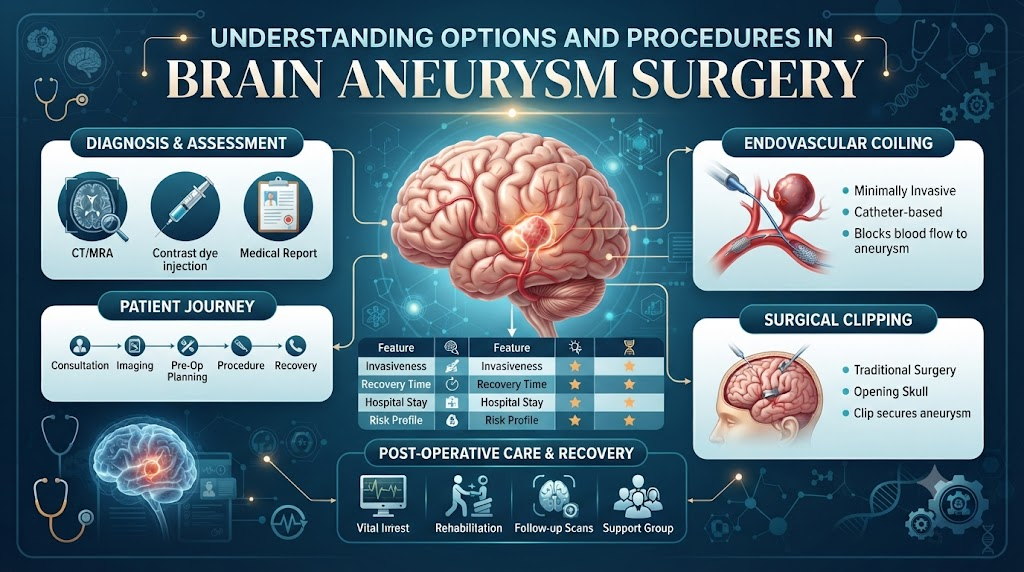
A brain aneurysm is a weak or bulging spot in the wall of an artery in the brain. Over time, the blood vessel wall thins, increasing the risk of leakage or rupture. Choosing an appropriate treatment strategy requires careful assessment by a cerebrovascular specialist.
Management and treatment options generally fall into two categories:
- Surgical Clipping: An open neurosurgical procedure where a small metal clip is placed across the neck of the aneurysm to block blood flow and prevent rupture.
- Endovascular Approaches: Minimally invasive catheter-based techniques, such as coiling, stent-assisted coiling, or flow diversion, which reinforce or occlude the aneurysm from within the blood vessel.
Neither approach is universally superior. Treatment selection depends on the aneurysm’s size, shape, structural orientation, and anatomic location, as well as the patient’s age and overall health.
Urgent Medical Notice: A ruptured brain aneurysm is a life-threatening emergency. If you or someone near you experiences a sudden, extremely severe headache (often described as the “worst headache of your life”), sudden weakness, vision changes, or loss of consciousness, call local emergency medical services immediately.
Epilepsy Surgery
For most individuals with epilepsy, anti-seizure medications effectively manage symptoms. However, when medication fails to provide adequate seizure control—a condition known as drug-resistant or refractory epilepsy—specialized evaluation may determine whether surgical management is an option.
Seizure Origin Mapping
Comprehensive testing, including continuous video-EEG monitoring, high-resolution structural MRI, PET, and SPECT imaging, helps identify the precise focus of seizure onset.
Surgical Interventions
Depending on the location and characteristics of the seizure origin, surgical options may include resective surgery, laser interstitial thermal therapy (LITT), or neuromodulation techniques such as responsive neurostimulation (RNS) or vagus nerve stimulation (VNS).
Epilepsy surgery is considered only after exhaustive evaluation confirms that the seizure focus can be safely targeted without causing significant neurological deficits.
Minimally Invasive Brain Surgery
Advances in medical technology have made minimally invasive brain surgery an effective option for specific neurological conditions. These techniques utilize smaller anatomical entry points, specialized endoscopic cameras, and computer-assisted guidance systems to reach target areas within the brain.
Common applications include:
- Endonasal Endoscopic Surgery: Accessing pituitary tumors and skull base lesions through the nasal passages without open cranial incisions.
- Stereotactic Radiosurgery: Delivering highly focused radiation beams directly to targets without physical surgical incisions.
- Laser Interstitial Thermal Therapy (LITT): Using catheter-guided thermal energy to treat deep-seated tumors or epileptic foci.
While minimally invasive methods offer potential benefits—such as smaller incisions or shorter hospital stays in select cases—they are not suitable or safe for every condition. Treatment decisions depend on tumor type, structural location, patient anatomy, and specialist evaluation.
How to Research Brain Surgery Hospitals
Evaluating medical centers requires a systematic approach to gather reliable information. Using a structured checklist helps keep your research organized:
- Identify the Diagnosis or Suspected Condition: Gather precise diagnostic notes, pathology reports, and imaging documents.
- Research Relevant Neurosurgical Expertise: Look for centers that specialize in your specific condition (e.g., cerebrovascular, skull base, neuro-oncology).
- Review Diagnostic Capabilities: Verify whether the facility offers specialized imaging technology like high-field MRI or PET facilities.
- Understand Available Treatment Approaches: Determine if the hospital offers both open and minimally invasive treatment modalities.
- Check Multidisciplinary Support: Confirm access to related specialties, including neurology, neuro-oncology, and neuro-rehabilitation.
- Review Rehabilitation and Follow-Up Care: Ensure post-operative care and rehabilitation programs are available.
- Understand Location and Accessibility: Consider travel distance, local accommodation options, and family support logistics.
- Ask About Medical Records and Imaging Requirements: Clarify what documentation is needed prior to initial consultation.
- Discuss Costs and Insurance Separately: Contact hospital administrative or financial counseling services directly to understand insurance coverage and out-of-pocket considerations.
Note: Treatment costs vary widely depending on the diagnostic complexity, procedure type, length of hospital stay, required intensive care support, and individual insurance coverage.
Neurosurgery Second Opinion
Seeking a neurosurgery second opinion is a standard, widely respected practice in complex medical care. Obtaining another perspective helps confirm diagnostic findings, explore alternative treatment approaches, and ensure you feel completely confident in your care plan.
A second opinion can be particularly helpful when:
- The diagnosis is complex, rare, or uncertain.
- Multiple treatment options exist with varying risks and benefits.
- Surgical intervention carries significant risk.
- You want to explore minimally invasive alternatives or non-surgical options.
Preparing for a Second Opinion Consultation
To facilitate an effective review, compile a complete package of your medical records, including:
- Official pathology and diagnostic laboratory reports.
- Radiology reports along with raw imaging files (DICOM format on CD or digital download).
- Operation reports or previous treatment summaries.
- A current list of medications and underlying health conditions.
- A written list of specific questions you wish to address.
Benefits of Researching Specialized Neurosurgical Care
Proactively researching medical centers and specialists yields significant benefits for patients and caregivers:
- Improved Understanding: Gaining clear insight into your diagnosis and potential care pathways.
- Informed Decision-Making: Asking targeted, meaningful questions during specialist consultations.
- Targeted Specialist Selection: Locating clinical teams with direct experience in your specific condition.
- Care Alignment: Evaluating facilities to ensure they offer comprehensive diagnostic and post-operative recovery infrastructure.
Conducting research empowers you to participate actively in discussions regarding your health.
Limitations of Online Medical Research
While digital resources offer educational value, online research has clear limitations:
- Cannot Replace Clinical Evaluation: Online information cannot account for individual physical anatomy or complex health histories.
- General Information Only: Educational articles describe broad medical patterns, not specific individual cases.
- Variable Quality: Online information varies in accuracy and currency.
- Lack of Diagnostic Context: Online resources cannot perform physical examinations or interpret raw imaging scans.
All medical information retrieved online should be reviewed with qualified physicians who understand your complete personal medical profile.
Emergency Warning Signs
Certain acute neurological symptoms demand immediate medical intervention rather than online research or scheduled appointments. Seek urgent care if you observe:
- Sudden, severe, or unprecedented headache.
- Sudden weakness, numbness, or paralysis in the face, arm, or leg (especially on one side).
- Sudden difficulty speaking, slurred speech, or trouble understanding language.
- Sudden loss of balance, severe dizziness, or loss of coordination.
- Sudden loss of vision or double vision.
- New-onset seizures or loss of consciousness.
If someone displays these symptoms, contact local emergency services immediately.
BrainSurgeryHospitals.com and Patient Research
Navigating complex healthcare options requires reliable, organized educational resources. BrainSurgeryHospitals.com provides patient-centered educational guidance to help individuals research neurological conditions, neurosurgical specialties, diagnostic procedures, and care facilities.
The platform assists patients and families in learning about brain surgery hospitals, evaluating neurosurgery hospitals, and exploring specialized centers focused on brain tumor treatment, brain aneurysm surgery, and epilepsy surgery. Additionally, it provides information on minimally invasive brain surgery options and guidance on obtaining a neurosurgery second opinion.
By offering clear background information on conditions, treatments, and specialist qualifications, the platform helps patients prepare for consultations with brain surgeons and neurosurgeons. BrainSurgeryHospitals.com serves as an educational research tool designed to complement—not replace—direct discussions with qualified medical professionals.
Medical Research Factors Comparison
| Research Factor | Why It Matters |
| Neurosurgical Expertise | Helps identify specialists and care teams relevant to your specific condition. |
| Diagnostic Capabilities | Supports accurate evaluation through advanced imaging and diagnostic testing. |
| Multidisciplinary Care | Ensures diverse medical specialists collaborate on complex treatment plans. |
| Surgical Techniques | Outlines available options, including traditional open and minimally invasive approaches. |
| Intensive and Follow-Up Care | Provides essential post-operative monitoring, neuro-ICU facilities, and rehabilitation support. |
| Second-Opinion Access | Allows patients to confirm diagnostic findings and evaluate alternative care strategies. |
Frequently Asked Questions
- How can I systematically research brain surgery hospitals?
Start by identifying your specific diagnostic details, then review hospital subspeciality programs, diagnostic imaging capabilities, multi-specialty support teams, and post-operative rehabilitation services. Always discuss your findings with qualified medical professionals. - What makes neurosurgery hospitals different from general medical centers?
Specialized neurosurgery facilities feature dedicated neuro-intensive care units, advanced intraoperative imaging technology, intraoperative neurological monitoring, and multidisciplinary care teams experienced in complex neurological conditions. - How do brain tumor surgery hospitals coordinate care?
These centers typically utilize multidisciplinary tumor boards where neurosurgeons, neuro-oncologists, radiation oncologists, and pathologists collaboratively evaluate patient cases to build integrated, personalized treatment plans. - What qualifications define experienced brain surgeons?
Specialized surgeons complete formal neurosurgical residency training and often complete additional fellowship programs focused on specific subspecialties, such as skull base surgery, cerebrovascular care, or neuro-oncology. - How should patients choose neurosurgeons for complex conditions?
Patients should evaluate a surgeon’s subspecialty focus, clinical background, experience with the specific condition, hospital affiliations, and willingness to answer questions clearly during consultations. - What factors influence the choice of brain tumor treatment?
Treatment strategies depend on tumor classification, size, precise anatomical location, tissue pathology, molecular markers, overall patient health, and functional goals established with the care team. - What is involved in brain aneurysm surgery?
Intervention typically involves open surgical clipping or endovascular techniques like coiling or flow diversion. Treatment selection depends on aneurysm characteristics and specialist evaluation. Emergency symptoms require immediate medical attention. - When is epilepsy surgery evaluated as an option?
Surgery is evaluated for individuals with drug-resistant epilepsy after detailed diagnostic mapping identifies a localized, operable seizure focus that can be treated without compromising critical brain functions. - Is minimally invasive brain surgery suitable for every patient?
No. While minimally invasive methods offer advantages for specific conditions, suitability depends on tumor location, anatomical structural factors, surgical safety, and the treating specialist’s clinical assessment. - Why should a patient consider a neurosurgery second opinion?
A second opinion clarifies diagnostic findings, confirms treatment recommendations, explores alternative surgical or non-surgical strategies, and helps patients feel confident in their care path. - How do I prepare for a second opinion consultation?
Compile complete medical records, official pathology reports, diagnostic imaging files on disk, treatment histories, medication lists, and a written list of specific questions for the specialist. - What questions should I prioritize during a neurosurgery consultation?
Focus on understanding your exact diagnosis, necessary diagnostic steps, available treatment alternatives, associated procedural risks, expected recovery timelines, and recommended follow-up strategies.
Conclusion
Navigating a neurological diagnosis requires clear information, careful reflection, and open communication with healthcare professionals. Finding appropriate brain surgery hospitals and qualified specialists ensures that your medical management aligns with your specific clinical needs. Because treatment pathways vary based on diagnosis, overall health, and anatomical factors, gathering comprehensive medical records, preparing structured questions, and seeking a second opinion when appropriate can help clarify your options. Utilizing educational tools and conducting thorough research allows you to approach clinical consultations thoughtfully. Work closely with qualified medical professionals to ensure all decisions are made safely and collaboratively.